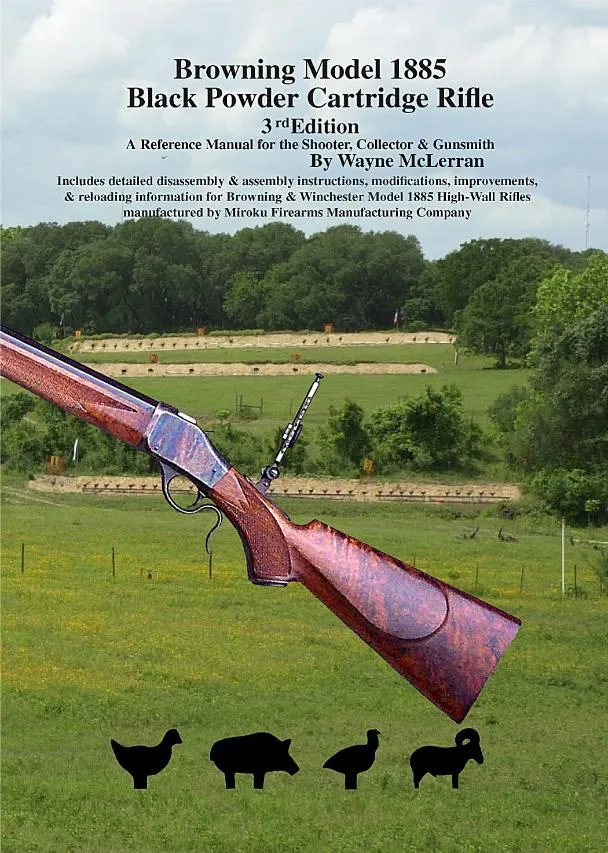
The greatly expanded 3rd Edition now available!
Browning Model 1885 Black Powder Cartridge Rifle 3rd Edition By Wayne McLerran
About the Book
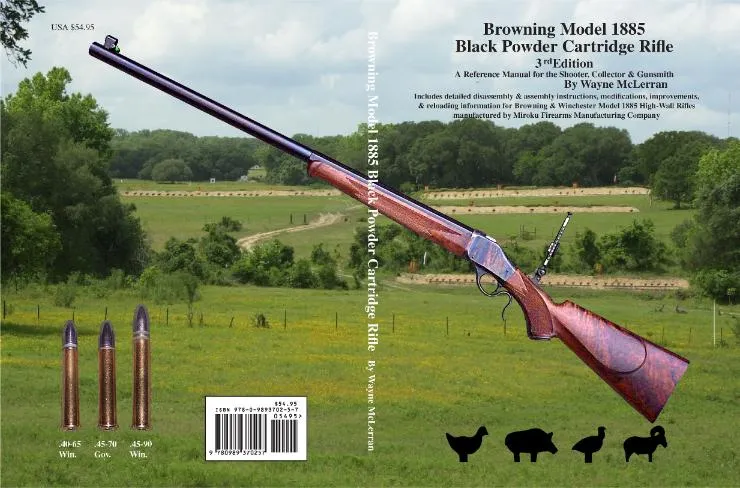
Published by TexasMac Publishing, the 13-digit International Standard Book Number (ISBN) is 978-0-9893702-5-7. The 10-digit ISBN is 0-9893702-5-9. The Library of Congress Control Number is 2013955482. The hardback book is approximately 9" by 6", contains 418 pages of text, 7 tables and 95 figures. Only high-quality components and construction was used in the manufacturing. For those of you somewhat familiar with book binding, it has a hard case bound cover. The cover artwork is laminated to the cover under a layer of durable textured clear poly. The inside pages are cut from 60 lb. bright-white acid-free archival paper. The book block (inside pages) are bound with a mill and notch binding operation including the white 100% cotton end sheets.
The Browning 1885 High Wall BPCR models are the focus of the 1st section, but due to the relatively minor differences in the design, much of the material in the appendices is applicable to the full line of Model 1885 Rifles manufactured by Miroku for both Browning and Winchester. In fact, if you ever decide to disassemble your Miroku manufactured Browning or Winchester Model 1885 rifle, Appendix 1 alone may be worth the price of the book. The term "Miroku manufactured" is used here to distinguish modern Browning and Winchester Model 1885 rifles from 19th century and early 20th century "original" Winchester rifles.
Containing 418 pages, this edition includes significantly more information than the 2nd Edition (272 pages). A few overlooked typos and errors were corrected and new comments included, helping to clarify some of the existing material. Several new sections and chapters were added and the original Appendix reorganized into four appendices. Although the book title does not mention Winchester, additional information on Winchester BPCRs is included as is a discussion on barrel break-in and 145 pages of shooting, reloading information and related subjects, including 20 pages of load specifications.
What Readers Are Saying
Since I don’t solicit feedback it’s a real pleasure when a satisfied customer takes the time to email me. Following are some of the most recent comments:
Table of Contents
- 3rd Edition Comments
- Preface
- Special Acknowledgements
- Warning
- 1. Introduction
- 2. Background
- 3. Meet the Rifle Designer
- 4. Browning Model 1885 BPCR
- 4.1 .40-65 & .45-70 BPC Rifles
- 4.2 .45-90 Creedmoor-Type Long Range Rifle
- 5. Receiver & Action
- 5.1 Overall Action
- 5.2 Trigger Design
- 5.3 Extractor Design
- 5.4 .40-65 Extraction Issue
- 5.5 Case Rim Edge Visible with Action Closed
- 6. Barrels
- 6.1 Muzzle Crowns
- 6.2 Chambers
- 6.3 Concentric Chamber Concerns
- 7. Sights
- 7.1 Front Sight Inserts
- 8. Stock, Grip Cap, Butt Plate & Forearm
- 9. Additional Rifle Data
- 10. Browning/Winchester Production History
- 10.1 Browning Production
- 10.2 Winchester Production
- 11. Browning/Winchester Serial Numbers
- 11.1 Browning Serial Numbers
- 11.2 Winchester Serial Numbers
- 12. Miroku Firearms Manufacturing Company
- 13. Rifle Boxes, Sight Boxes & Labels
- 13.1 Rifle Boxes
- 13.2 Rifle Box End Labels
- 13.3 Rear Sight Boxes & Labels
- 14. Sales Literature
- 15. Collecting the Rifles
Appendices
Appendix 1 – Operations, Specifications & Gunsmithing
- 1A. Chamber & Bore Data
- 1A.1 Chamber Terminology
- 1A.2 Browning/Winchester Chambers
- 1B. Operation of the Action
- 1B.1 Firing Control & Cocking Sequence
- 1B.2 Extractor Operation Sequence
- 1C. Action Disassembly & Assembly
- 1C.1 Disassembly
- 1C.2 Assembly
- 1D. Rear Sight Issues
- 1D.1 Excessive Fore & Aft Movement
- 1D.2 Excessive Lateral Movement
- 1D.3 Ladder Detent Reliability
- 1D.4 Enlarging Eyecup Hole Diameters
- 1D.5 Windage Adjustment Tension
- 1E. Front Sight Issues
- 1E.1 Replacing Spirit Level Tube Caps
- 1E.2 Replacing the Spirit Level Vial
- 1E.3 Refilling the Spirit Level Vial
- 1E.4 Loose Creedmoor Sight
- 1F. Trigger Issues
- 1F.1 Trigger Pull Adjustment Issues
- 1F.2 Quick & Cheap Way to Lighten Trigger Pull
- 1F.3 Dale McGee Modification
- 1F.4 J&B Innovations Trigger Kit
- 1F.5 Lee Shaver’s Trigger Sear
- 1G. Reinforcing the Stock Through-bolt Hole
- 1H. Additional Gunsmithing Notes
- 1H.1 Hammer Will Not Cock – Rests on the Firing Pin
- 1H.2 Hammer Will Not Go to Full Cock
- 1H.3 Hammer Stops at Half-Cock When Fired
- 1H.4 Light (Weak) Primer Strike
- 1H.5 Extractor Blocks Cartridge Rim
- 1H.6 Fixing .40-65 Extraction Problem
- 1H.7 Action Locks Up or Extractor Does Not Work
- 1H.8 Comments on Stock Replacement
- 1H.9 Comments on Barrel Replacement
- 1H.10 Removing a Tight Forearm
- 1H.11 Forearm Modifications to Improve Accuracy
- 1I. Rifle 1st Aid Kit
- 1J. Accessories & Part Suppliers
- 1J.1 Sources for Modern Scope Bases & Rings
- 1J.2 Installing a Wm Malcolm-Style Scope
- 1K. Exploded Illustrations & Parts List
Appendix 2 – Shooting & Cleaning
- 2A. Barrel Break-In
- 2A.1 Badger Barrel’s Break-In Procedure
- 2A.2 Lee Shaver’s Break-in Procedure
- 2B. Smokeless Ammunition
- 2C. MOA Sight Adjustments
- 2C.1 Rear Sight Windage
- 2C.2 Rear Sight Elevation
- 2C.3 Creedmoor Front Sight Windage
- 2D. Sight Settings – MOAs vs. Points
- 2E. Shooting Short-Case Cartridges – Myths & Facts
- 2F. Case Stretching & Separating
- 2G. Fouling Control
- 2H. Making a Blow Tube
- 2I. Cleaning the Action & Breech
Appendix 3 – Reloading
- 3A. Chamber Casts & Impact Impressions
- 3A.1 Sulfur Chamber Casts
- 3A.2 CerroSafe Chamber Casts
- 3A.3 Adjusting Data Taken From “Aged” Casts
- 3A.4 Impact Impressions
- 3B. “Grease-Groove” Bullet Mould Considerations
- 3B.1 Selecting a Mould Manufacturer
- 3B.2 Selecting and/or Specifying a Mould
- 3C. Bullet Casting & Lubrication
- 3C.1 Dip (Ladle) Bullet Casting
- 3C.2 Bullet Lubrication
- 3D. Determining Overall Case Length
- 3D.1 Quick Methods
- 3D.2 Utilizing a Chamber Cast or Impact Impression
- 3E. Annealing Case Necks
- 3F. Stretching Short Brass
- 3F.1 Case Stretching Options
- 3G. To Resize or Not To Resize?
- 3H. Large Pistol Primers & Primer Wads
- 3H.1 Large Pistol Primers
- 3H.2 Primer Wads
- 3I. Making .40-65 from .45-70 Brass
- 3I.1 A Reforming Technique
- 3I.2 Fire Reforming Alternative
- 3I.3 My Preferred Reforming Method
- 3J. Case Preparation & Loading
- 3J.1 New Case Preparations
- 3J.2 Loading Steps
- 3K. Browning/Winchester Load Specifications
- 3K.1 .40-65 Winchester
- 3K.2 .45-70 Government
- 3K.3 .45-90 Winchester
- 3L. Case Cleaning – Tumbler vs. Ultrasonic
- 3L.1 Ultrasonic versus Tumbler with Ceramic Media
- 3L.2 Tumbler with Stainless Steel Pins
Appendix 4 – General Information
- 4A. Shipping Rifles & Cracked Stocks
- 4B. Case Hardening & Case Colors
- 4B.1 Protecting Case Colors
- 4C. The Story of Creedmoor
- 4C.1 The Story of Creedmoor
- 4C.2 Additional Creedmoor Information
- 4D. References