Shooting “Short-Case” Straight-Wall Black Powder Cartridges - Myths & Facts Concerning Chamber Rings & Accuracy
Having written and published a book on the Browning and Winchester BPCR rifles I receive many questions and concerns from current owners and those considering acquiring one of the rifles. Although most of the questions are specific to the Browning and Winchester BPCRs, many are general in nature and come from both new and experienced shooters. What I found interesting and, in some ways, disconcerting is several of the inquiries were due to myths concerning chamber rings and accuracy that have been perpetuated as fact due to being passed around from shooter to shooter and on Internet shooting forums. I thought I’d “take a shot” at debunking a couple of the myths and confirm one regarding accuracy. By the way, having no experience with bottle-neck black powder (BP) cartridges and unable to locate any data relevant to the following subjects, my comments pertain only to straight-wall cartridges.
Myth: Firing cartridges with an air space between the BP over-powder wad and the bullet can result in a “ringed” chamber.
While buying and selling BPCRs for many years, I purchased three rifles over the Internet in which, during initial inspection, the chambers were found to be “ringed”. Each had a circular or ring-shaped deformation to the inside wall of the chamber, not a lead or fouling ring. In each the ring was located where the base of the bullet was positioned in the cambered cartridge, not in front of the case mouth. These were clear cut examples of what can happen when using improperly loaded smokeless ammo with an air space between the powder/wad and the bullet base. Until recently I believed that, if not loaded properly, chamber rings could result when using either smokeless or black powder. But after additional research and checking my records, it’s clear that two of the rifles were fired extensively with reduced smokeless loads, not black powder as I had originally assumed. I don’t know what type of filler material, if any, was used and I have no idea the type of powder or loads used in the third rifle.
In the book, The Modern Schuetzen Rifle – Second Edition (Copyright 1999) by Charles E. Dell and Wayne Schwartz, Charles Dell devoted a chapter to his chamber ringing experiments. Using smokeless powder, he was successful in repeatedly ringing chambers with reduced powder loads with gaps between the over-powder wad and bullet base. By holding and firing the rifle vertically to create the gap, he was also able to produce chamber rings with reduced smokeless powder loads without using an over-powder wad. In a later chapter on black powder cartridge shooting Charlie discusses his failed attempts to ring a chamber with reduced black powder loads using the same experimental techniques. He wrote, “To date I cannot find any tendency at all indicating a ringing force strong enough to damage a barrel when using fixed ammunition loaded with FFg black powder when a gap exists between the bullet base and over powder wad.” By the way, ringing is a cumulative effect and many shots are normally required before a ring becomes apparent. The ring may go unnoticed until case extraction becomes a problem.
It’s a well know and accepted practice to ensure that black powder cartridges are sufficiently filled with powder to eliminate air gaps between the powder column, wad and bullet base. This is certainly the safest approach, but based on Charles Dell’s research it’s not a critical consideration when using black powder. Especially since he also points out that, “Certainly our forefathers, if breech seating their bullets, could not have followed this rule”. To this day, some black powder shooters that breech seat bullets routinely leave a gap between the over powder wad and bullet base and do not have chamber ringing problems. I’m also aware that some breech seaters use the same technique with smokeless powder, but based on Charlie Dell’s findings they’re risking damaging the chamber, especially if the rifle is old with a “softer” barrel.
Myth: Firing cartridges with cases shorter than the chamber can result in a “ringed” chamber.
This is definitely false. “Short-case” cartridges can have negative effects on accuracy and create other problems, but ringing a chamber is not one of them. A good example is shooting .45-70 Gov. ammunition in a .45-90 Win. chamber, a common question or concern of new BPCR shooters or non-reloaders considering the purchase of a rifle chambered in .45-90 Win. Reinforcing the myth, shooters have reported older rifles with ringed chambers, attributing the damage to shooting short ammo in a longer chamber.
It’s been my experience that what may appear to be a chamber wall ring resulting from firing short cartridges in a longer BPCR chamber is either hard fouling or lead deposited in front of the case mouth that remains in the chamber after cleaning. If moisture is trapped under the deposits, corrosion can result. The resulting etching/pitting can also appear as a chamber ring. One .45-90 Browning Creedmoor BPCR I purchased for resale appeared at 1st glance to have a chamber ring in front of where a 45-70 case would end. I knew a lot of 45-70 BP ammo had been fired in the rifle. After close inspection with a Hawkeye bore scope, it turned out the ring was actually lead and hard fouling. After cleaning out all the remaining lead with an Outers Foul Out electrochemical cleaner and scrubbing the chamber, it was essentially OK, but with some signs of discoloration and slight etching from inadequate cleaning. When peering into the chamber with a light source at the muzzle, even after being cleaned, the slight etching appeared to be a chamber ring.
Although not a direct comparison, I’ve fired thousands of hot .38-special rounds in a .357 mag. revolver and the result was not one bit of etching or erosion in front of the case mouth. And there are many “long-chambered” rifles that routinely handle BP cartridges with shorter factory length cases with no ill effects. Case in point is the Browning .40-65 BPCR which needs an overall case length of 2.125” - 2.130” to properly match the chamber length. Many shooters are not concerned with closely matching case length to chamber length and fire loads with 2.090” - 2.10” length cases in their rifles with no ringing or chamber etching.
Here’s another example. As a youngster I fired tens of thousands of rounds of .22 shorts and some .22 long cartridges in two different rifles designed to handle .22 long rifle ammunition with no signs of a ring or chamber erosion. Whenever I could come up with a few bucks I’d pick up a “brick” (case) of ammo and, at the time, .22 shorts were cheaper than 22 longs or 22 long rifles. I was taught to religiously clean the rifle after each use until the chamber and bore were spotless. One rifle was a Rem. single shot and the other was a Marlin Golden 39A lever action. Both were designed to handle all common .22 ammo. Of course it may depend on the type of barrel metal used. I would imagine some of it can be relatively soft, especially in the cheaper .22’s.
Finally, if using a short case can result in a ringed or etched chamber, why doesn’t a ring eventually form in the transition step/throat of a BPCR? Don’t get me wrong. I’m not suggesting it’s a good idea, accuracy wise, to shoot “short-case” ammo. But a rifle will not be damaged by shooting black powder cartridges with straight-wall cases shorter than the overall chamber length, which leads me to the next subject.
Fact: Shooting “short-case” ammo can result in decreased accuracy.
The earlier example of firing correctly loaded .45-70 ammo in a .45-90 chambered rifle is not a safety issue and will not damage the chamber but accuracy may be diminished. Key to understanding the following comments is to keep in mind that in a correctly designed chamber the neck region is dimensionally larger than the bore to allow room for the wall thickness of the cartridge case, and the ideal case length should match the chamber length plus head clearance (see note below), resulting in the case lip contacting or almost contacting the transition step from the chamber to the throat (see note below). Therefore, when a cast bullet is fired from a cartridge case of the correct length, there is very little or no space for the bullet to expand larger than the throat and groove diameter. See Figure 1.
Notes
-
SAAMI (Sporting Arms and Manufacturers’ Institute, Inc.) defines head clearance as “The distance between the head of the fully seated cartridge or shell and the face of the breech bolt (breechblock) when the action is in the closed position”. In Figures 1 and 2, head clearance is visually exaggerated for sake of clarity. It is generally held to 0.001” for bench-rest rifles but is typically found to be 0.003” to 0.006”, possibly more, in production rifles to allow for variances in case rim thickness. By the way, many confuse head clearance with headspace. Figures 1 and 2 illustrate the difference.
-
It’s not clear in Figures 1 and 2, but my definition of the throat includes the transition step, freebore (a smooth cylindrical section forward of the transition step which is devoid of riflings) if it exists, and the leade (leading edge or ramp portion of the rifling lands).
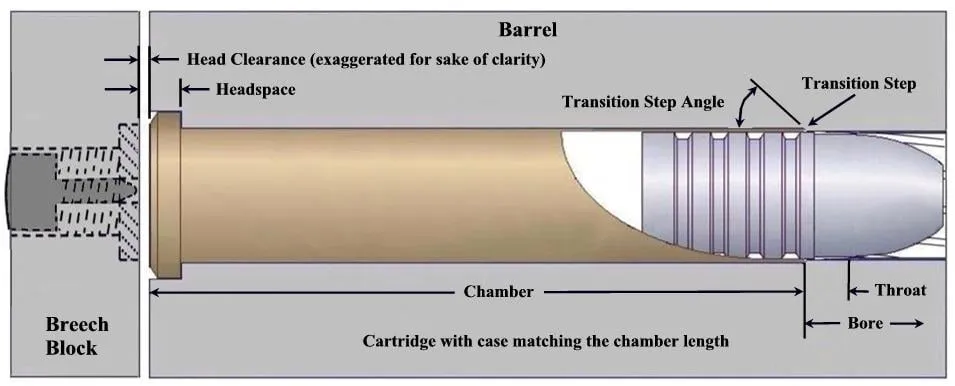
Figure 1
As the cartridge fires, internal pressure forces the case and bullet diameters to increase. I.e. the bullet “bumps up” (obturates) and the case expands to tightly fit and “grab” the chamber wall. Experiments have shown that this happens almost instantly, before the bullet moves forward to any extent. As the case body and neck expand, the case tries to shorten slightly and the case lip tends to pull back. At the same time, frictional forces on the inside of the case from the powder, wad and bullet tries to lengthen the case slightly. Therefore, any gap between the case lip and the transition step may or may not widen. A full-length resized case, being slightly smaller in diameter, will expand and “pull back” more than a “fire-formed” un-resized case.
So, let’s consider what happens when a cartridge with a significantly shorter case is fired in longer chamber. A good example is firing a .45-70 cartridge in a rifle with a .45-90 chamber. Since .45-70 brass (typically 2.1” long) is shorter than .45-90 brass (2.4” long), the bullet will bump up to a larger diameter to fill the excess chamber space over 0.3” of its length. If there are exposed lube rings, which are typically much smaller than 0.3” wide, the space will fill with lube and lead from the expanded bullet. See Figure 2. As the expanded bullet moves forward it is squeezed down 0.020” to 0.025” in diameter by the transition step. If the gap is excessively wide, as in this example, the displaced lead may be smeared back; resulting in “finned” driving bands or remain in the chamber as a shallow ring. If the transition step angle is relatively sharp (45 degrees is common) lead may be stripped off, trapped and build up in the transition step, which is likely to degrade the accuracy of subsequent shots.
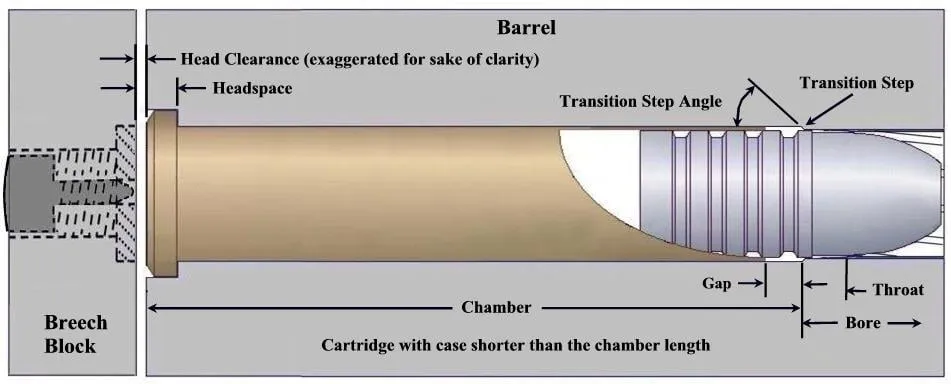
Figure 2
Another example; the Browning .40-65 BPCR has a chamber plus head-clearance length of 2.125” – 2.130”. New .40-65 brass is typically 2.095” long and around 0.008” to 0.010” less in diameter than the chamber. When fired the case will expand to match the chamber diameter and shorten around 0.008” to 0.010” assuming it was full-length resized. The case will immediately shrink about 0.001” in diameter, allowing for easy extraction. The fire-formed case is now larger in diameter but shorter than when new, resulting in a mismatch or gap approaching 0.040” in the Browning chamber. Although much smaller than the previous example, the gap is still considered too large and may affect accuracy for the same reasons, but not to the degree previously noted. In this example the gap is relatively narrow, less than the width of a typical lube groove. If the bullet is seated in the case so that an exposed lube groove aligns with and covers the gap when loaded, lube will fill the gap rather than lead, diminishing the possibility that lead may remain in the chamber as a shallow ring or trapped and build up in the transition step. By the way, reloaders reforming .45-70 brass to .40-65 dimensions have an advantage. After reforming, the case will be longer than the .40-65 chamber and is easily trimmed to the correct overall length to match the length of the chamber plus head clearance.
Some new .45-70 brass is also slightly less than 2.10” long when new and will shorten an additional 0.008 - 0.010” when fired (fire-formed). If the chamber dimensions are in compliance with SAAMI’s specifications (some are not), the length will be very close to 2.10” and all is well. When the cartridge is fired the small gap created between the case mouth and the transition step is relatively small and should not have a significant effect on accuracy. Although an exact match is the ideal solution, a well-known shooter and experienced BPCR experimenter has determined that it is good practice to ensure the gap between the end of the fire-formed case and the end of the chamber does not exceed 0.010”.
So, although “short-case” cartridges can be safely fired with sufficient accuracy for hunting or even informal target practice, for the above noted reasons it’s not a good idea if the goal is to maximize accuracy.
Wishing you great shooting,
Wayne