Selectable-Aperture Eyecups – Comparisons & Comments
Notes:
-
Selectable-aperture eyecups come with some rear sights. This article assumes you already own or have decided on a rear tang sight without a selectable-aperture eyecup. If not, than you may be interested in my article titled, Sight Suppliers for Black Powder Cartridge Rifles.
-
In the following discussion “aperture” is defined the same as when discussing optics or optical components, i.e. a hole or an opening through which light travels.
There are five suppliers that I’m aware of for selectable-aperture eyecups for black powder cartridge rifle tang sights. “Hadley-style” eyecups are available from Montana Vintage Arms (MVA), Lee Shaver Gunsmithing, Kelley Sights and Davide Pedersoli. MVA and Kelly offer two eyecup versions, a standard size and a magnum or large size. Baldwin Sights and Kelley Sights make “Lyman-style” selectable-aperture eyecups.
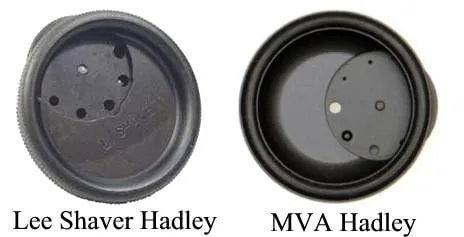
MVA & Lee Shaver Standard Size Hadley
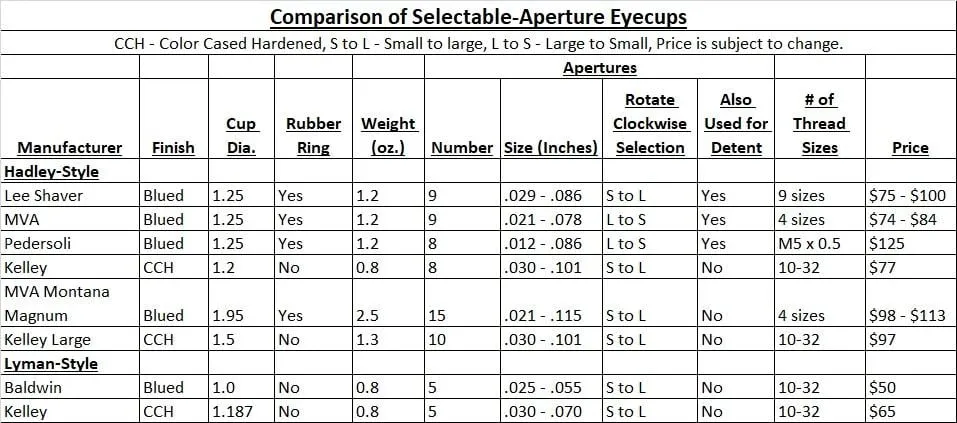
The two most common Hadley-style standard eyecups purchased are the Lee Shaver and MVA. I have used both. They are well made and at first glance appear very similar to each other. They do suffer one disadvantage which is discussed below under Other Considerations. From the front the Lee Shaver and MVA look almost identical, but a closer inspection will identify a few differences. As featured by several suppliers, both the Shaver and MVA have a rubber ring around the outer edge to help protect the shooters eyes and/or glasses due to rifle recoil, and the stock comb when the sight is folded down. The main differences are the layout and the size of the apertures. The MVA standard eyecup apertures are laid out in reverse order compared to the Shaver, which may or may not be important to a shooter. In other words, rotating the MVA aperture disk clockwise decreases the diameter of the selected aperture; rotating the Shaver aperture-disk clockwise increases the aperture diameter. For what it’s worth, the Shaver setup, which is common to most of the other suppliers, seems more “natural” to me since it’s somewhat analogous to other manual controls such as volume, speed or brightness for example, which are normally increased by rotating clockwise.
Another difference not noted in the table is the Shaver is stamped L. SHAVER on the front of the sight. The MVA has no markings at all. The Shaver has a matt blued finish on the front and back. The MVA has a matt blued finish on the front and a gloss blued finish on the back. The Shaver inside cup surface is a little flatter (less concave) than the MVA. The Shaver requires less effort to rotate the aperture disk between detent positions. Considering all of the above and assuming both are available in the thread size you need; I would probably give the nod to the Lee Shaver version.
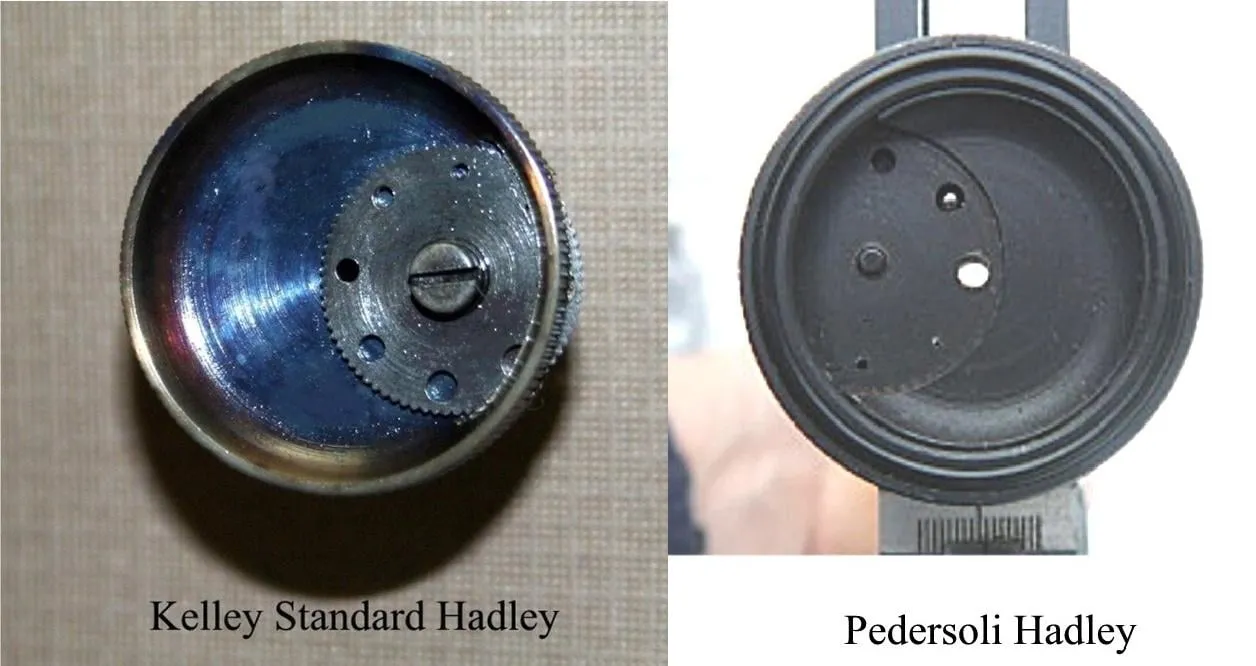
Kelley & Pedersoli Standard Size Hadley
I have not used the Kelley or Pedersoli Hadley eyecups, but did discuss the construction and features of the Kelley Hadley with the manufacturer Jim Kelley. The Kelley design eliminates the problem discussed below under Other Considerations.
Pedersoli’s Hadley is very similar to the MVA or Lee Shaver design but has one less aperture selection. It has a metric M5 x 0.5 thread size to match their rear sights. The diameter of the eyecup is not listed on Pedersoli’s website but it’s approximately the same size as the MVA or Lee Shaver. It also uses the back of the adjacent aperture for the detent positions and, like the MVA standard Hadley, rotating the aperture disk clockwise decreases the diameter of the selected aperture.
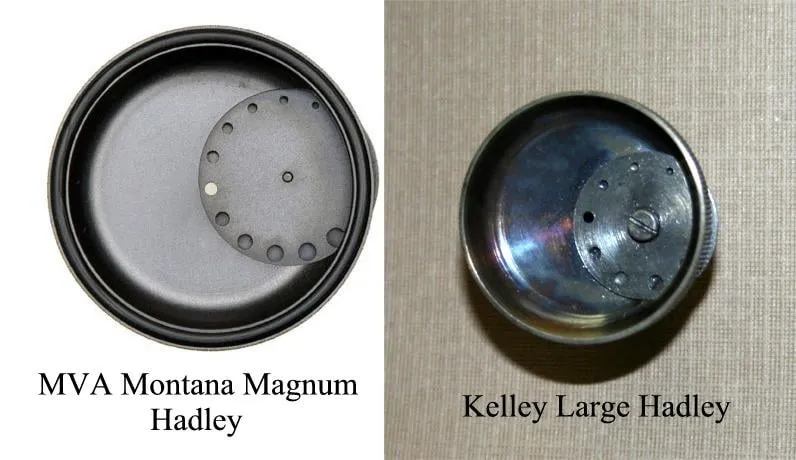
MVA Montana Magnum & Kelley large size Hadley
I have not used the MVA Montana Magnum or Kelley large eyecups, although I have handled and installed the MVA Magnum on a rear sight. At 1.95” in diameter, it is the largest of the Hadley-style designs. It weighs a hefty 2.5oz and features a wide selection of aperture sizes. It has a matt blued finish on the front and gloss blued finish on the back. What I found interesting is the apertures are arranged in the reverse order of MVA’s standard size Hadley. The size may be too overwhelming for some shooters. By the way, it does not have the problem discussed below in Other Considerations.
The Kelley Large Hadley is described very well in the table and is a “petite” design when compared to the very large MVA Magnum. As noted in the discussion on the standard size Hadley’s, the Kelley also does not have the problem discussed below in Other Considerations.
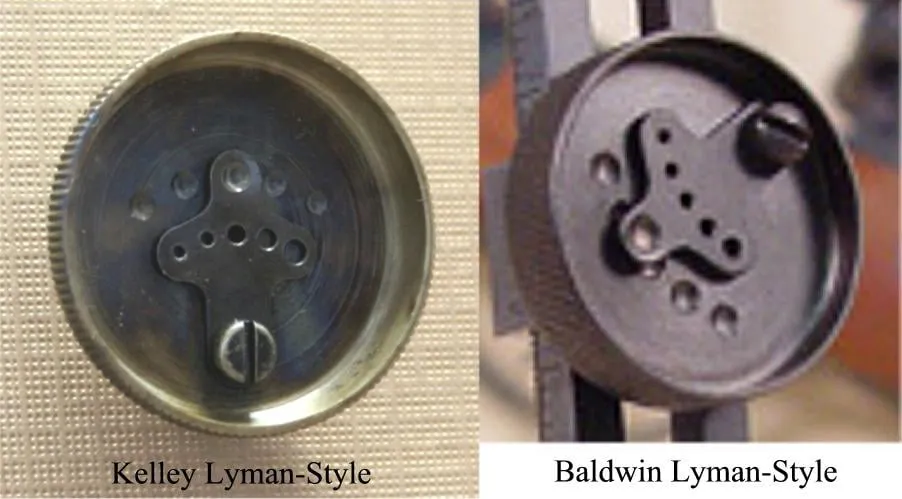
Steve Baldwin & Kelley Lyman-Style
If you like the looks of a traditional style eyecup and the smaller size is visually pleasing, the Lyman-style may be the ideal solution as long as your rear sight will accept 10-32 threads. The main difference between the Baldwin and Kelley is the finish. The Baldwin has a matt blued finish and the Kelley is color cased hardened. And be sure to read the following discussion in Other Considerations that highlights one key benefit to the Lyman-style design.
Note - The Kelley Lyman-style is the standard eyecup that comes with a Kelley rear sight. It is not listed as a separate item on Buffalo Arms website but it can be purchased directly from Kelley Sights.
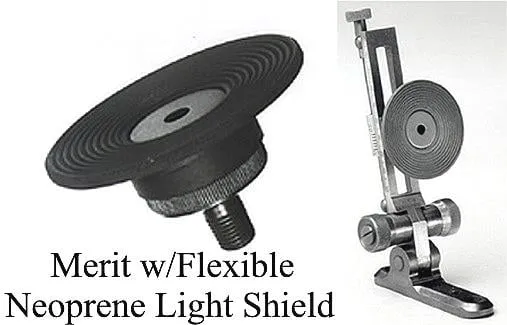
Merit Adjustable-Aperture Eye Disc
A discussion on multiple-aperture eyecups would not be complete without touching on the Merit eye disc. Merit Corp. offers several models of iris-type adjustable aperture eye discs, the most popular being the #3 Adjustable Master Aperture eye disc with the 1.5” neoprene light shield. As of this writing, due to the nontraditional design, they are not approved for NRA sanctioned BPCR silhouette matches. I do understand the Merit discs are permitted in BPCR long range target matches. The aperture diameter is continuously adjustable from .022” to .125” and it’s available with three shank lengths and three thread sizes: 7/32-40 (12-40), 10-32, 10-40. The disc with the light shield is available directly from Merit ($66.00) or from Midway USA ($60.99).
Other Considerations
If you’re struggling with making a decision between a Hadley-style or Lyman-style eyecup, it’s obvious that one advantage of the Hadley-style is the larger selection of aperture sizes. But the Lyman-style and Kelley Hadley designs have an advantage over the Lee Shaver and MVA’s standard Hadley’s that may not be obvious. The problem with the design of some of the Hadley eyecups is the detent ball is in the same radius as the apertures and snaps into the back of the adjacent unselected aperture for the detent positions. Therefore, if the detent ball is lubricated, oil can transfer to the apertures, making them a dust/lint magnet. Although limited in aperture selection, the Lyman-style design avoids the problem as does the Kelley Hadley design and the MVA Montana Magnum. Look closely at the photos of the Hadley’s and you’ll spot the reflection of the detent ball. The “Also Used for Detent” column in the above table indicates which eyecup is at risk.
Another consideration and a possible negative of the Hadley-style can occur when loosening the eyecup to adjust the elevation setting. Depending on the location of the aperture disk, the disk can be inadvertently and unknowingly rotated to a different aperture. The Lyman-style prevents this from happening.
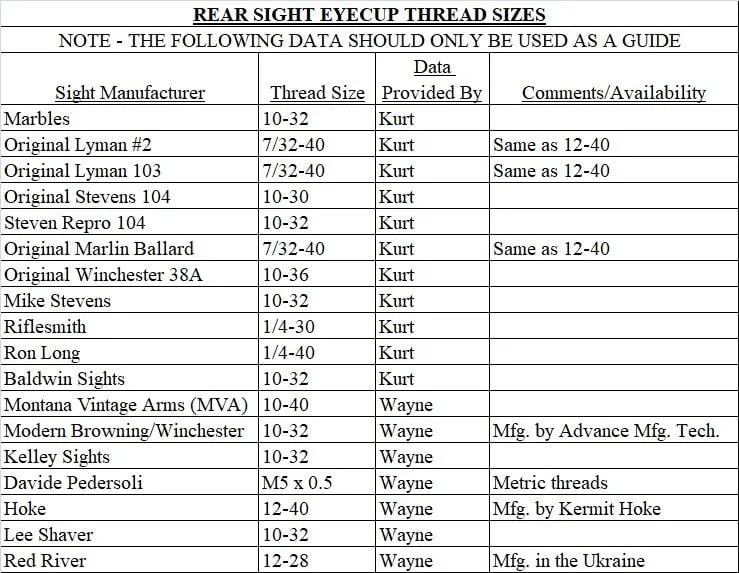
During your selection process, keep in mind that the threaded shank of the eyecup must match the rear sight threads or the threads in the elevator of the rear sight staff. If you already have a rear sight and know the thread size the information in the following chart is most likely not important. As noted, the most common thread size is 10-32, but it’s certainly not a standard. Kurt Schinze provided much of the data. I added a few details. But you know what they say about assumptions, so don’t assume the thread sizes listed are accurate. Double check the threads in your sight or contact the sight supplier prior to ordering an eyecup.
Manufacturers & Suppliers
Baldwin Sights (Steve Baldwin)
P.O. Box 971, Jones, OK 73049
Phone: (405) 399-2875
A well-known high-quality supplier of BPCR sights
Brownells Inc.
200 South Front Street, Montezuma, Iowa 50171
Phone: (800) 741-0015
Brownells sells Davide Pedersoli sights and Hadley-style adjustable eyecup.
Buffalo Arms Co. (BACO)
600 Vermeer Court, Ponderay, ID 83852
Phone: (208) 263-6953
Buffalo Arms is the leading supplier of products for the BPCR reloader and shooter. BACO sells the following brand of soule-type sights and accessories: Kelley, Lee Shaver, Red River and Pedersoli.
Kelley Sights & Accessories
High-quality sights for BPCRs. To check out the Kelley sight offerings go to www.kelleysights.com/ or Buffalo Arms Co. (www.buffaloarms.com). With the exception of their Lyman-style eyecup Kelley sights are available for purchase from Buffalo Arms.
Lee Shaver Gunsmithing
P.O. Box 570, 1020 Broadway, Lamar, MO 64759
Phone: (417) 682-3330
Lee supplies his own line of sights and accessories. Contact Lee directly or go to Buffalo Arms Co. (www.buffaloarms.com) for his products.
Merit Corporation
P.O. Box 9044, Schenectady, NY 12309
Phone: (518) 346-1420
www.meritcorporation.com/products.html
Merit manufactures adjustable aperture discs for shooting glasses and rifle sights.
Montana Vintage Arms (MVA)
61 Andrea Drive, Belgrade, MT 59714
Daytime phone: (406) 388-4027, Evening phone: (406) 388-3405
MVA is a well-known high-quality supplier of BPCR sights and accessories.
VTI Gun Parts (Pedersoli)
P.O. Box 509, Lakeville, CT 06039
Phone: (860) 435-8068
http://www.vtigunparts.com/store/shopcontent.asp?type=home
VTI is the USA based supplier of Davide Pedersoli sights, parts and accessories. Pedersoli sights are also available for purchase from Buffalo Arms (www.buffaloarms.com).
Wishing you great shooting,
Wayne