Searching for a Cost Effective BPCR Scope Solution for Silhouette Competition
Contents
- Introduction
- Background
- Research Data on Current Suppliers
- Considering Options
- Evaluation of the Leatherwood
- Unertl Mounts & De-clicking a Unertl
- D. Z. Arms Mounts
- Unertl Optical Co.
- J. W. Fecker Scopes
- Measuring Scope Magnification (Power)
- Short Malcolm-Style Scope Mounting Adapter Rail for Browning or Winchester M1885 BPCR
- Recommendations
- In Closing & References
Introduction
In my book, Browning M1885 Black Powder Cartridge Rifle, a section is devoted to installing one of the long externally adjustable “tube type” period-style scopes patterned from the classical Wm Malcolm design. The discussion did not include available scopes or mount options. Prior to selecting a scope for one of my rifles I spent a substantial amount of time researching the subject and fully evaluated one scope during the process. If you’ve considering mounting a classic tube-style scope, either a modern day replica or an original, on a BPCR you may find some value in the details of my research and findings. For additional help, check out Montana Vintage Arms (MVA) web site. You’ll find some good information applicable to mounting and adjusting an externally adjustable scope. MVA’s web site is listed below under the section titled Research Data on Suppliers.
As of this writing I own a Leatherwood brand replica scope which is currently mounted on a caplock muzzle loader. I also have several original J.W. Fecker scopes, four of which are mounted on a couple of Browning BPCRs, Sharps 1874 BPCR and a Steven’s Model 44 .22LR.
Background
Since good quality Soule-style aperture rear tang sights and front spirit level sights with interchangeable inserts are quite adequate and very accurate for long range target or silhouette shooting, there’s little need for a rifle mounted telescope unless one is required due to “aging eyes” or special circumstances. Unfortunately, I have scar tissue in the central portion of the lens in my dominant right eye, resulting from a childhood accident and subsequent operation. The scar tissue is not visible or a problem with normal vision, but obstructs the central portion of the target image when enhanced by using an aperture rear sight with a small peep hole. Knowing a scope would solve the problem; I researched the subject and started a full-scale investigation of the available scopes and mounts. I intended to use the scope in NRA sanctioned silhouette matches; therefore, it had to meet the NRA’s rifle silhouette rules, which I will go into more detail on later. The following information chronicles the process I went through to select a scope for my rifles. Hopefully it will provide you some insight to help in your decision process.
Fundamentally, there are two scopes designs, internally adjustable and externally adjustable. Technology advancements have resulted in significant and numerous improvements and features since rifle telescopes first appeared in the mid to latter part of the 19th century. Modern scopes mounted on most hunting rifles are internally adjustable for windage and elevation. They typically are short in length with large diameter objective lenses made to gather lots of light, offer variable power (magnification) adjustments, long eye relief and many other high technology features. The mounts are generally spaced 4” to 5” apart and only serve to rigidly hold the scope from moving and connect it to the action and/or barrel.
Original or modern-day versions of classical 19th century and early 20th century scopes do not have internal adjustments for windage and elevation. The mounts not only must hold the scope rigid prior to firing the rifle, they serve two other very important functions. The rear mount must be adjustable for both windage and elevation and both the front and rear mounts are generally designed to allow the scope to slide forward, minimizing the effects of recoil on the scope and possible shooter eye damage due to the relatively short eye relief of the design. The front mounts are also designed to allow the scope to pivot when the rear mount is being adjusted for windage or elevation. These scopes are relatively long, generally 18” to 34” in length.
Externally adjustable rifle telescopes were introduced in the USA in the early part of the 19th century. A few companies are still manufacturing updated versions for the BPCR shooter. Most are either patterned after the classic William Malcolm design or at least heavily influenced by the old Malcolm scopes. William Malcolm, who previously worked for a telescope manufacturer, began production of an achromatic lens and rifle telescope in 1855. Two years later The Malcolm Rifle Telescope Manufacturing Company was established in Syracuse, NY. Malcolm scopes were used in the Civil War by sharpshooters. Although there were earlier rifle telescope manufacturers, Malcolm’s scope design is the one most referenced by current manufactures. A ladder-type rear mount he introduced much later is also used as the design basis for a current supplier.
Moving forward, the most well-known early 20th century supplier is Unertl, followed by Lyman, Winchester, and possibly Stevens. Less known are J. W. Fecker and R. A. Litschert. Several configurations included large diameter tube bodies, large objective lenses and high-power options. Although no longer produced, many of these scopes are still being used and can provide very good service for long range silhouette and target competition. In fact, many silhouette shooters prefer the older scopes to those available from current manufacturers, which can be more costly and may not offer adequate mounts in some cases. Of course, the older models and mounts must meet the NRA rifle silhouette rules.
With the recent addition of a very nice scope manufactured by D.Z. Arms, the list of current USA companies manufacturing externally adjustable scopes now stands at two. Montana Vintage Arms (MVA) and D.Z. Arms are the only USA manufacturers I’m aware of. R.H.O. Instruments, Romano Rifle Co. and Parsons Scope Service no longer make scopes. There are also a couple of brands imported into the USA by Leatherwood / Hi-Lux Optics and Dixie Gun Works.
All the scopes in the following discussions are in full compliance with the features and dimensional requirements stated in the NRA’s rifle silhouette rules. The same cannot be said for some of the mounts. There are no power limitations on BPCR silhouette scopes, but there are physical design limitations. As of this writing the NRA says that scopes must meet the same requirements as BPC rifles, i.e., made in the United States prior to 1896 and being typical of the era. Replicas thereof, regardless of origin of manufacture, are permitted. The current NRA rules also include the following stipulations:
- Maximum rifle weight with scope is 15 pounds.
- No length or power limitation. Scope tube body to be ¾” or less in diameter and any ocular or objective lenses, adjusting or assembly rings to be less than 1” in diameter.
- No internal adjustments for windage or elevation.
- Mounts are to be of a traditional style of the period, and contain the windage and elevation adjustments for the scope in either, or both, the front or rear mounts. No click adjustments in the mount. Either dove tail mounting or scope block mounting is allowed.
The current NRA Rifle Silhouette Rules handbook further states that, Original scope mounts of either the Cataract or Malcolm style or variations thereof, or replicas or derivatives of either style, are allowed provided the replica or derivative conforms to the criteria of rule 4) above.
- Cheek pieces may be used and may be of any height.
Research Data on Current Suppliers
(Product Offerings, Features & Comments)
Please note that some of the following data may be “dated”. Therefore, prior to making a final decision I recommend you check out the current product offerings of the suppliers.
R.H.O. Instruments
In 2010, Randy Oates owner of R.H.O., decided to get out of the scope manufacturing business. I’m including the details here since there’s a good chance of finding a used R.H.O. scope.
- Magnification: 6X.
- Field of view at 100 yards: 10 feet.
- Telescope weight: 13 oz.; mounts: 6 oz.
- Reticle: plain fine crosshair only.
- Achromatic objective lens, for improved image clarity.
- Eyepiece is adjustable for focus.
- Eye relief: approximately 4”.
- Vernier elevation scale on rear mount is graduated in 2 minute increments. Total adjustment available: 180 minutes.
- Windage scale on front mount is graduated in 3 minute increments. Total adjustment: 36 minutes, 18 minutes each side of center zero.
- All scales are machine cut, and then nicely numbered on a restored 1943 Gorton Pantograph Engraving Machine.
- Mounts install in the dovetail slots in your barrel.
- Mounts are available with standard dovetail dimensions made to fit Shiloh or C. Sharps factory dovetail slots.
- All mount parts are machined from solid steel stock. No stampings or castings are used. Telescope is 3/4” diameter 4130 drawn steel tubing. Eyepiece and dust caps are machined from solid brass.
- All parts precisely machined, fitted, polished, and blued.
- Were available only for rifles with 30”, 32” or 34” barrels.
Additional comments
- Since R.H.O. scopes are rigidly mounted and are not allowed to slide under recoil, I discussed the long-term durability with Owner, Randy Oates. He said he has not had a scope returned due to a recoil related problem
- Front and rear mounts use dovetails, which must be cut if not available.
- Mounts must be drifted out of the dovetail to use on another rifle.
- Scopes are not hermetically sealed but do use O-rings and silicon grease to eliminate moisture problems.
- Reticle is a fine-wire design with one vertical wire and two horizontal wires (one in the center and one approximately 18 minutes lower)
- Brass eyepiece
- Parallax adjustment is not available. 9/6/08 – Randy Oates replied to my question to him on parallax, “… the telescopes are not adjustable for parallax. However, due to the quite long focal lengths of the lenses used in the telescopes, parallax is not much of an issue. The telescopes are zeroed for parallax at 200 yards, and there will be essentially no parallax at distances further than this. At say, 100 yards a small amount of parallax may be observed, but this will amount to no more than approx 1/8’’ total movement of the crosshairs. At 50 yards observable parallax will be about ¼’’. In practice, actual effective parallax will be even less since the relatively small exit pupil diameter of this type of telescope tends to keep the eye well centered in the image (field of view). If a person wants to use one of the telescopes at a very short distance all the time, say 25 or 50 yards, I can adjust the parallax to zero at this distance, but there will then be some parallax at longer distances. Regards, Randy Oates.
Parsons Scope Service
http://www.parsonsscopeservice.com/, 513-867-0820
Note: Parsons’ no long manufacturers scopes, but does repair most brands of vintage external adjustable scopes or modern copies thereof. I’m including them here since there’s a good chance of finding a used Parsons made scope. Parsons says that MVA essentially copied their scope and mount system.
- 6X power, ¾” blued steel tube
- Eye relief: 2” (which works fine due to the fact that scope slides under recoil)
- Scopes are not hermetically sealed but do use O-rings and silicon grease to eliminate moisture problems.
- Can use screw-on or dovetail blocks. Lyman/Unertl type screw-on blocks require drilling and tapping the barrel. Parsons does not supply the blocks but refers buyers to Steve Earl Products (781-585-3929).
- Adjustable objective for parallax adjustment.
- Front and rear mounts are very high quality and allow the scope to slide under recoil. Scope has a battery stop to reset back to shooting position. The front mount is designed to work with a Pope-style rib, which is on the bottom of the front portion of the scope and insures the scope does not rotate as it moves fore and aft.
- Can be easily moved to another rifle that has correct mounting blocks.
- Reticle is fine-wire crosshair (custom 7-dot reticle, similar to MVA’s Mil-Dot Reticle, is available for an additional $100)
- Six tube lengths (24”, 26”, 28”, 30”, 32”, 34”)
- Last retail pricing was around $900.
Montana Vintage Arms (MVA)
http://www.montanavintagearms.com/, 406-388-4027
MVA offers three styles of externally adjusted scopes, their original standard series scope in various lengths, a reproduction of the Winchester’s “B” series scope and a newer “A” Series.
MVA’s standard scope series
- Magnification: 6X
- Range adjustment: 10 yards to infinity
- Parallax adjustable using adjustable objective
- Reticle adjustment for Level
- Field of view @ 100 yards: 10 feet
- Exterior finish: blued steel
- Pope style rib allows the scope to slide under recoil
- A stop is provided to return the scope to the battery position
- Malcolm style mounts (blued steel) , with front and rear windage adjustment
- Screw-on covers for both ends
- Clear objective cover lens to protect lenses
Additional Comments
- Eye relief: 2” (which works fine due to the fact that scope slides under recoil)
- Scopes are not hermetically sealed but do use O-rings and silicon grease to eliminate moisture problems. MVA admitted that if the scopes get extremely wet for an extended amount of time, as in a heavy rain, it’s possible for some moisture to work its way inside.
- Choice of screw-on or dovetail blocks. Lyman/Unertl type screw-on blocks require drilling and tapping the barrel.
- Front and rear mounts are very high quality and allow the scope to slide under recoil. Scope has a battery stop to reset back to shooting position. The front mount is designed to work with a Pope-style rib, which is on the bottom of the front portion of the scope and insures the scope does not rotate as it moves fore and aft.
- Can be easily moved to another rifle that has correct mounting blocks.
- Several reticle styles, which are acid-etched on a glass plate, are available at no additional charge.
- Four scope lengths and choice of silhouette or schuetzen mounts.
- Great phone customer service concerning sales and answering technical questions.
- Scopes are only available direct from MVA. No retailer or Federal Firearm License (FFL) discounts are available.
MVA’s “B” Series scopes
The scopes are advertised to be an exact reproductions of Winchester’s “B” Series scopes.
- The blued steel scopes are available in three power versions: 3x (B3), 4x (B4) & 5x (B5), and are 13.5” to 15.5” long depending on the power.
- They come with your choice of reticles, mounts and scope blocks.
- The scopes do not have a Pope-style rail, but do feature a longitudinal indentation to provide the sliding function while preventing rotation. The front mount uses a spring loaded plunger that rides or tracks in the indentation to keep the scope from rotating. With each shot the scope slides forward due to recoil and must be returned to “battery” prior to the next shot.
- Additional features include a reticle level adjustment, parallax adjustment and focus from 10 yards to infinity.
- The windage and elevation adjustments on the #1 or #2 rear mounts are non-click-style. The #1 mount has scales on top of the turret heads that give a rough 1.5 MOA of adjustment resolution.
- The #2 mount is larger for more windage and elevation adjustment and has finer micrometer-style scales on the side of the turret and barrel for approximately 0.5 MOA of adjustment resolution.
Based on the above noted features, the #1 mounts should be an excellent solution for general shooting and hunting. The #2 mounts would be necessary for silhouette competition with targets set at various extended ranges, requiring precise and repeatable windage and elevation adjustments.
By the way, a MVA “B” Series scope with #1 mounts is similar to the Leatherwood Malcolm scope with standard Leatherwood mounts. The differences are that the Leatherwood is 6-power, does not slide under recoil unless an adapter is used, does not have a parallax adjustment, and the Leatherwood mounts are not manufactured to the high-quality standards of the MVA mounts.
MVA’s “A” Series scopes
- Available is either 8 power or 10 power, the scopes are a variation of the MVA standard 2000 series scope.
- Has an 8” pope-style rib which allows for mount spacing’s of 10.34″ or 7.2″.
- Three different mount configurations are available including a unique adjustable front mount which allows the shooter to use the front mount for coarse adjustment, while keeping the rear mount in the center of adjustment. The shooter can then keep a constant cheek hold from short range all the way to long range.
D.Z. Arms Scopes
http://www.dzhepburn.com/, 405-691-1215
Made in the USA, the original scope was introduced in late March 2014. It can be purchased separately or with a “scope-ready” package. For additional information on the mounts see the later discussion titled D.Z Arms Mounts.
- Magnification: 8X
- Length: 20”
- Construction: ¾” blued steel tube
- Screw on scope cover for both ends
- Cross-hairs are acid etched on a glass plate
- Parallax adjustable using adjustable objective
- Add-on adjustable rib and scope stop is available to allow the scope to slide under recoil
- Additional “scope-ready” package includes the following: D.Z. Arms mounts, add-on rib, 2 mounting bases (blocks)
Leatherwood / Hi-Lux Optics
http://www.leatherwoodoptics.com/, 310-257-8142
Leatherwood scopes are imported into the USA and distributed to firearm dealers and retailers by Hi-Lux Optics. The scopes are available from several companies including Buffalo Arms 208-263-6953, Dixie Gun Works 713-885-0700, Cimarron Firearms 830-997-9090, Numrich Gun Parts 845-679-2417. Davide Pedersoli & C. is the European retailer. With a FFL license, wholesale or reduced pricing is possible directly from Hi-Lux Inc. or possibly from some of the retailers.
Note – I fully evaluated the Leatherwood 18” long 6 power scope. Additional details and comments are provided later.
Leatherwood 30.5” (long) scope
Image is reported to be very clear and sharp, better than MVA or Parsons and most likely the preferred scope for hunting, especially in wet conditions. These comments also apply to the 18” 6X version.
- 6X power, ¾” blued steel tube
- Eye relief: approx. 4.0” (long scope)
- Waterproof – hermetically sealed and nitrogen filled. No chance of moisture getting inside.
- Plain fine-wire crosshair reticle (No option for different reticles)
- Will fit 26” to 34” barrels on single-shot rifles, depending on extension tube used (3”, 5”, 7” & 9”). The 5” extension tube is used on 30” barrels.
- Front and rear mounts are not sufficient quality for competition.
- Shinny Brass eyepiece and crosshair ring. (Using an appropriate bluing solution the brass can be darkened)
- Parallax adjustment is not available.
- With the normal mounts the scope is rigidly mounted and is not allowed to slide under recoil.
- A Sliding Mount Accessory (SLDMT) is available, which allows the scope to slide under recoil. One end of the SLDMT attaches to the rear mount (replaces the rear mount scope clamp). The other end clamps on the scope and slides on the rail.
- A Sliding Lock Ring (SLR) is also available to allow the scope to slide an inch or so under recoil but not rotate. The SLR replaces the standard front locking ring.
- Standard front and rear mounts require a dovetail, but with the heavy-duty base adapter the rear mount is secured with screws requiring drilling and tapping the barrel.
Leatherwood 17” & 18” (short) Scopes
- 17” – 3X power, 18” – 6X power, both are ¾” blued steel tube
- Eye relief: approx. 4.5”
- Waterproof – hermetically sealed and nitrogen filled. No chance of moisture getting inside.
- Plain fine-wire crosshair reticle (No option for different reticles)
- Normally the scope is rigidly mounted – not allowed to slide under recoil.
- Leatherwood offers a Scope Sliding Lock Ring (17SLR) similar to the one for the long scope, but works with the front mount on either the 17” or 18” scopes. It rigidly clamps to the scope body and provides an under-tube bar that slides in a notch in the front ring, allowing the scope to slide under recoil.
- Rear micrometer mount looks like a copy of an original Lyman small-game scope mount (no click adjustment & a locking ring to lock the adjustment knobs). Due to the coarse markings located only on the top of the knob they are not adequate for the precision adjustments required for long range competitive shooting.
- Parallax adjustment is not available.
Leatherwood’s reproduction of the 8x USMC Sniper Scope with precision mounts
Since, as of this writing, one can be purchased for less than $600 and it comes with nice mounts similar to Unertl’s, Fecker’s or DZ Arms, I was curious enough to call the company and get the actual measurements. The outside diameter (OD) of the objective bell housing at the widest part (knurled rings) is 36.1mm. The OD at the front is 35.0mm and the actual lens diameter is 31mm but ends up around 30mm due to the retainer ring.
NRA BPCR silhouette rules state that any ocular or objective lenses, adjusting or assembly rings to be less than 1” (25.4mm) in diameter. 22 BPCRA rules state that any ocular or objective lens must not be larger than 1” as measured from the inside of the lens opening. Therefore, the scope does not meet the rules for either type of sanctioned matches. In addition, the rear mount is click adjustable which is not allowed unless it can be de-clicked.
By the way, if the precision mounts can be de-clicked, they can be purchased separately for around $250, less than half the price of DZ Arms mounts (discussed later), but they do not offer the extended elevation adjustment available with the DZ mounts. Utilizing a 7.2” mount spacing the DZ arms mounts have 200MOA of elevation adjustment vs. 125MOA for the Leatherwood/Hi-Lux. If de-clicking is possible they would be a good solution to pair up with Leatherwoods 18” 6 power scope.
Considering Options
The costs of some of the new scopes can certainly “put a crimp in your budget”. Are they worth the price? After discussing some of the pros and cons with several scope owners I contacted an experienced BPCR scope shooter and highly regarded gunsmith. In his opinion MVA mounts are good but have some potential for backlash. Therefore, he suggested obtaining good set of used Winchester A5 or Lyman 5A mounts and purchase the scope separately. Winchester A5 rear mount is referred to as the “grasshopper” mount in reference to the under-tube spring. The current MVA “B” series scope uses this mount design. Both the Lyman and Winchester, if they are the clicked version, could be easily de-clicked to make them NRA legal. He further commented that Unertl mounts are the best of all, but most if not all are not NRA legal due to having click adjustments. By the way, I did check with MVA and found the following on their web site. Concerning backlash MVA says, “You may notice very slight backlash in the threaded adjustments, but this is necessary for any threads to ensure that they do not bind up during operation. As long as any adjustments made are in the same direction of rotation of the screw, there will be no correction required for the backlash.”
All of the precision high-quality rear mounts, which feature precise and repeatable adjustments, are generally referred to as “micrometer-style” mounts. In contrast to MVA’s standard ladder-type or Malcolm-style, the Unertl or Cataract-style are sometimes referred to as cage-type mounts; cage-type being used in reference to their shape. The basic design is attributed to the Cataract Tool & Optical Company, which was later improved on by the J. W. Fecker Company. Unertl essentially copied the J. W. Fecker Company improved design. The cataract-style mounts are spring loaded to eliminate the possibility of backlash in the adjustments.
The Unertl-like very high quality J.W. Fecker mounts can be found with and without click adjustments. The Fecker click mounts can be “de-clicked” – more on this later. As far as I know all the Unertl rear mount are click adjustable but I figured out how to “de-clicked” them to comply with NRA rifle silhouette rules. If you’re interested in a Unertl mount, I’ve included much more data later on including the different style of mount bases and the simple technique I used to disable the clicking adjustment.
Now, this brings me back to the Leatherwood scopes. I had heard good things about the quality of the Leatherwood scopes but not the original mounts. The Leatherwood Wm Malcolm scopes are certainly much cheaper than those from MVA or D.Z Arms. So, being an opportunist at heart, I figured the odds were good that I could save several hundred dollars by matching up a Leatherwood with the Unertl mounts. After checking and performing a few calculations, it became clear that the 30.5” Leatherwood scope was too long to use with the limited adjustment range of the Unertl rear mount. But the shorter 18” scope was ideal and offered more than sufficient range.
I will not go into all the details of the calculations here. As mentioned earlier, I devoted a chapter in my book to mounting an externally adjustable scope on a BPCR, including the necessary calculations. If you are interested you can order a copy from this web site. But I will discuss the subject a bit more. The same formula for adjusting iron sights can be used with an externally adjustable scope. Therefore, if one knows the minute-of-angle (MOA) value required for adjusting the scope from say 200 meters to 500 meters (the overall target distances for silhouette competition), one should easily be able to determine if the rear mount has sufficient adjustment range.

So let’s use the formula, which in one form is: MOA adjustment range = rear mount adjustment (RMA) range in inches x 3600 ÷ mount spacing (MS) in inches or “. When reviewing my shooting notes, I found that, for 200 to 500 meters, a realistic adjustment value for a .45-70 or .40-65 caliber rifle is 55 MOA. Also knowing that the maximum adjustable range of the Unertl rear mount is 0.250”, let’s use 7.2” for the scope mount spacing, which is common for 18” to 23” long scopes. So, after “plugging” the values into the formula, the answer is 125 MOA, which is more than sufficient and allows a comfortable margin. Now I had to find a Unertl front mount and a scope to fit. I decided to order an 18” Leatherwood scope and evaluate it.
But before moving on to a discussion on my evaluating of the Leatherwood, I’d like to cover another example of mount-to-scope fit or compatibility. Let’s determine if the Unertl rear mount will work with a 30” long scope. Using the same formula and the same rear mount adjustable range (0.250”), let’s now use a scope mount spacing of 17”, which is typical when mounting a 30” long scope. The answer is a total adjustment range of only 53 MOA, which is not sufficient. Now keep this example in mind for a later discussion on mounts available from D. Z. Arms.
Evaluation of the Leatherwood
(Model # M634181)
Initial evaluation prior to firing
Scope specifications: 18” long, ¾” tube diameter, 6X power, 17mm objective, 12’ field of view at 100 yds, 4.5” eye relief, weight 18 oz (see more on this below), 5.8mm exit pupil, no parallax adjustment. All air-glass optic surfaces are fully multi-coated for maximum light transmission. Parallax is set for 10’ to infinity. The reticle is a fine crosshair. The scope is shockproof, waterproof and nitrogen filled.
Opening the shipping box I found the following
- The scope, with mounts installed, metal protective end caps and scope blocks; came double sealed in plastic bags (sealed in a clear plastic bag inside a sealed bubble wrap bag). Also included are an 8-page instruction manual and a cheap, small square piece of felt cloth to clean lenses.
- The scope, end caps, mounts and scope blocks were covered with lightweight oil.
- Only markings on the scope (Wm MALCOLM over 6X) are located 1&1/4” in front of the eyepiece locking ring.
To remove the front and rear mounts from the scope required 1st removing the adjustable eyepiece and locking ring. The scope has as inner sealed glass lens in front of the eyepiece to maintain the hermetic seal and allow eyepiece adjustment and removal. I weighed everything on a very accurate postage scale. The results were:
- Scope, end caps, mounts and blocks (no block screws) – 19.6 oz (1 lb 3.6 oz)
- Scope without mounts, end caps or blocks – 12.8 oz
- Both protective end caps – 2 oz
Scope
The exterior surface finish of the all-metal (possibly steel) scope tube, objective lens housing, eyepiece and eyepiece locking ring are acceptable. The blued metal finish has a few very light machining marks in a couple of areas. The adjustable eyepiece and end cap threads are rough but functional. All were coated with a light oil, including the inside threads for the end caps, which were very close to the objective and ocular (eyepiece) lenses. Knowing what oil can do to scope lenses, this concerned me. If the scope was not nitrogen filled and hermetically sealed, I would have been very concerned due to the high probability of oil leaching into the inner workings of the scope. To eliminate the possibility of oil getting on the lenses, I gently removed all the oils in the threads with Q-tips and solvent, being cautious not to get solvent on the lenses. Surface oils were removed from the scope exterior surfaces with the cheap lens cloth.
INITIAL EVALUATING OF OPTICS: CLARITY IS EXCELLENT.
Front mount & locking ring
Mount is functional but not well finished. Blued metal surfaces are rough with lots of casting and machining marks. The mount is designed with a locking screw to attach to a standard 60-degree dovetail block. The separate locking ring works with the front mount to prevent the scope from rotating or moving fore and aft but allows the scope to pivot for windage and elevation adjustments.
Note – I did purchase a sliding lock ring (Part # 17SLR - sold separately), which allows the scope to slide out of battery under recoil but keeps it from rotating. It replaces the standard lock ring. The construction and metal surfaces are similar to the front mount.
Rear cage-type mount with windage and elevation adjustments
Mount is functional but not well finished. Blued metal surfaces are rough with lots of casting and machining marks. The scope contact surfaces of the turret knobs are very rough and will definitely scratch or score the scope surface during adjustments. One complete turn of the knobs provides 0.020” of scope adjustment. The mount is designed with a locking screw to attach to a standard 60-degree dovetail block. To call it a micrometer-type mount would be a misnomer since there are no micrometer-type scales on the turret knob housings to use as a reference. In other words, if the turret knobs are turned and the number of rotations is not noted, it would be almost impossible to return the knob to a previous setting. Clearly, at least in my mind, the mounts are made for recreational shooting or hunting, where the scope is adjusted for a specific distance and the knobs locked in place with the locking rings. Even in this case I would definitely file and polish the ends of the turret knobs to eliminate or reduce scope surface damage.
Dovetail style mounting blocks
The two identical standard 60-degree type dovetail mounting blocks are reasonably well machined, blued and finished. The blocks are ½” (actually 0.490”) wide on top with 60-degree shoulders, and are 1.285” long. The two mounting holes in each block are spaced 14.2mm (0.559”) apart and will accept standard 6-48 or similar size screws. The blocks that came with my scope are designed with a half moon slot on one side and a Posa slot on the other side to also fit Unertl, Fecker or similar type mounts. I understand that blocks shipped with more recent scopes only the standard half moon slot on one side.
INITIAL RECOMMENDATION: FOR SILHOUETTE COMPETITION, KEEP THE SCOPE AND REPLACE THE MOUNTS WITH NON-CLICK OR DE-CLICKED LEATHERWOOD’S SNIPER RIFLE MOUNTS, UNERTL, FECKER OR D.Z ARMS HIGH-QUALITY MOUNTS.
Evaluation under firing conditions
After additional considerations I decided to mount the Leatherwood on a 50 caliber caplock muzzleloader I used for local competition many years ago and plan on using for whitetail deer hunting. It’s a customized version of the Thompson Center Hawken rifle and my aged eyes have been having a hard time focusing in on the front sight. Another reason for mounting it on the TC was to try it out prior to possibly using it on one of my Browning BPCRs. Following is a photo of the Leatherwood mounted on the custom Thompson Center.
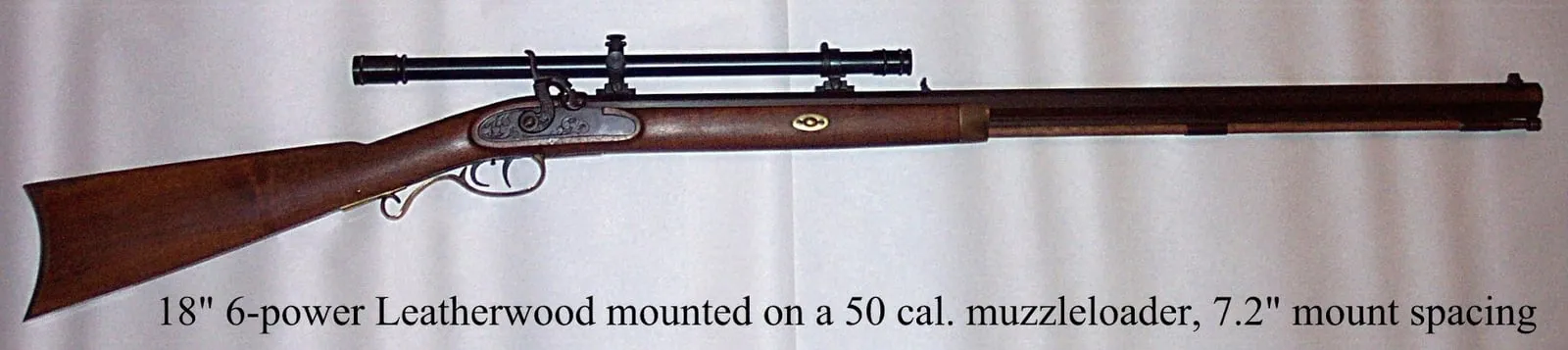
The TC flat top barrel was drilled and tapped for mount spacing of 7.2”. The Leatherwood scope blocks worked fine with 6x48 screws. The front mount setup allowed the scope to pivot sufficiently for windage and elevation adjustments, but held the scope from sliding under recoil. After 50 or so rounds and adjusting the scope, I must say I was impressed and quite satisfied with the whole setup as a hunting scope setup. The scope image was very bright and crisp with no distortions, and the plain crosshairs were sharp. The front and rear Leatherwood mounts worked great. The rear windage and elevation adjustments worked fine and stayed in place. Once I had the scope centered, I locked the rear mount elevation and windage adjustments with the knurled finger-locking nut and nothing moved during subsequent shots.
Following is a photo of an 18” Leatherwood mounted on a recent Winchester M1885 Limited Series rifle, which is identical to the Browning M1885 Traditional Hunter. The existing factory dovetail for the rear barrel sight was used as were the existing factory holes in the receiver.
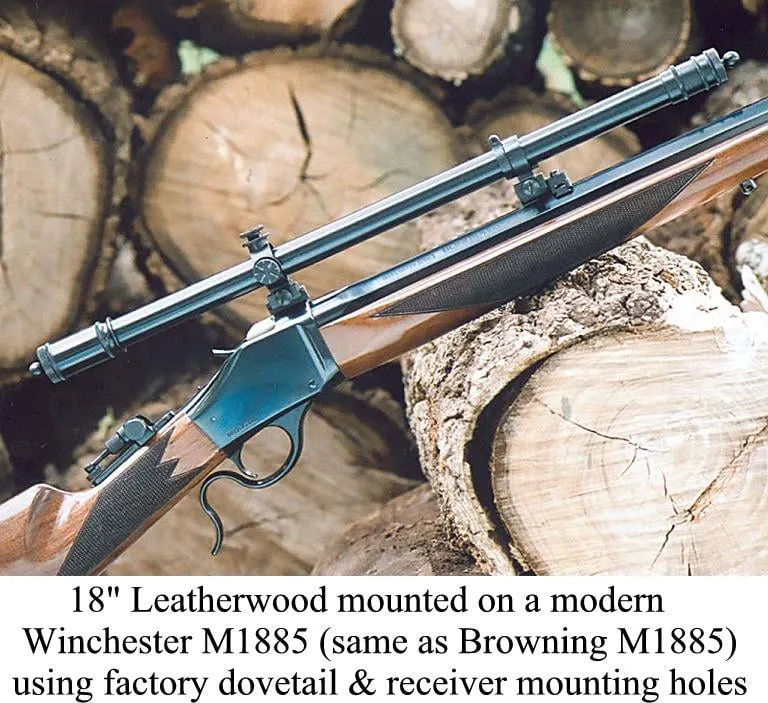
FINAL LEATHERWOOD SCOPE RECOMMENDATION: I CONCUR WITH MY INITIAL NON-FIRING OPINION. THE LEATHERWOOD SCOPE AND MOUNTS ARE FINE FOR HUNTING. I BELIEVE THE SCOPE WILL WORK VERY WELL FOR SILHOUETTE COMPETITION, BUT THE MOUNTS ARE NOT SUITABLE FOR BPCR SILHOUETTE OR CREEDMOOR COMPETITION DUE TO THE LACK OF SIDE SCALES (MICROMETER TYPE), WHICH DOES NOT ALLOW ACCURATE AND REPEATABLE ADJUSTMENT SETTINGS. PLUS THE ROUGH FACTORY FINISH ON THE MOUNTS IS NOT ATTRACTIVE UNLESS ADDITIONAL REFINISHING STEPS ARE TAKEN.
Unertl Mounts & De-clicking a Unertl
First, allow me to make the following very clear. I’m no expert on Unertl scopes or mounts. I don’t know if all Unertl turret mount adjustments are similar, but the one I have was easy to de-click to make it NRA silhouette legal. See the photo below of the disassembled ¾” mount. The spring and plunger pictured to the left of the mount reside in the lower left cavity of the mount. They apply the necessary force to hold the scope body firmly against the two adjustable turrets, effectively eliminating backlash.
A right-angle pin is installed into a hole in the bottom end of each turret assembly. When functioning as originally designed, as the knob and threaded section of the turret are rotated during adjustments, the pin holds the bottom end from turning while sliding up and down as necessary in a slot in the mount housing. Through the center of the threaded section, the bottom end of the turret assembly is directly connected to a thin round flat disk resting on top of the knob. Since, due to the right-angle pin, the bottom end of the turret assembly cannot rotate, the flat disk cannot rotate. The flat disk has a small “dimple” close to the edge. When the knob is rotated under it the dimple snaps over notches formed in the top of the knob. Removing the right angle pin de-clicks the turret. It’s that simple. Just completely unscrew and remove the turrets. Then grab the right-angle pin with a pair of pliers and pull it out while gently rotating it back and forth. In my case, one came out easily. The other one was very tight. If it breaks off and you have no plans for using the click feature, just file off any remaining rough edges. To control the tension on the now de-clicked mount, tighten the screw in the upper right-hand corner. Another method that reportedly works is to clean the turret threads of oil and apply a drop of linseed oil or some rosin. I have not tried either so can’t comment, but it sounds reasonable to me.
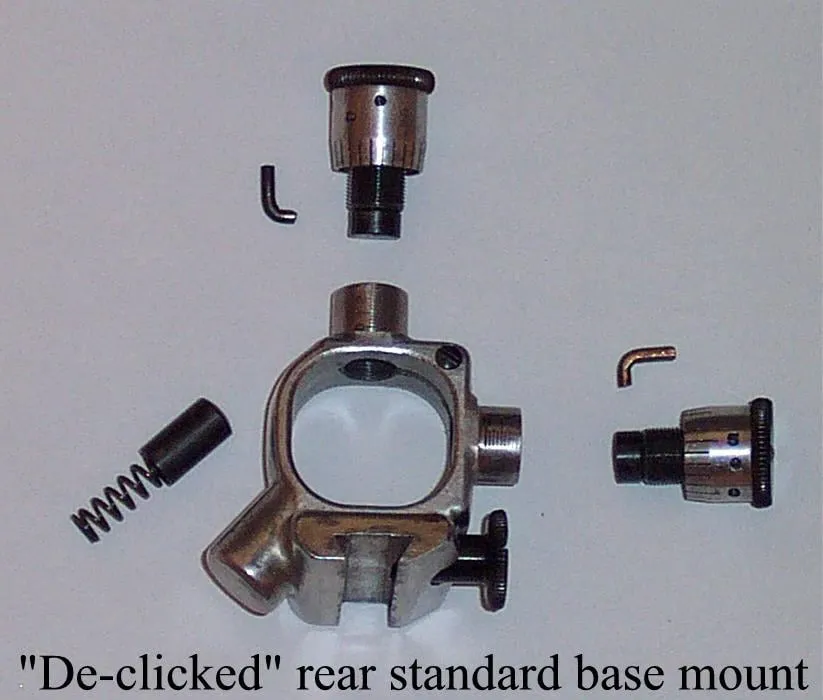
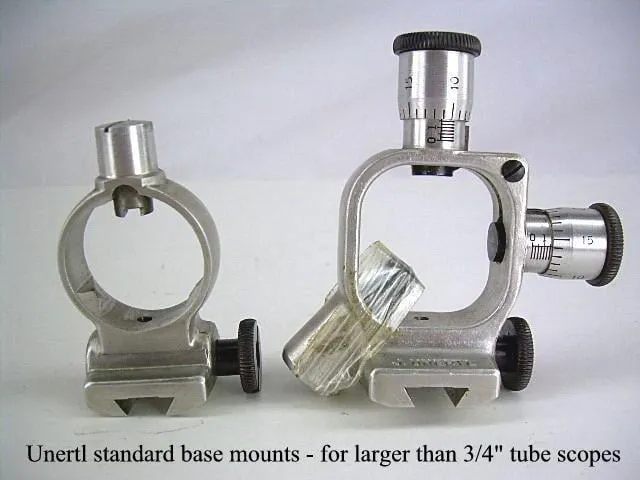
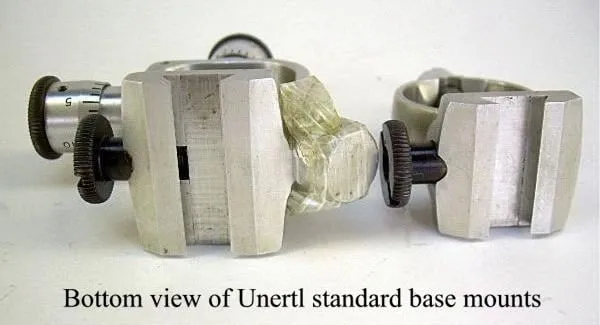
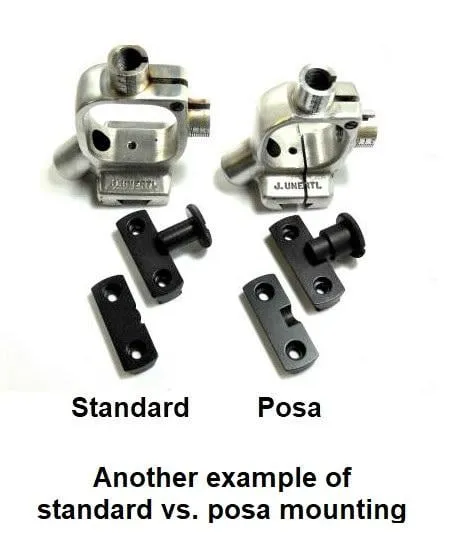
Unertl cage-style micrometer rear mounts come in two variations, a standard base design and a Posa base design. The one shown disassembled in the above photo has a “standard” base. Most Unertl mounts you see are the standard base design. The two photos below are of a complete set of front and rear mounts with standard bases. These are for a larger diameter scope, but the design is basically the same for a ¾” scope. Tape is holding the spring and plunger from popping out. Also evident is the notch in the front mount plunger, which slides over and aligns itself on the Pope-style rail or rib on the front top of the scope. The rib serves to hold the scope in rotational alignment while also allowing it to slide due to recoil.
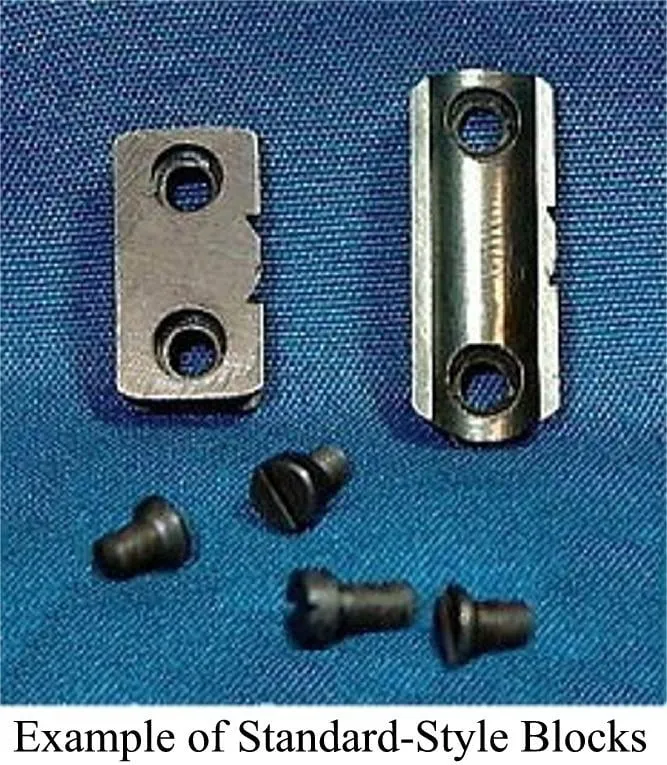
Unertl mounts with standard bases require unique matching blocks, which screw-mount onto the top of the action and/or rifle barrel. It’s not visible in the photos, but the end of the base thumb-screw is cup or concave shaped to fit a matching bump or convex shape on the scope block. Some refer to the block as having a crescent cut to accept the standard thumb screw. In contrast to the Posa-base mounts detailed below, standard style Unertl mounts only clamp on one side of the dovetail and in the convex bump on the other side. The convex bump and matching thumb screw also ensures the mount does not slide on the block, maintaining rigid center-to-center mount spacing. Following the two standard base mount photos below is a photo of a standard block.
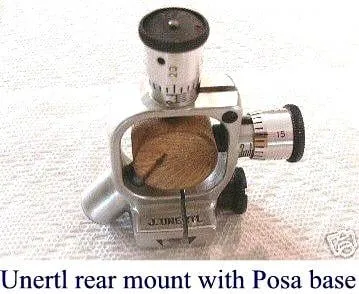
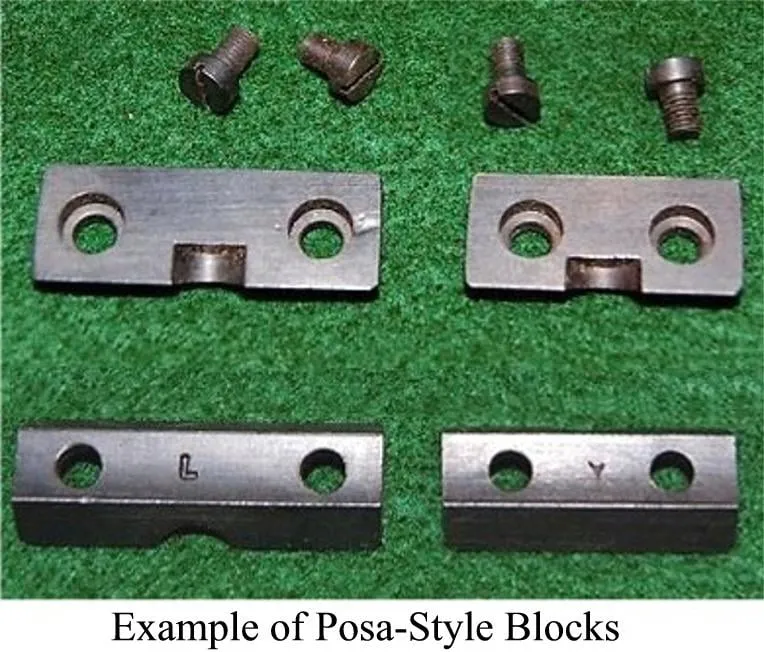
Another version of the Unertl mounts has, what’s referred to as a Posa base. Below is a photo of a Unertl rear mount with a Posa base. Another photo of front and rear Posa mounts can be seen in the following discussion on D. Z. Arms mounts. Although the Posa base mount is very similar to the standard base mounts detailed above, notice the base is split, which allows the mount to tightly clamp and align on both sides of the dovetail. Hence Posa mounts are more rigid and are typically only used with larger scopes to handle the heavier recoil assuming a recoil spring is used (see note below). Posa base mounts require unique matching blocks. The end of the base thumb screw is flat bottomed to fit into a flat bottom notch on the scope blocks. The notch only serves to locate the mounts fore and aft to hold center-to-center mount spacing.
Note – If a recoil spring is not used than the split-base design of the Posa mount is not utilized to its fullest extent since the mounts are only subjected to the frictional forces of the sliding scope when the rifle recoils. If a recoil spring is used than the front mount must absorb the spring energy due to recoil and especially when the spring returns the scope to battery. Therefore, it’s more important that the front mount is a Posa design than the rear mount although for symmetry and esthetics both mounts are usually Posa style.
D. Z. Arms Mounts
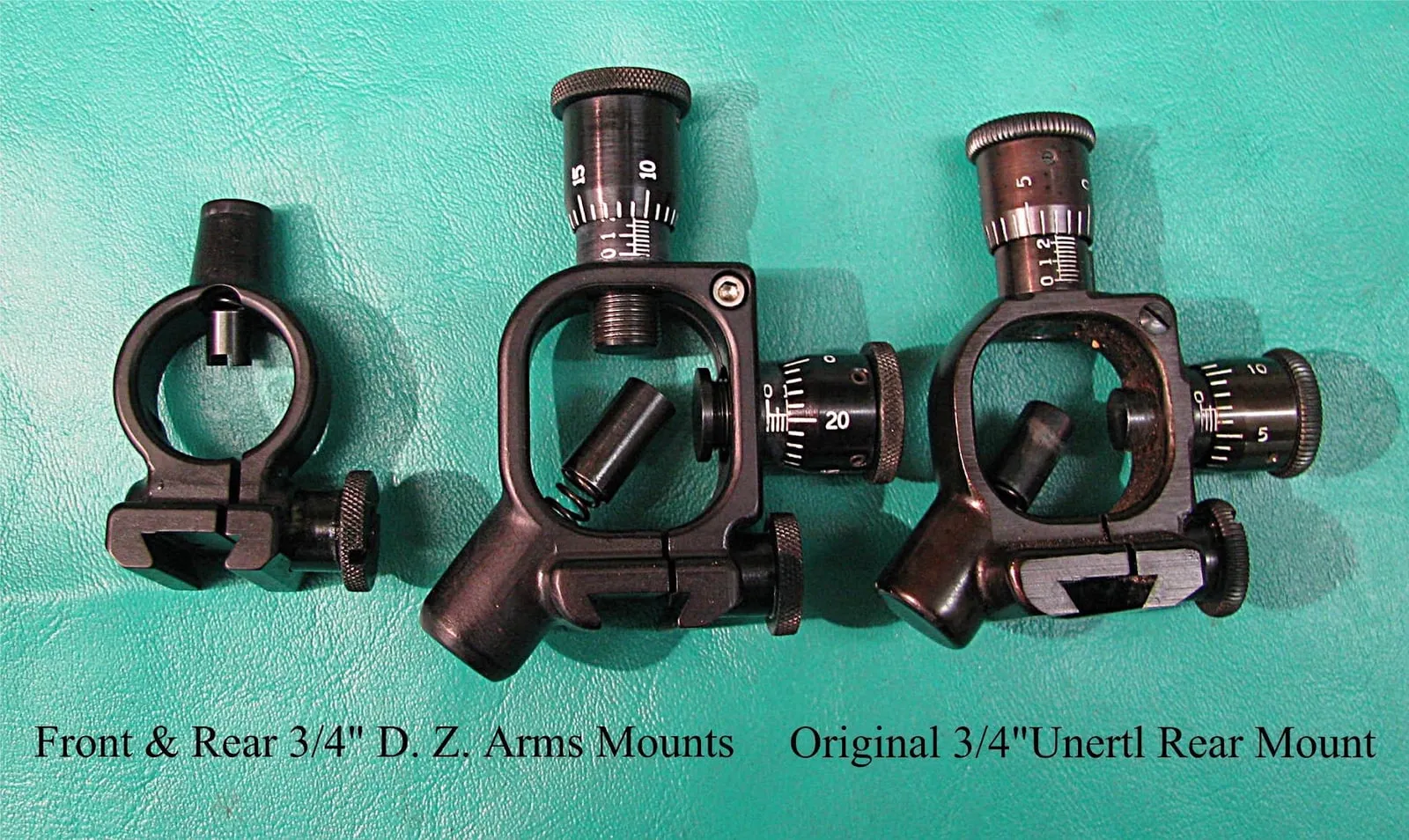
Now, let’s digress back to the earlier example in the section titled Considering Options where the scope mounting formula indicated the Unertl mount did not have sufficient adjustment range for a 30” long scope. Enter a company named D. Z. Arms, which came up with a solution, a very high-quality modified version of Unertl’s ¾” mounts. Dan Zimmerman, the owner and the “D. Z.” in D. Z. Arms, informed me that Sean Moore, an employee of D. Z Arms, deserves all the credit. The mounts feature an extended elevation adjustment range for long scopes. They are a little taller in the vertical direction and have a longer elevation turret resulting in 200MOA of vertical (elevation) adjustable range with a mount spacing of 7.2”. The end of the windage turret has also been redesigned slightly to allow for the additional range. The mounts do not have click adjustment and therefore meet the NRA rifle silhouette rules. They make mounting a 30” or 34” scope possible while benefiting from the backlash free design of the original Unertl or J.W. Fecker mounts. If spaced 17” apart the mounts provide approximately 95MOA of elevation adjustment.
The photo below displays the redesigned mounts to the left of an original Unertl rear mount. By the way, note that the mounts in the photo are designed with a Posa-style split base, but standard non-split mounts are also available. And if you’re wondering how they work with a MVA scope, which has the Pope-style rib on the bottom, the not so obvious answer, at least to me at the time, is to just turn the MVA scope over. I felt like a real idiot after asking Dan the same question and receiving his response. He’s probably still laughing. The company contact information: http://www.dzhepburn.com/, dan@hepman.com, phone, 405-691-1215.
Unertl Optical Co.
Although the earlier discussion on Unertl focused primarily on their mounts, I also mentioned that Unertl is the most well-known supplier of early 20th century externally adjustable scopes. Unertl scopes are considered by many to be top of the line and generally command a price premium when one comes up for sale. Although manufacturing of externally adjustable scopes ceased many years ago, Unertl is still in business. Following is a short overview of the current company.
Formerly known as John Unertl Optical Company, Unertl was founded in 1934 and was originally based in Mars, Pennsylvania. The current Unertl Optical Company, Inc. continues to manufacture and market products under the brand name Unertl. The product line includes telescopes, mirror mounts, riflescopes; specialized sights and optics for law enforcement agencies and armed service branches.
A small operation is now located at 17 S. Hampton Rd., PO Box 234, Donnelsville, OH 45319-0234, staffed by Aaron Davis, a long-term Unertl employee. Aaron repairs and reconditions externally adjustable Unertl scopes. He can be reached at 937-631-2854 or via email at aaron_unertl@earthlink.net. Some parts are also available for sale. If you need parts and/or repairs, this is the Unertl guy you need to contact.
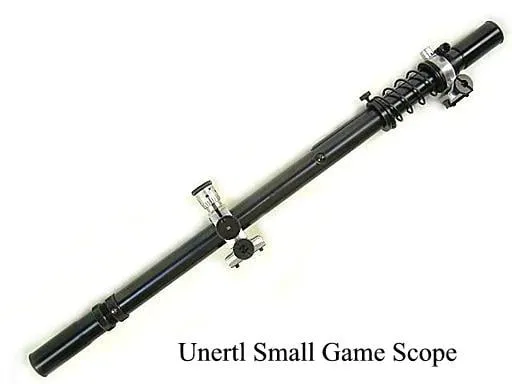
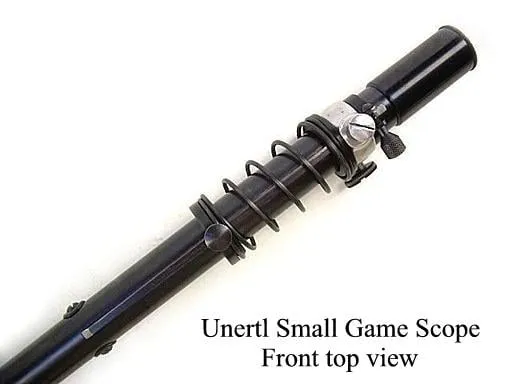
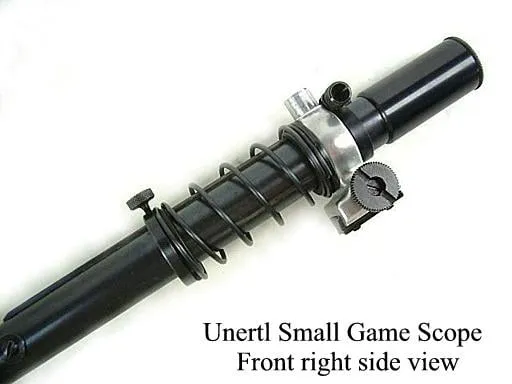
Before closing out this section on Unertl, I included three photos of a Unertl ¾” Small Game Scope, which is, as far as I know, the only Unertl scope that meets the NRA’s rules for silhouette competition. The mounts would need to be de-clicked to make them NRA legal. The Small Game Scope was originally manufactured in 3X, 4X or 6X power. It’s 18” long and weighs approximately 16 oz. Both the objective and ocular lenses are 3/4” diameter. The magnification of the scope in the photos is 6X. If you look closely, the Pope-style rib or rail extends along the top front section of the scope under the spring and front mount, and ends just behind the objective lens bell housing. The rib serves to hold the scope in rotational alignment while also allowing it to slide under recoil. The rib slides in a notch in the front mount plunger. Revisit the earlier photos of the front mounts and you’ll see one clearly displaying the notch. The large spring assembly around the front end of the scope is appropriately referred to as a recoil spring and is meant to absorb recoil and automatically return or slide the scope back to “battery” position after the rifle is fired. Since, per my understanding, the recoil spring is not allowed by the NRA, it can be easily removed and the scope slid back to the battery position by hand after each shot.
Another feature of the Unertl Small Game Scope is the parallax/focus adjustment, which is located at the back end of the rib. It consists of a screw and washer on each side of the scope body. Focus and parallax is adjusted by loosening both screws slightly then sliding the screws back and forth a small amount while looking through the scope to check parallax and focus. The screws hold the internal erector lens in place. The normal procedure is to adjust parallax for the most common shooting distance and leave it along. This works fine for a small game rifle used at typical hunting distances, but may not be acceptable for long-range silhouette competition where banks of targets set from 200 to 500 meters. With that said, I do know of silhouette shooters that do not adjust parallax during an entire match.
J. W. Fecker Scopes
As noted earlier, Unertl is the most well-know 20th century externally adjustable scope manufacturer. Also mentioned were Winchester, Lyman, Stevens and Litschert. But scope historians and knowledgeable shooters are also well aware of scopes made by J. W. Fecker. Fecker was in business many years before Unertl opened shop. In fact, John Unertl sharpened his skills as an employee of Fecker prior to leaving around 1934 to start his own business. Also known by scope historians is the fact that the J. W. Fecker Company was the original developer of the cage-type micrometer mounts later adopted by Unertl and others. If you can locate a copy of the May 2002 edition of The Accurate Rifle magazine, it contains an excellent article titled, The Life and Times of J. W. Fecker by Clarence Anderson.
In all aspects Fecker scopes are as well made as a Unertl, possibly better. In fact, in some respects a Fecker scope could be considered a notch above a Unertl. During the process of finding a suitable scope for my rifle, I ran across two very nice Fecker scopes and bought both of them. I later purchased several others. Since Fecker’s are not as well known and readily available as Unertl’s, I found that a Fecker in excellent condition can be purchased for significantly less than a Unertl of comparable condition. When comparing a Fecker to a Unertl it’s evident that both are of very similar construction. But Fecker’s have a unique feature not found on Unertl’s or on other similar scopes.
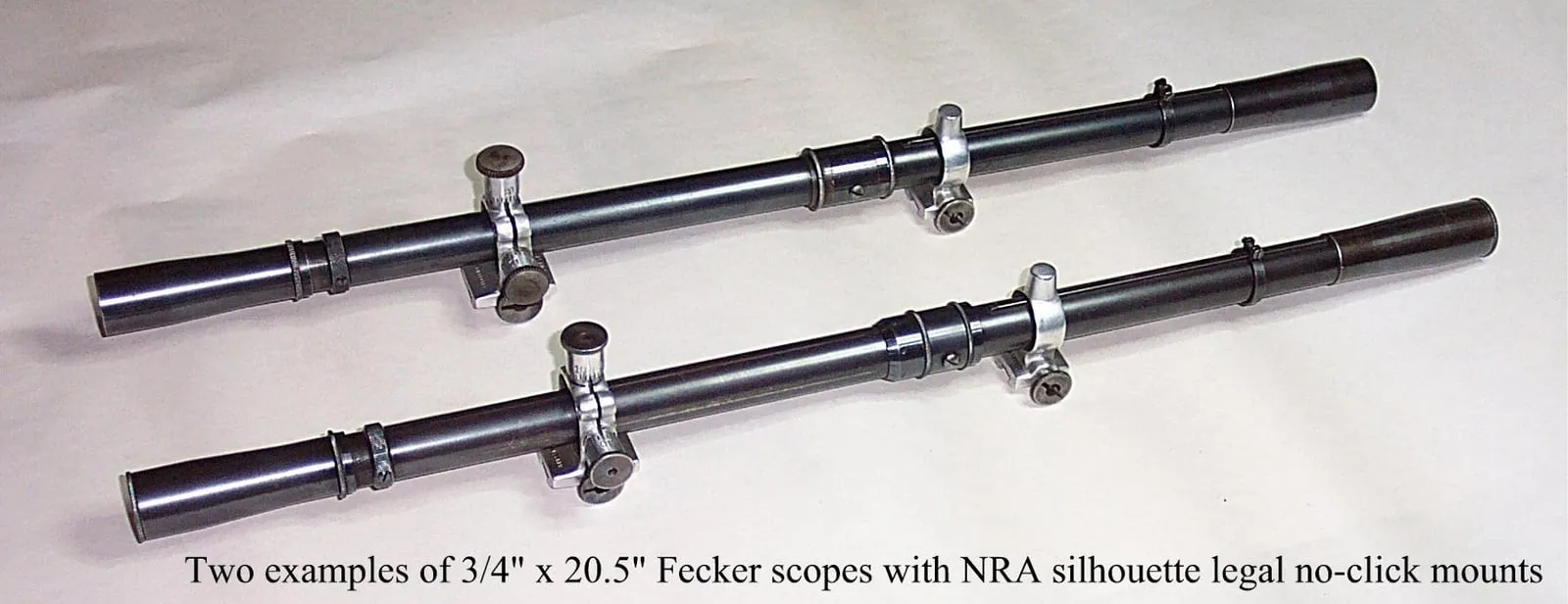
Fecker scopes have an easy to adjust parallax/focus adjustment located in the middle of the scope body. The profile of a Fecker has been humorously described as being similar to a chicken snake that has recently swallowed an egg. In actual use, when the scope is mounted on a rifle, the adjustment is easier to reach and adjust than one located at the objective end of the scope. It’s a significant improvement over the crude screw and washer adjustment found on the previously discussed Unertl Small Game Scope. In addition, many of the ¾” tube Fecker’s can be found in either 8X or 10X magnification, both exceeding the 6X power of the Unertl Small Game Scope. Unertl and others have produced ¾” tube body scopes that exceed 6X magnification, but none that I’m aware of meet NRA’s ocular or objective lenses requirement that the adjusting or assembly rings must be less than 1” in diameter. By the way, refer to the next section discussing how to determine scope magnification if the scope is not marked.
Below is a photo of my two ¾” tube Fecker scopes. Both are the same length (20.5”) although the one in the foreground appears longer due to being closer to the camera. The scope in the background (serial # 2385) is the older of the two. The one in the foreground is serial # 5588. You can clearly see the mid-scope parallax adjustment and slight differences in the design, although both work the same way. Also notice the left adjustable rear mounts are slightly different. It’s somewhat hard to discern in the photo but the top of the turrets on the top scope mount are smooth and rounded which the turrets on the bottom scope mount have flat tops with a small cavity machined in them. Also looking closely, you can see the Pope-style rib or rail that runs on top of each scope between the parallax adjustment and the objective lens bell housing. Also evident is the scope stops, which are the thin circular rings clamped around the tube body and the rib. Prior to firing the rifle, the scope is pulled (slid) back until the clamp contacts the front mount. When the rifle is fired, due to recoil, the scope slides forward in the mounts.
Measuring Scope Magnification (Power)
Although the magnification is not marked on the Fecker scopes pictured, the newer one in the foreground is 8X and the one in the background is 10X. I verified the power of both using two independent techniques. By the way, the 19th and early 20th century term used to indicate scope magnification or power was diameters. Therefore, a 6X (6 power) scope was referred to as a 6-diameter scope.
One technique is based on the telescope “rule of thumb” formula that the exit pupil diameter is equal to the diameter of the objective lens divided by the power. Put another way, the power is equal to the objective lens diameter divided by the exit pupil diameter. The objective lens diameter is very easy to measure. The diameter of the exit pupil is the size of the image projected on the pupil of your eye when looking through the scope. Measuring the exit pupil is a little more complicated. But with a little work and preparation it’s not too hard. To make a good measurement the scope must to be held steady, not rigidly mounted, but held sufficiently steady to make a measurement of a focused spot around 0.065” in diameter.
An easy way is to just lay the scope on a table. Now align a bright light source, lamp for example, approximately 2 to 3 feet in front of the scope. It must be in line with the scope and objective lens. I.e., aim the scope directly at the lamp as if you were sighting it on the lamp. If aligned properly the image of the light source should pass through the scope and form a small spot on a piece of paper held within inches of the eyepiece (ocular lens). With the scope on the table and focused on a bright light, I taped a piece of paper on the back of a chair and slid it to within inches of the scope. If the light source is too far away from the scope it may not supply sufficient light to illuminate the full spot or, if too bright, may flair out on the paper making it difficult to define and measure the spot edges. Move the paper back and forth until the spot is focused to the smallest diameter. Grab your calipers and measure the spot diameter. Divided the diameter of the objective lens by the spot diameter and you have the approximate power of your scope.
Another, possibly easier method for some is to use the time-honored technique of looking at a small far away object with one unobstructed or “naked” eye while looking at the same object through the scope with the other eye. Then, while superimposing both images over each other, estimate how many times the image seen by the naked eye will fit into the larger image seen through the scope. Admittedly this can be a little tricky. It requires a very steady rest and the ability to concentrate on both images at the same time, which some find hard or impossible to do. In performing this highly scientific procedure an excellent object to look at that offers a great reference image is a brick wall, better yet a brick column. If you are able to master the technique, just count how many of the small bricks seen with the naked eye fit into one of the large bricks as seen though the scope. The answer is the approximate scope power. If circles are used rather than bricks, it’s easy to understand where the old term diameters originated to define the power; for example, a 6-diameter scope.
Short Malcolm-Style Scope Mounting Adapter Rail for Browning or Winchester M1885 BPCR
If you’re like me and prefer to avoid having additional mounting holes drilled and tapped in your rifle barrel, there’s an alternative solution when mounting a short externally adjustable Malcolm-style scope on a Browning or Winchester M1885 BPCR. Steve Earle, the well-known supplier of scope blocks for externally adjustable scopes, is now offering a scope block rail that will attach using the existing factory holes. For more details on Steve’s scope rail see my article titled, Short Malcolm-Style Scope Mounting Rail for Browning or Winchester BPCRs.
Recommendations
At this point in my research, I had decided to mount a Leatherwood on my BPCR using Fecker or “de-clicked” Unertl mounts. I believe it’s still an excellent idea and likely the most cost-effective solution available if the mount can be found at a reasonable price. However, my plans were changed due to coming across a couple of good deals on Fecker scopes complete with silhouette legal mounts. The amount I paid for each Fecker was less than the cost of a Leatherwood and separate Fecker, Unertl or D. Z. Arms mounts. In addition, the Fecker scopes feature a Pope-style sliding rib feature. Remembering the earlier comments made by Randy Oates, the owner of R.H.O., I’m not convinced a sliding scope is necessary. But since the feature is available on the Fecker’s, I’ll use it.
One area I did not discuss in any detail is the option to install mounts in the existing dovetails on your rifle barrel. Modern day mounts or scope blocks made from good quality steel may very well offer a satisfactory solution for dovetail mounting, but I’ve been warned to stay away from dovetail mounts in general as they are prone to work loose. If the dovetail blocks are sufficiently hard the barrel steel may not be. A long Malcolm style scope is much heavier than the typical front sight on a BPC rifle and therefore puts significant lateral stress on the dovetail slot.
I’ve covered and discussed several options for “scoping” a BPCR, including USA made top-of-the-line modern day replicas, mixing and matching original models with silhouette legal mounts or with modern copies of legal mounts, and a couple of imported models. If money is not an option, in my opinion, the best high-quality solutions are a MVA standard scope with D.Z. Arms mounts or a complete D.Z. Arms setup with scope and mounts. A less costly option is the MVA “B” series scope setup. The only other items required to install the scope and mounts are the correct scope blocks (bases) and the option of an adapter rail discussed earlier from Steve Earle for the modern Browning or Winchester BPCRs.
But, as the title of the article implies, this was an exercise to find a cost-effective solution. To that end the most cost-effective solution is to mount a Leatherwood 18” 6X scope with a set of Fecker or de-clicked Unertl mounts, or better yet, use the Leatherwood Sniper scope mounts assuming they can be de-clicked. If a Leatherwood is desired with a scope sliding feature, a sliding lock ring will be required to ensure the scope does not rotate as it slides under recoil and is returned to “battery”. Hopefully I’ve provided sufficient information to help you understand the various other options available and come to a decision.
But before you make a final decision see my article titled, Consideration & Math for External Adjustable Scopes.
In Closing & References
In closing, I’d like to leave you with a couple of references:
A good guy you need to get to know is Steve Earle. Steve supplies dovetail-type scope blocks for many old and new mounts for external adjustable scopes. He can fit just about any scope mount and rifle configuration and supplies the adapter rail for Browning and Winchester BPCRs mentioned earlier. Steve can be reached at Steve Earle Products, Inc., 24 Palmer Rd., Plympton, MA 02367, (781) 585-3929, http://www.steveearleproducts.com/, steven.m.earle@comcast.net.
Finally, for a list of companies that can help you mount your scope or return your damaged scope back to operating condition, see my article titled, Wm Malcolm-Style Scope Adjustments & Repairs
Now you know everything I do about available scope and possible options. Have an enjoyable time with your scope shooting and come back now and then to check in to see what new information or items have been added to my web site.
Wishing you great shooting,
Wayne