Removing Bore Leading
The following is an update to a couple of articles I wrote a few years ago on removing lead from firearms bores. The 1st was titled, Warning – Using Hydrogen Peroxide & Vinegar to Remove Lead Will Etch Firearm Bores. The other one was, Getting the Lead Out. When those articles were published, I was not aware of a commercial product called NO-LEAD which may not have been available at the time. And neither article discussed the use of mercury in removing lead.
Since lead alloys used in bullets generally don’t react to most chemical-based solvents, removing lead in the bore has been typically more of a mechanical process. But oil-based solvents like Kroil can be useful. Combining a mechanical method such as wrapping a Kroil soaked patch on a jag with copper wool (Chore Boy) or 0000 steel wool will maximize the effectiveness. The Kroil creeps under & loosens the lead & the copper or steel wool grabs the lead.
Electrochemical Lead Removal
For a few years the Outers Foul Out electrochemical lead removal system was available to quickly remove copper & lead, even severe leading, from firearm bores within a few minutes. But it was pulled off the market due to bore damage caused by misuse & customers not following the manufacturers recommendations. Using low voltage, a current-limiting circuit design & with special electrolytic solutions, a metal rod is inserted in the bore with O-ring spacers. When used correctly, copper or lead is removed from the bore via an electrolysis process & transferred to the rod. If there is rust (ferric oxide) in the bore it could literally pull iron molecules from the bore surface resulting in pitting. Even without rust, damage could result if it was used for several hours.
Lead Removal Using Mercury
Very few shooters have a sufficient amount of mercury available to fill a rifle bore, even a .22 bore. But if you do, it’s reported to be very effective at removing leading. Use a rubber plug as a bore-stop & wear gloves as a precaution. Allow the mercury to remain in the bore for an hour or two then pour it out through cheese cloth back into the bottle. The cloth removes the lead which floats on mercury. A simple patch cleans the bore to like new condition. Mercury is toxic if ingested. Although exposure to mercury through skin absorption is unlikely during limited use, long-term exposure to vapors can pose significant health risks
Turpentine With a Tight Patch
Turpentine with a very tight patch is my “go-to” method when at the range or during a match to determine if leading is the cause when accuracy drops off & time is of the essence. It’s very effective at “grabbing” & removing heavy lead which will come out as long shinny strips. The patch needs to be very tight for the turpentine to grab the lead. It will even remove small flakes of lead from the corners of the lands & grooves.
Commercial Bore Cleaning Solutions
Over the years I’ve tried several commercial bore cleaning solutions that promise to dissolve or remove lead. But all were nearly useless or did a poor job, requiring a lot of “elbow grease” pushing patches through the bore to remove even small amounts of lead. Of the commercial solutions, JB Bore Paste is the best I’ve used but requires a lot of work to remove severe leading. It’s great at removing carbon fouling but only marginal at best removing lead. There are numerous comments on firearm forums touting NO-LEAD Brushless Lead Remover made by Sharp Shoot R Precision Inc. So, to determine its effectiveness I purchased a bottle from MidwayUSA. See the experimental results covered below.
A Simple Home-Made Solution
For many years there’ve been Internet firearm forum discussions about a quick, cheap & effective lead cleaning chemical made by combining equal amounts of white vinegar (acetic acid) & hydrogen peroxide in the same container. Some of the comments are positive while others warn against using it. The reaction forms a new compound called Peroxyacetic acid (also known as peracetic acid or PAA). Peracetic acid is a colorless liquid with a low pH and a strong, pungent, vinegar-like odor. It’s used in many industries as a disinfectant. Although effective at removing lead, it’s unfortunately very aggressive to soft metals such as mild steel, iron, copper, zinc & brass. It’s less corrosive to hard carbon steel but will corrode it & has no effect on stainless steels or aluminum. Several years ago, I ran some lead removal & steel etching tests using PAA & wrote an article on the results which the following experiment reconfirms.
Home-Made (PAA) vs. NO-LEAD
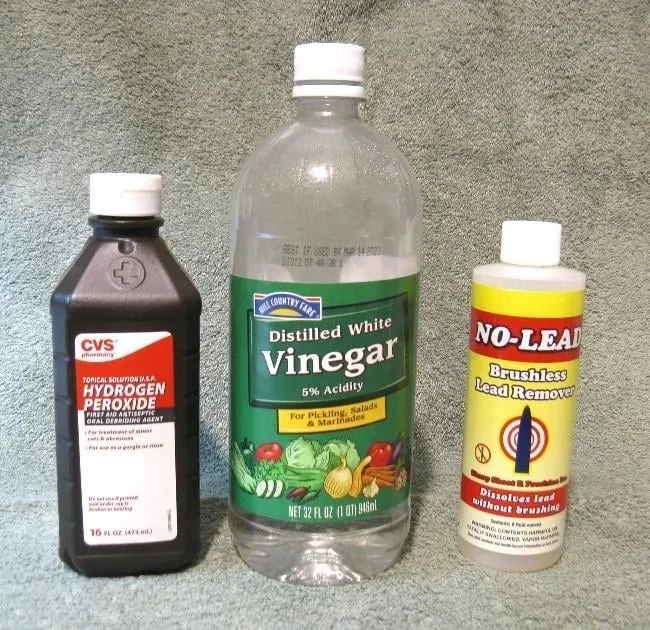
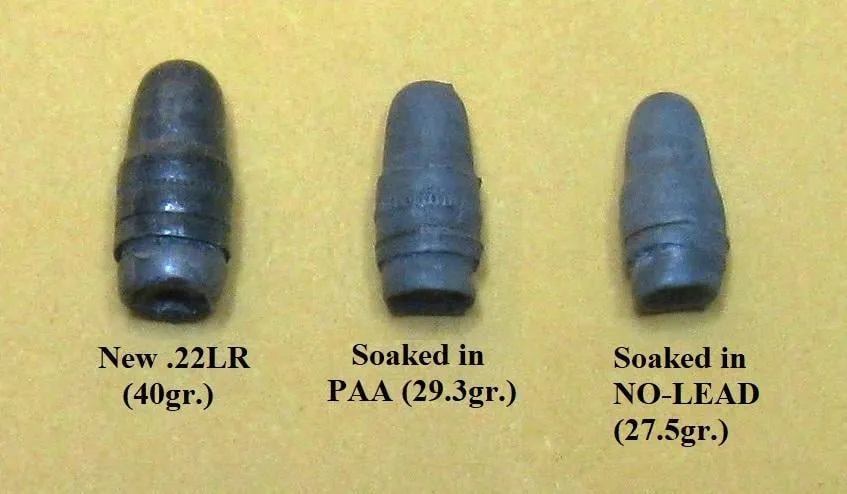
To determine how effective the PAA solution was compared to NO-LEAD, a clean .22 bullet was dropped into small containers with ½ oz of the solutions. The bullets were pulled from long rifle ammo & weighed. After removing all the lube, the bullet weights were verified at 40.0grs using a powder loading scale.
I tested both solution with PH test strips. Both were strong acids, measuring 0 on the PH scale. You could see the acidic action go to work immediately, bubbles rising off of the bullet; the NO-LEAD appeared much more aggressive. The bullets were left in the solutions overnight. The next day, approximately 10hrs. later, the bullets was wiped off & weighed. The bullet in the PAA was coated with a soft black layer that easily wiped off & had lost 10.7grs., a 26.8% reduction in weight. There was also a dark gray, almost black residue in the bottom of the container. The bullet in the NO-LEAD lost 12.5grs., a weight reduction of 31.3%. It was coated in a gray residue with a lot of gray scum in the bottom of the container.
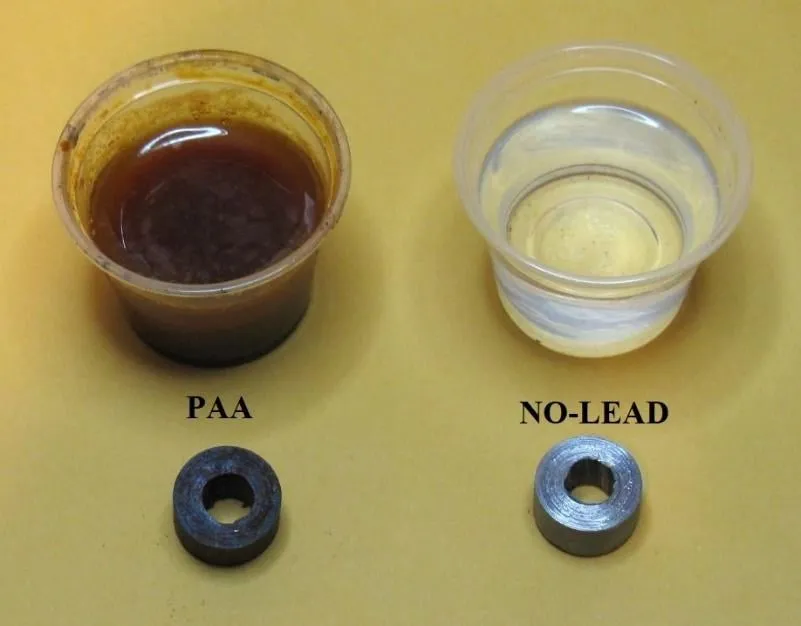
I also tested how both solutions affected barrel steel. Cutting off short ½” sections of a rifle barrel, both were put in small containers with ½ oz of the solutions. Withing a few minutes the PAA solution started to turn rust red. Within 30 minutes it was dark red. In one hour, it was dark brown, essentially confirming my previous results indicating PAA is a strong steel oxidizer creating rust (ferric oxide) & pitting which it does is rather quickly. The NO-LEAD appeared to have no reaction on the barrel steel. The solution was crystal clear after an hour. After leaving the barrel steel in the NO-LEAD for over 24 hours the solution was still clear with absolutely no signs of corrosion or pitting of the metal.
Conclusion
As noted in the above experiments, PAA is corrosive to many metals, especially so to the softer ones with the exception of aluminum. If left in the bore longer that a few minutes it will definitely form rust & etch the bore. Although NO-LEAD is a more aggressive lead remover it has no effect on barrel steel. The manufacturer does have very specific instructions on the NO-LEAD bottle, “DO NOT let NO-LEAD work for any longer than 20 minutes”. It’s because the active ingredients in no lead are totally used up within 20 min. For that reason, the recommendation is to apply it in 20 min. cycles. Based on my results I would not hesitate to leave NO-LEAD in the bore of my firearms for a few hours.
Wishing you great shooting,
Wayne