Remington Cases in a Browning .40-65 BPCR
The three most common brands of brass available for BPCRs are Starline, Winchester and Remington. Regardless of the brand, matching the bullet and case dimensions to the chamber dimensions is essential to achieving match-grade precision. This article covers the methods to measure and modify Remington brass for uniform neck tension and bullet obturation when fired in the Browning .40-65 BPCR.
For their .45-70 2.1” long chamber, being SAAMI members, Browning was compelled to use the SAAMI chamber specs which uniformly tapers from just in front of the rim recess to the chamber mouth, followed by a 12.75-degree transition step to the throat with no freebore and essentially no leade. Although their .45-90 is not specified by SAAMI, similar chamber dimensions were used, but of course it’s a bit longer at 2.4”, followed by a 12.75-degree transition step to the throat, then some freebore (extended throat) and a 1.5-degree leade. Neither chamber has a well-defined neck. Therefore, for both the .45-70 and .45-90 chambers the case wall taper compensates for the chamber ID taper, essentially resulting in constant tension along the seated length of the bullet and uniform obturation. So, no modifications to Remington bass necks are necessary, but that’s not so with the .40-65 Win chamber.
Since the .40-65 Win. is not specified by SAAMI, Browning was free to design the chamber with a cylindrical (constant diameter) well-defined 0.5” long neck followed by a 12.75-degree transition step to the throat, then some freebore (extended throat) and a 1.5-degree leade. Therefore, striving for uniform neck tension, the ideal case neck wall should have no taper. To remove the taper requires outside neck turning or, better yet, reaming out the inside of the case neck. Other brands of brass such as Winchester or Starline with no neck wall taper should not require turning or reaming. “Uniforming” Remington case necks results in several benefits. One is to ensure bullet alignment and consistent tension over the length of the bullet, and uniform obturation throughout the length of the neck. Another is to ensure that variations in neck thickness does not contribute to deformation and an unbalanced bullet. I.e., if the thickness of the walls varied around the neck, when the bullet obturates prior to leaving the neck, the thicker wall area will displace some of the lead resulting in a weight shift to the opposite side and an unbalance bullet. This could be referred to as a dynamic concentricity factor.
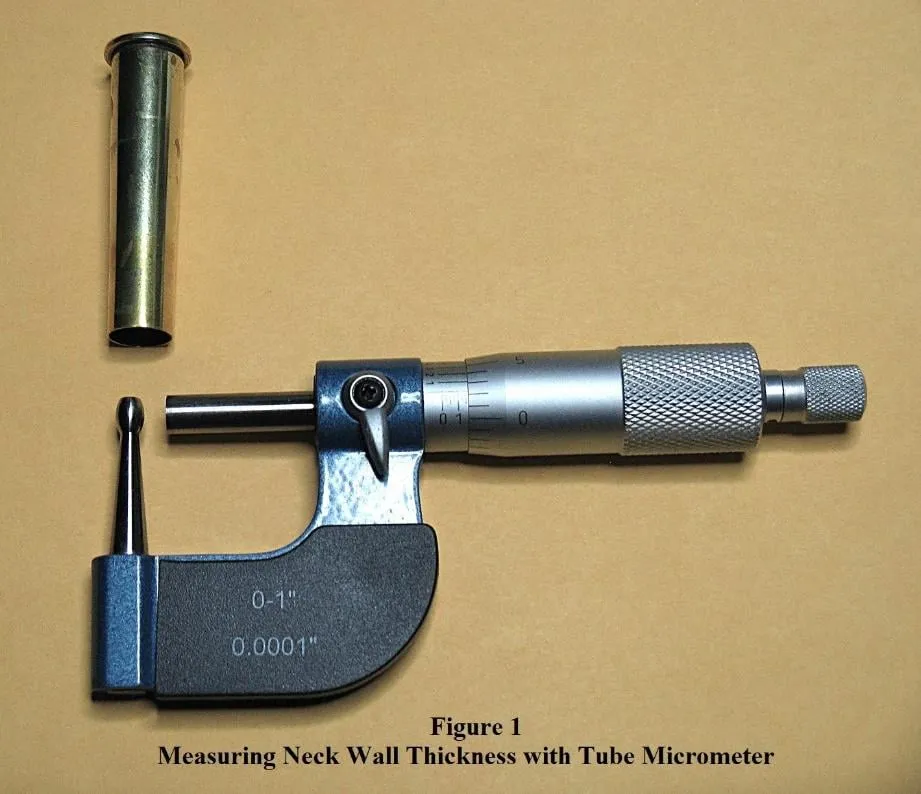
First expand the case neck with a 0.410” neck expander. It will shrink to approximately 0.409” after removing from the expander die. Then, uniforming the necks to 0.5” below the case mouth is a good idea if bullets of various lengths will be used. 0.5” also matches the chamber neck length. Since the case wall is tapered and attempting to accurately measure the thickness down 0.5” into the case, vernier calipers will not work. The best tool to use is a ball-tip tube micrometer (Figure 1). As of this writing, several are available on eBay for as little as $15, many in the $20 to $50 range. Remington neck walls can typically vary in thickness from 0.010” to 0.012”, some 0.011” to 0.113”. If a tube micrometer is not available, using a vernier caliper to determine the mouth thickness, outside turn the necks to a uniform thickness of 0.010” (Figure 2) or inside ream with a 0.409” (10.4mm) chucking reamer (Figure 3).
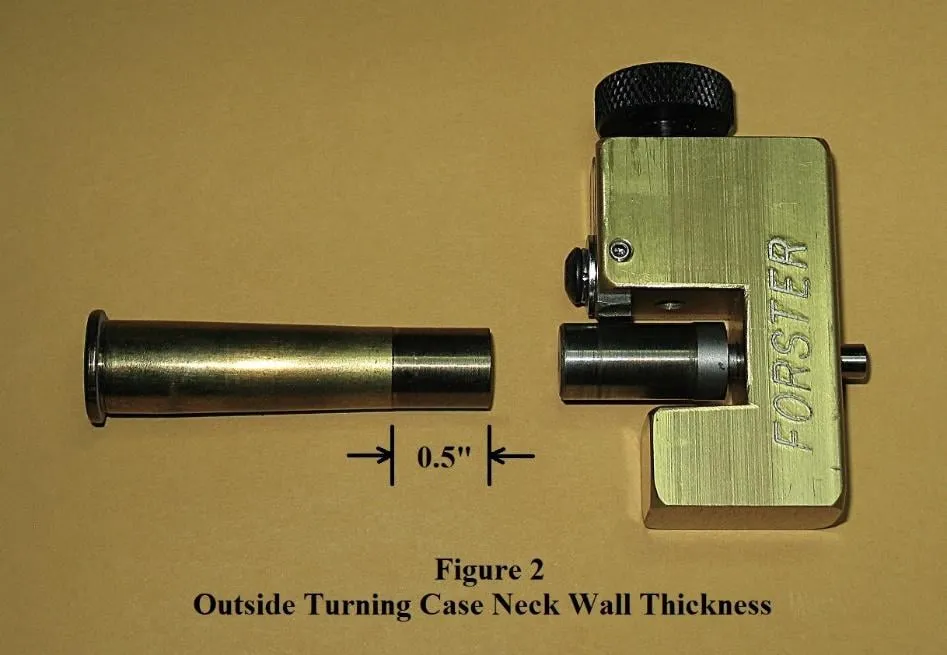

Several reloading equipment suppliers make outside neck turners including K&M, Precision Shooting Products, Foster Products, RCBS and Hornady, but they can be relatively expensive. Depending on the expanded case neck inside diameter, you’ll need a 0.409” or 0.410” pilot. A 0.410” pilot was the only available option with my Forster neck turner. A very nice Chinese made carbide 10.4mm chucking reamer is by far the least costly option. I found one on Amazon for $9.99 although it required 3 weeks to arrive from China. If you don’t have a lathe, a hand drill will work to hold the reamer as long as you’re careful and come up with a method to securely hold the case without damaging it while reaming. Since I have a lathe I have not tried the following suggestions that come to mind. Using a vice as a clamp, wrap the case in leather-coated rosin or rubber. Another vice method is to drill out a rectangular or square block of wood, cut it in half and coat with rosin.
The above steps should result in the ideal Remington case neck wall with no taper to match the Browing .40-65 chamber neck, eliminating one of the many variables affecting precision shooting. Determining the correct case length, ideal bullet dimensions, bullet alloy, powder charge, primer, wad, etc., are the subjects for many other articles.
Wishing you great shooting,
Wayne