Pan-Lubing BPCR Bullets My Way
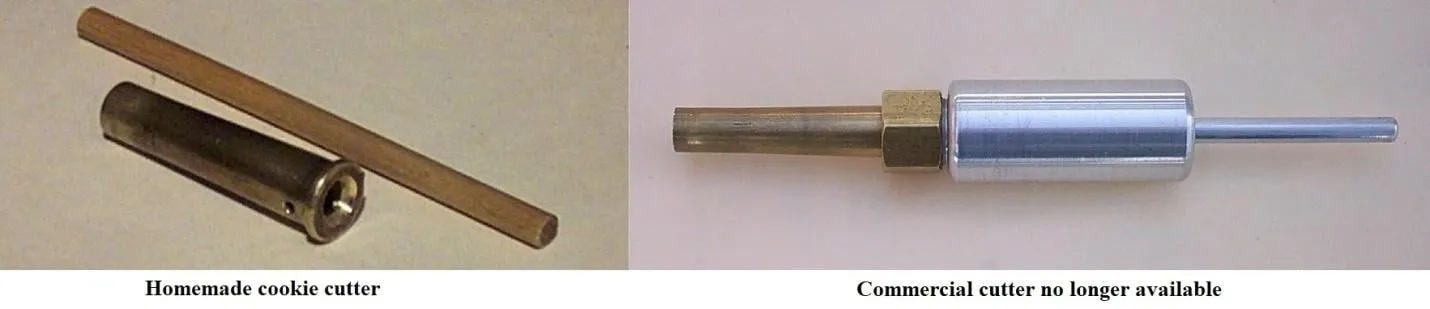
Although it’s not a complicated process, no doubt there are as many variations on pan-lubing black powder cartridge (BPCR) bullets as there are reloaders utilizing versions of the technique. After a few years of cutting bullets out of the lube cake using a homemade “cookie cutter” made from a modified cartridge case and with a dowel rod, then progressing to a commercial unit that’s no longer available, both are pictured below, I eventually wised up and switched to “thumb punching” the bullets out. It’s much faster and achieves the desired result. To do so efficiently, I’ve settled on a process that works very well for me.
By the way, all my lube is stored in a freezer in the original 1lb tubs and in a quart Mason jar. Freezer storage may not be necessary but it’s my way of minimizing any negatives due to aging. The Mason jar has a handle (the type used to drink out of) and holds sufficient lube to process 180 bullets, which is enough for three silhouette matches and the number that I cast and normally lube at one time. With the handle, it’s convenient for pouring the hot lube into the lubing pan or bowl. Following are the details and photos of my lubing process.
The safe way to heat lube is using a water bath, i.e. place the container of lube in a pan of water and heat until the lube is fully melted. The water-bath method prevents the lube from getting hotter than 212 degrees. Although recommended against doing so by the “experts”, to reduce the heating time, I place the frozen lube-filled Mason jar in a microwave for a few minutes until it’s completely melted, which is easy to determine since the container is clear. I’ve used this method for several years and haven’t noted any signs of lube degradation. Just be sure not to overheat and scorch the lube.
While the lube is heating, the container that will hold the bullets and lube is prepared. I’ve found the perfect container (Pyrex # 7210 7”x5”x1.5” rectangular glass bowls), which hold 60 bullets and provides just enough space for pouring in the lube. Therefore, “bowl lubing” would be a more accurate description of my process.
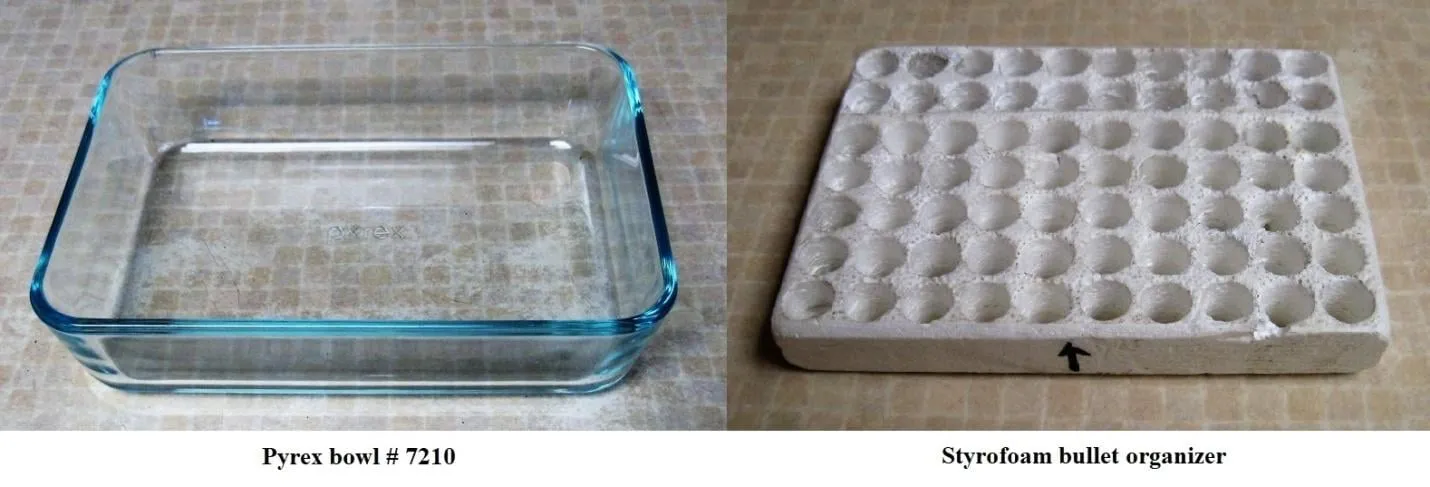
The bowl is first lined with aluminum foil, which allows for easy removal of the hardened lube cake. A Styrofoam bullet organizer, discussed in further detail below, is used to align and gently push the foil down into the bowl while lifting the edges of the foil so it does not catch and tear on the corners of the bowl. The foil is then folded down around the edges of the bowl. Using the organizer to gently push the foil down and form it to the bottom of the bowl helps to minimize wrinkles which will prevent the bullets from sitting flat. Wrinkles in the foil will also allow additional lube to creep under the bullet bases.
The bullet organizer is made by modifying 50-hole Styrofoam trays from ammo/bullet boxes – the ones available from MidwayUSA and possibly from other suppliers. The trays I use will work with .40 caliber and .45 caliber bullets. Assuming the existing holes are slightly larger than the bullets to be lubed, use some sort of punch or very sharp thin tool to extend the holes completely through the bottom of the tray and attach (glue on) two punched-out rows cut from another tray. The result is an organizer that fits perfectly in the Pyrex bowl and can accommodate up to 70 bullets, but one row is not filled to allow space for pouring in the lube. By the way, some types of common glues will dissolve Styrofoam, so water-based white or woodworking glues were used to add the additional two rows to the organizer.
I made up two of the organizers from three trays and have used them for lubing several thousand bullets to date. They’ve held up very well but are starting to look a little ragged. Of course, if you’re comfortable working with wood and have a drill press, a similar wood organizer could be made. Since the organizer is also helpful in forming the aluminum foil to fit the bowl, slightly round off the bottom corners and edges to prevent tearing the foil.
Prior to using the organizer, mark an arrow on one side with a felt-tip pen and place the organizer in the bowl so that the arrow is always orientated the same way. The reason will become obvious when it’s used to aid in punching out the lubed bullets – more on this later. With the organizer in the lined bowl, place the bullets, bases down, in the holes. Gently remove the organizer so as not to disturb the bullets. Needle-nose pliers are ideal to grab and lift the organizer.
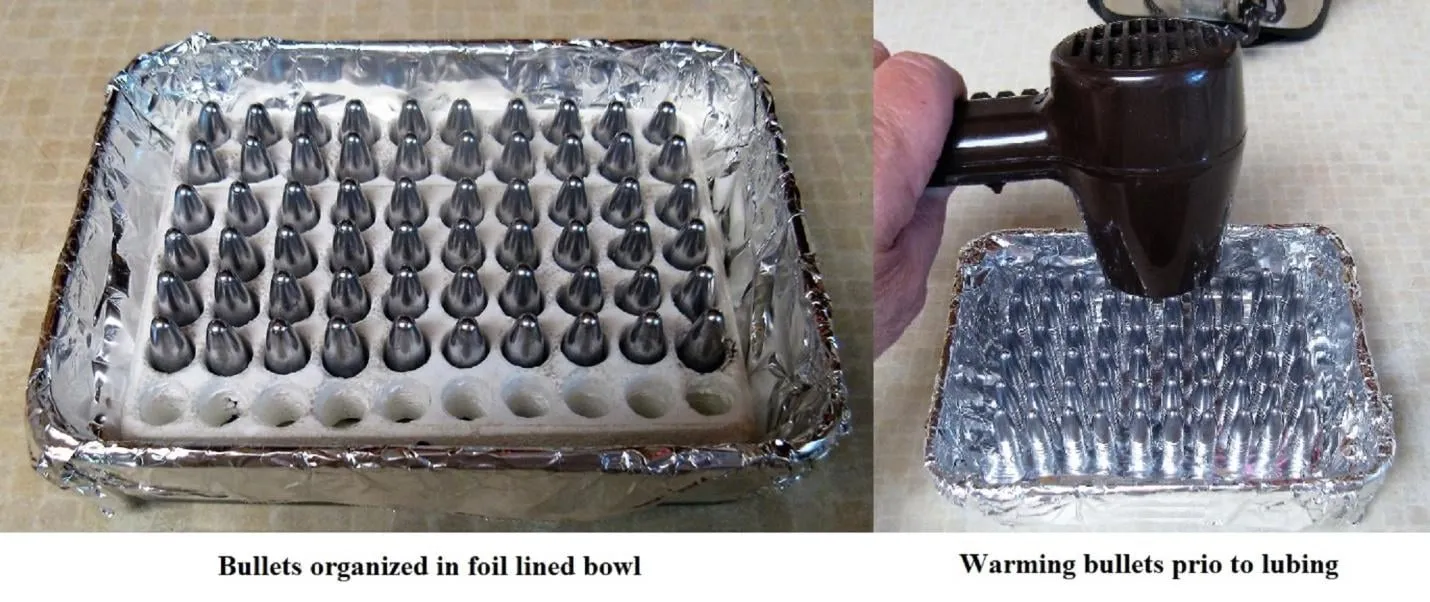
Next, and I consider this a key step, after gently removing the organizer and prior to adding the hot lube, the bullets are warmed up by passing a hot-air gun or hand-held hair dryer over them for several seconds. I’ve found the lube adheres better to warm bullets and will not have a tendency to roll out of the grooves when punched out of the cooled cake. When the hot-air gun or hair dryer is moved back in forth directly over the bullets they will not move due to their aerodynamic design, unless the bases are not flat due to being cast in a mould with a loose sprue plate.
Slowly fill the bowl with lube until the level is slightly above the top lube groove. Allow the filled bowl to cool for several minutes (30 minutes is good) and the lube to harden slightly before moving it to a refrigerator or freezer for additional cooling. If the bowl is moved too soon there’s a good chance one or more bullets will tip over and you’ll have a real mess on your hands due to the “falling domino effect” knocking over a bunch of the bullets. To speed up the process, direct a fan at the cooling lube cake.
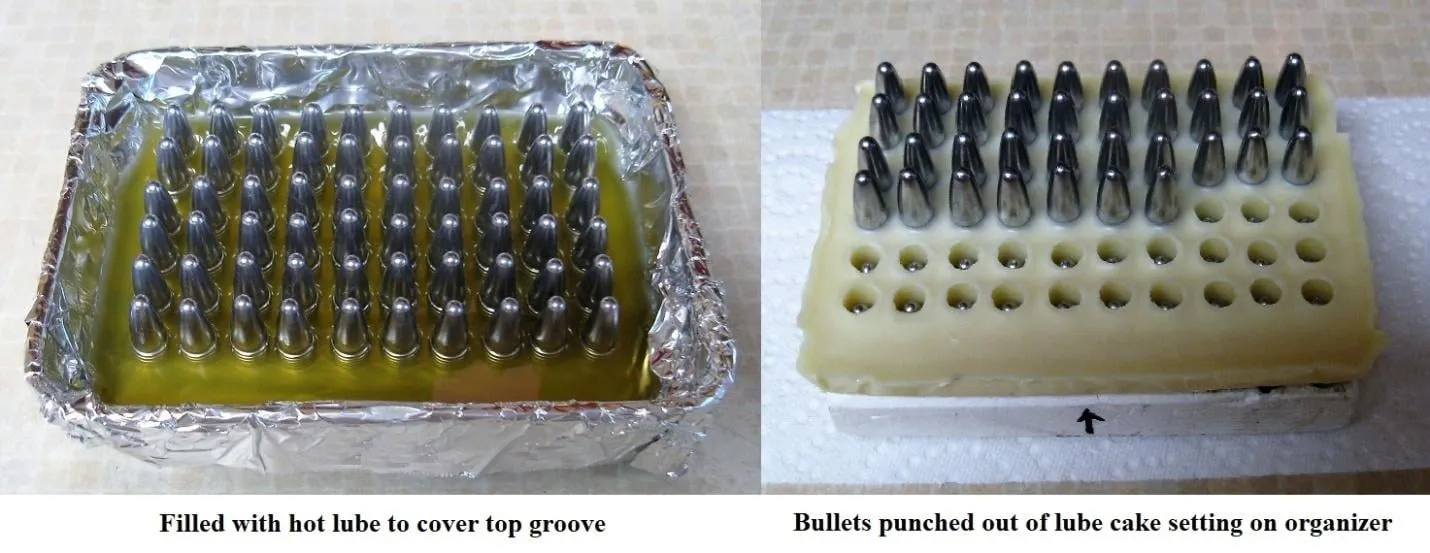
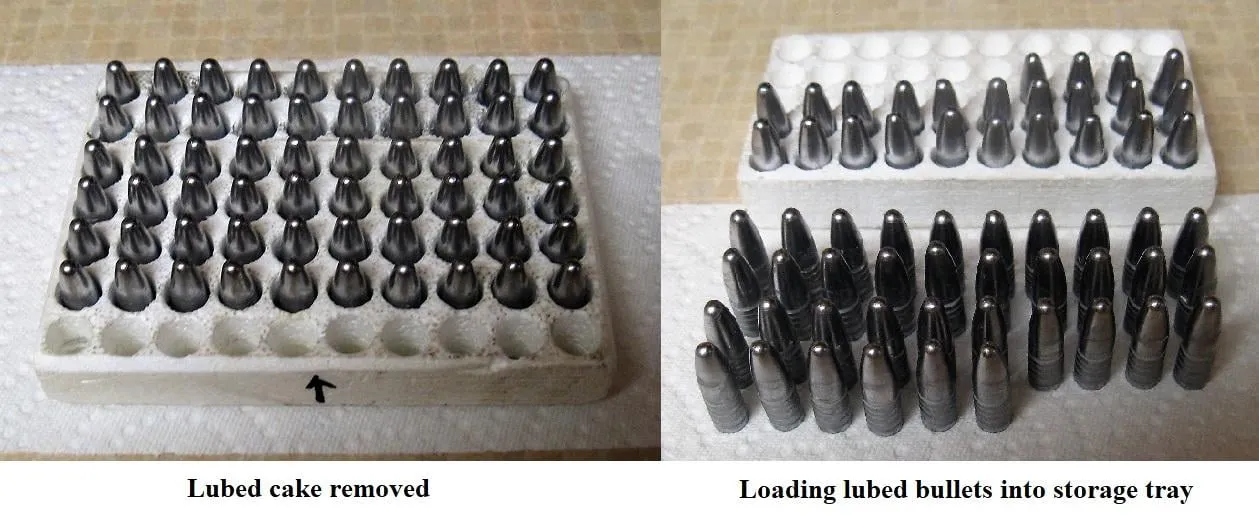
Now comes the 2nd use for the bullet organize. Place the organizer over a kitchen towel or one or more sheets of paper towels which will cushion the bullet bases when being punched out of the lube cake and can also be used to remove any lube that has crept under the bases. The organizer should be positioned in the same orientation as when it was first used to arrange the bullets in the bowl, hence the reason for originally “marking” the organizer with a felt-tip pen and always orientating it the same way. Once the lube and bullets are cooled sufficiently, a trial and error process, lift the lube cake out of the bowl with the aluminum foil or turn the bowl over and catch the cake, then peel off the aluminum foil. Position the lube cake, bullet bases down, on top of the organizer. At this point it’s a good idea to flip over the lube cake and organizer together to ensure the bullet bases are aligned with the holes in the organizer.
With the lube cake accurately positioned over the organizer, using thumb pressure, push the bullets down out of the lube cake into the organizer. To cushion my thumb, which tends to get sore pushing on the nose of a bunch of bullets, a folded section of paper towel is placed over each bullet nose as its being forced down. Other options include using a small piece of leather, or cut the thumb off an old leather glove, slip it on and use it. If the lube cake is at the correct temperature, the bullets should “snap” out of the cake into the organizer as the lube grooves shear off the lube. If the lube cake is too cold and the bullets will not budge, warm up the lube cake with the hot-air gun or hair dryer, or let it sit at room temperature for a few minutes. Just keep in mind the bullets will transfer heat much faster than the lube, so check for the correct temperature by pushing out a bullet rather than sticking something or pushing a finger into the lube to check for softness. If the bullets are easy to push out and don’t snap out of the cake, than the lube cake may be too warm. Through trial and error you’ll figure out what works for you. If done correctly the bullets should “punch out” with minimal thumb pressure and with completely filled lube grooves.
I find that using the organizer works much better than using a folded up towel or foam cushion under the lube cake when punching out bullets. The organizer helps to hold the bullets in alignment as they’re pushed out of the cake and helps to eliminate problems due to the lube cake breaking apart.
So that’s my complete procedure. If you haven’t tried pan lubing, don’t be intimidated by all the details provided. Once you get the “hang of it” the process is relatively straight forward, simple, and is by far the easiest and fastest way I’ve found to lube bullets. Another benefit, when shooting in hot conditions the lube will be firmer and stands up better than extruding the same lube by passing the bullets through a “lubrisizer”. For those of you that already pan lube, hopefully I’ve provided some hints to further reduce the somewhat tedious process.
Wishing you great shooting,
Wayne