Evaluation of the WM. Malcolm® 18” Two-Tone 6X Rifle Scope (Model M634181B)
I evaluated and published an article on cost-effective BPCR scopes a few years ago which included the original WM. Malcolm® 18” 6X Rifle Scope (model M634181) purchased in 2008. Although the price was significantly less than models from other suppliers at the time, mainly Montana Vintage Arms (MVA) and D.Z. Arms, and the construction of the scope body and optics was excellent, I could not recommend the scope for BPCR silhouette. The machined finish of the mounts (rings) was a little rough, but the main problem was the rear mount which was unsuitable for competition due to the lack of micrometer-type reference scales on the turrets, an absolutely necessity for accurate and repeatable adjustments.
For those that may be interested in the vintage-style scope for hunting or target shooting the same scope and mounts are currently available for $385 on Hi-Lux Optics website as is a PDF version of the instruction manual. But be aware that the two photos of the rear mount on page 10 of the manual are incorrect and misleading. The photos are of the older Gen I full micrometer Unertl-style mount with adjusting clicks and turret tension adjustment screw that came with the 20X Target Scope or 8X USMC Sniper Scope. Prior to discussing the new redesigned scope a few comments about Hi-Lux Optics are in order.
A full line of modern (internal adjustable) and vintage-style (external adjustable) precision scopes are manufactured in China, imported into the USA and distributed to firearm dealers and retailers by Leatherwood® Hi-Lux Optics (https://www.hi-luxoptics.com, 888-445-8912). The WM. Malcolm® scopes discussed in this article are available directly from Hi-Lux Optics, Optics Planet and MidwayUSA among others. Buffalo Arms listed the scopes at one time but currently shows everything out of stock. Davide Pedersoli & C. is the European retailer. Being aware of my article which included the evaluation of the original 6X scope, and knowing that I am an avid BPCR competitor, Hi-Lux Optics solicited my help to evaluate the redesigned model M634181B.
The scope (Photo 1) arrived a few days later. When opening the box the most obvious change is the two-tone feature. The scope now sports brass objective and eyepiece lens housings with shiny brass end caps. As a side note, if the shiny brass is a little too gaudy and not esthetically pleasing it can be easily toned-down to an antique-brass look with a couple of applications of cold bluing. Birchwood Casey Perma Blue® works great. The scope body is nicely finished as are the front and rear mounts. A closer inspection of the rear mount highlighted the redesign to the adjustment turrets. The original scope rear mount has a course scale on top of the turrets. The new design has a much finer scale on the side of the turrets but lacks a reference scale along the adjustable axis of the turrets. Keep this in mind as I later discuss the results of range testing the scope. Although the scope came with scope blocks and instruction manual the mounts will fit standard crescent cut (non-Posa) Unertl or Fecker-style blocks. Additional details are listed below:

- Power: 6X
- Fully multicoated high density lenses
- Objective lens diameter: 17mm
- Field of view (100yds): 12’
- Exit Pupil: 2.8mm
- Eye relief: approximately 4.5”
- Overall length (without end caps): 18”
- Tube body: ¾” diameter blued steel
- Weight (without end caps): 17.6oz
- Adjustable eyepiece to focus the crosshair reticle.
- Plain fine-wire crosshair reticle (No option for different reticles).
- Waterproof – hermetically sealed and nitrogen purged. No chance of moisture getting inside.
- Mounts are constructed of steel with a durable black coating.
- Sliding Lock Ring on the front mount allows the scope to slide under recoil.
- Rear mount turret scale has ¼ MOA (minutes of angle) graduations assuming the mount spacing is 7.25” center to center.
- Rear mount has locking thumbscrews and is click-less during adjustments.
- Parallax is set at 100yds and is not adjustable.
- Listed on Hi-Lux Optics website for $475.
After visually checking out the scope and mounts I enthusiastically headed to the range to check the outfit out on both a high quality Stevens 44 .22LR and Shiloh Sharps 1874 .40-65, two of the rifles I use for BPCR competition. The scope instruction manual suggested the rear mount does not offer sufficient elevation adjustment for big bore black powder cartridge rifles out to the normal 500 meters shot in big bore BPCR silhouette. The comment is doing a disservice to the scope as I found more than sufficient elevation adjustment.
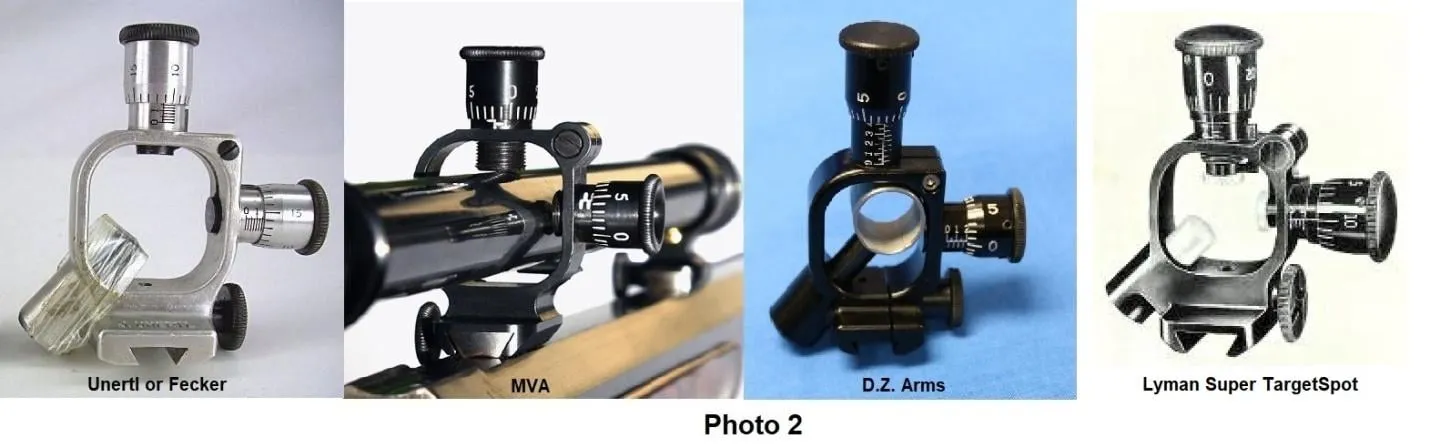
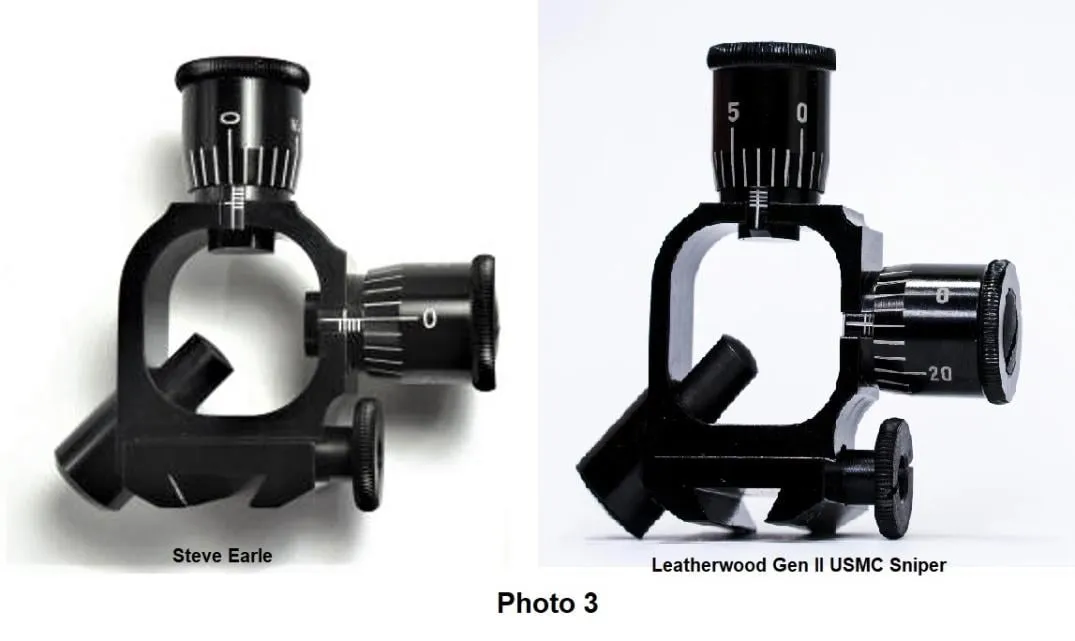
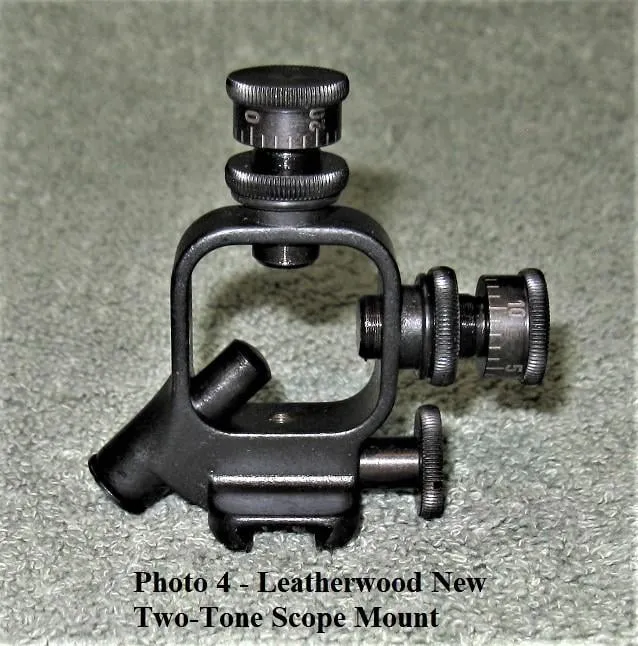
The outfit easily mounted on the Stevens 44 and Sharps 1874 rifles. Both have Unertl/Fecker standard crescent cut blocks set at 7.25”. To cut to the chaff so to speak and make a long story short the results of the range testing was a disappointment. When inspecting the rear mount turret design I failed to realize there was no reference scale along the adjustable axis of the turrets. The various mounts in photo 2 are examples featuring the necessary scale in addition to the scale on the circumference of the turret. Note that all also have a screw located between the turrets to adjust tension on the turrets. Photo 3 displays the Steve Earle and Leatherwood® USMC Sniper mounts. Both have the critical scale but lack the tension screw. The adjustment clicks prevent the turrets from turning during use. Photo 4 is of the Leatherwood® Malcolm mount. Since each turret has locking thumbscrews a tension screw is not necessary, but the mount lacks the critical scale. The lack of the scale is a major problem when shooting in BPCR competition. Allow me to explain further.
BPCR silhouettes are typically shot in the following order: chickens, pigs, turkeys, rams. Even in .22BPCR an adjustment of around 30 MOA is required to get from the chickens at 50 meters to the rams at 200 meters. And in big bore BPCR the chickens are at 200 meters and the rams at 500 meters requiring around 50 to 55 MOA of total adjustment. Therefore both types of competition will require many turns of the elevation turret which, on the Leatherwood® Malcolm scope, has only one reference scale with a resolution of ¼ MOA and a range of 6.25 MOA per full turn assuming the mount spacing is 7.25”. Since everyone cannot start with the chickens, shooters are assigned a starting set of silhouettes but are still required to shoot the silhouettes in the same order. For example, when a shooter (assigned to the pigs) has finished shooting the pigs, he or she will then move to the turkeys, then to the rams and finally to the chickens.
So let’s assume a common .22 BPCR situation. The shooter is assigned to start on the rams but the scope happens to be adjusted for the chickens. The elevation turret must be adjusted to raise the scope about 30 MOA (4.8 turns) or 4 turns plus 20 scale marks on the turret. Since there is no reference scale along the adjustable axis of the turrets, counting full turns and adding the necessary scale marks would be required. Another possibly worse-case example – the elevation turret setting is unknown. Therefore the only option is to adjust the turret until the scope body hits either the top or bottom of the mount frame and adjust from that point. Of course this would assume the shooter had previously prepared for this situation and documented the number of turns necessary for a specific silhouette. It is feasible but all this would get very confusing during the stress of timed competition. On Unertl or Fecker-type rear mounts it is easy to document and keep track of the adjustment setting. Therefore, due to the lack of a reference scale along the adjustable axis, the reason the original scope and mounts were not recommended, I cannot recommend the redesigned scope and mounts for BPCR competition.
None of this should come as a surprise to the scope mount designers since the current Gen II rear mount that comes with either the 20X Target Scope or 8X USMC Sniper Scope has the required reference scale. But this mount has adjusting clicks which are not legal in BPCR sanctioned matches. Those reading this may wonder why not just use the 8X Sniper Scope for BPCR but have the rear mount turrets de-clicked? But even with de-clicked turrets the larger diameter of the objective lens housing on the Sniper Scope is another feature not allowed in BPCR sanctioned matches. Of course, if the upgraded mount could be de-clicked and a method found to keep tension on the turrets without the clicks it could be used as a replacement for the Malcolm mount but at an additional cost.
All of the precision high-quality rear mounts, which feature precise and repeatable adjustments, are generally referred to as “micrometer-style” mounts. In contrast to ladder-type patterned after the Malcolm C mount and found on some of the MVA vintage-style scopes the Unertl or Cataract-style are sometimes referred to as cage-type mounts; cage-type being used in reference to their shape. The basic design is attributed to the Cataract Tool & Optical Company, which was later improved on by the J. W. Fecker Company. Unertl essentially copied the J. W. Fecker Company improved design. The cataract-style mounts are spring loaded to eliminate the possibility of backlash in the adjustments.
Some of the Fecker mounts were manufactured without adjusting clicks. But even the versions with clicks can be relatively easily de-clicked as can the Unertl mounts and similar mounts made by Lyman. But all of these including modern versions made by MVA and D.Z. Arms for externally adjustable scopes have a tension screw to adjust the tension on the turrets. The upgraded Leatherwood® Hi-Lux Optics Gen II mount does not have the tension adjustment feature. Only the click mechanism is used to keep the turrets from turning during use. Therefore de-clicking the turrets would allow the turrets to turn during use.
I mentioned earlier that, contrary to the instruction manual, the Leatherwood® Malcolm rear mount has sufficient elevation adjustment for shooting big bore black powder rifles out to 500 meters. I tested this with the Sharps .40-65 using my standard competition loads with a velocity of 1270 fps. There was no problem reaching out to 500 meters. Based on the additional amount of adjustment available 600 meters is most likely the limit. And I did check to determine if any parallax could be detected at 500 meters. There was no detectable movement in the crosshairs when moving my eye around within the visual limits of the eyepiece which was not a surprise due to the low 6X magnification and relatively small eyepiece diameter.
Finally, I suggest that Leatherwood® Hi-Lux Optics consider the following improvements to make the scope setup usable for BPCR competition:
- Redesign the mount to add a reference scale along the adjustable axis. Or design a click-less version of the Gen I USMC Sniper Mount. The Gen I has the turret tension adjustment screw so a click-less version of it should work fine.
- Make the slots in the mount-to-base locking screw heads sufficiently wide to use a penny or larger coin to tighten the screws should they loosen during a match.
- To help eliminate metal-to-metal scratching on the scope body as the scope slides under recoil add hard delrin or similar plastic inserts to the tips of the turrets. And use a similar material for the spring loaded boss that applies tension to the scope body. The vintage Lyman Super TargetSpot mount has these features.
- Since the rear mount is adjustable to over 500 meters, introduce an 8X version of the scope with the above improvements for big bore BPCR competition. 6X works but 8X is a better magnification due to the longer target distances for big bore. Depending on the shooter, 10X can be a little too strong since it significantly magnifies the rifle and scope movement when shooting the chickens off hand.
Wishing you great shooting,
Wayne