Evaluation of Locking Handles for Casting Moulds
First, a little background - I’ve been casting bullets for smokeless and more recently black powder cartridges for nearly 35 years. I’ve used Lyman, RCBS and SAECO moulds with the appropriate matching handles. The majority of my current moulds are from Paul Jones (now retired) and Buffalo Arms (BACO). The moulds are based on SAECO blocks, therefore SAECO handles fit them perfectly. When casting .40 caliber 410gr bullets from a single-cavity BACO mould the typical weight spread is +/- 0.5grs, which is certainly adequate. But during the last few years, after reading many online discussions, locking handles caught my interest. It has been my opinion that if a high-quality mould is used with good handles and with a refined casting technique, locking handles are not an advantage. But I wondered if the weight spread could be further reduced, and are there additional less obvious advantages to using the handles?
The functioning of locking handles is very similar to pliers commonly referred to as vice lock pliers, lock grip pliers, or pliers manufactured under the well-known “Vise-Grip” trade name. The design incorporates an “over-center action” adjustable link between the two handles. In use the link is adjusted so that the control handle lightly snaps over-center (locks in position) once the mould halves completely close. Adjusting the link determines how tightly the mould halves are squeezed together. Once set the pressure holding the mould together is consistent from bullet-to-bullet, theoretically eliminating one of the variables contributing to variations in bullet weight. Prior to writing this article, the only two locking handles I was aware of were made by Cabin Tree and R & J (Ron Jordan).
After a little online research it turns out the original Cabin Tree handles, slightly modified, are now manufactured by ST Machining and sold through Desperado Cowboy Bullets website. (http://cowboybullets.com/Mould-Handle_p_56.html) and Buffalo Arms Co (https://www.buffaloarms.com). Two versions (regular for 1 or 2-cavity moulds and long for 6-cavity moulds) are now available in steel or aluminum. The original Cabin Tree handles were only available in steel. The price is $70 plus shipping for all versions. For this article I will refer to them as STM handles and only the regular aluminum version will be evaluated. The R & J handles are available directly from R & J Mould Handles (http://www.rj-mouldhandles.com/), a Canadian based company, or from Shiloh Sharps (https://shilohrifle.com/reloading-supplies/r-and-j-custom-mould-handles/). The price is $75 plus shipping. I decided to purchase one of each brand and try them out.
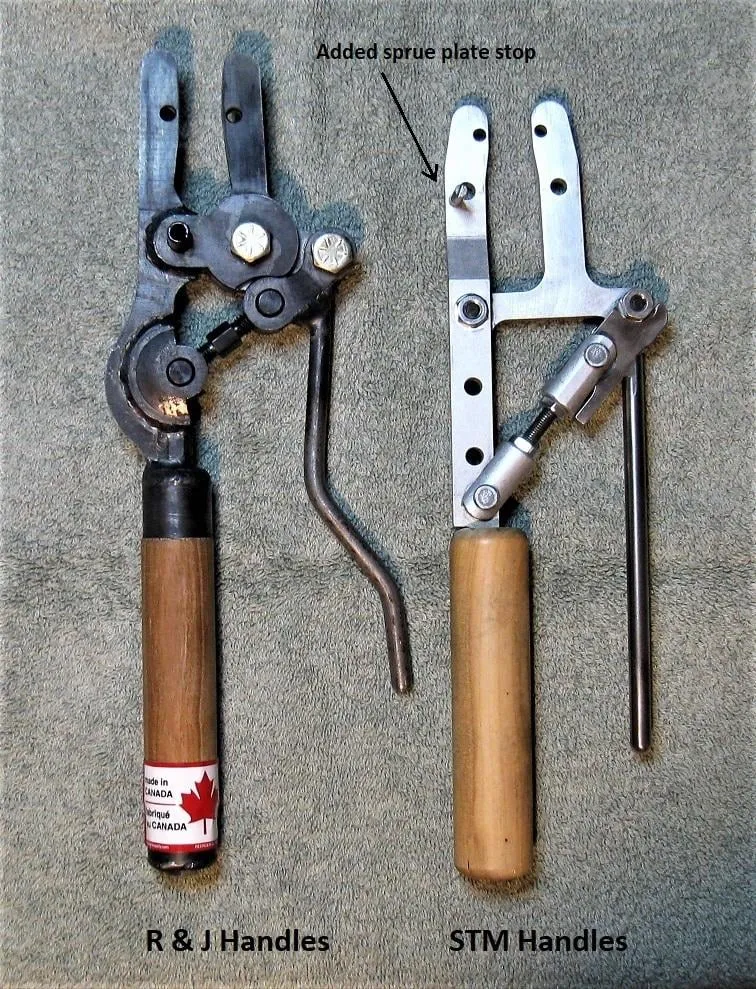
When opening the box containing the R & J handles the 1st thing noticed was the significant weight, which measured 1lb 11oz on a precision postage scale. As a comparison, standard SAECO handles weigh right at 1lb. The 2nd was the lack of instructions. Being mechanically inclined I quickly figured out how to adjust the handles but that may not be the case for some. The 3rd thing was the shape of the metal control handle. It’s bent away from the main wooden handle. Being right handed, when casting and using standard (non-locking) handles, the handles with mould are held in my left hand. After filling the mould I grab the mould mallet with my right hand. To open the mould the portion of the handle that’s being held by my fingers is “flicked” open. This is all done with one hand and is impossible with the R & J handles due to the control handle design. I should make it clear at this point that having to use two hands to open the mould is not a significant disadvantage, but after casting 25 bullets I quickly lost interest in using the handles due to the weight and resulting hand fatigue, which is contrary to the advertised benefits listed on R & J’s website. And I don’t have what I consider weak wrists or hands. As a comparison, with standard SAECO handles, I can easily cast a session of 120 bullets or more without fatigue.
By the way, I do know that some shooters use two mould/handle setups to speed up the process when casting larger/heavier bullets – setting one aside to cool slightly while filling the other. As noted earlier, the heaviest bullets I cast are around 410grs. After the mould is preheated and the alloy is ready, my casting rate is approximately 120 bullets per hour. Therefore using two setups would not be an advantage for me.
Upon opening the box containing the STM aluminum handles the lighter weight was quite obvious. To be accurate the handles are not constructed of all aluminum. The control handle and a portion of the adjustable link are steel. The handles weigh 11oz, a full pound lighter than the R and J handles and 5oz lighter than the standard SAECO handles. Even the all steel STM handles only weigh 1lb 1oz. Oh, and excellent instructions were included.
One possible negative of aluminum handles is it takes longer to bring the mould up to casting temperature since aluminum is a much better conductor of heat than steel. I use a small laboratory hot plate to preheat my moulds. When casting with a BACO mould and steel SAECO handles the hot plate easily preheats the mould to the 440 to 450 degrees, my desired starting mould temperature. With the STM handles and BACO mould the temperature peaked out at approximately 400 degrees and it took a lot longer getting there. I tried out the handles by casting 135 408gr bullets without stopping. Afterwards the bullets were weighed in the order cast. I was not surprised that 13 of the 1st bullets had to be discarded due to significantly lighter weight. I also found a faster cadence was required while casting to maintain the mould temperature, which should be a distinct advantage when casting larger 45 caliber bullets. By the way, due to the light weight and locking feature I could have easily extended the casting session to 180 bullets or so, which is sufficient for three silhouette matches, but would have required adding additional alloy to the pot.
With the STM handles I was able to use my left hand to flick open the mould since the control handle was much closer to the main wooden handle. The one feature I felt was missing was a sprue plate stop, which I added after the 1st casting session and was a needed improvement to prevent the plate from rotating too far when opening and getting in the way when closing the mould. Since the ideal location of a sprue plate stop is dependent on the design of the mould (1 or 2-cavity) and shape of the sprue plate, I can understand why it’s not a standard feature. I drilled, tapped and installed a 10-24 threaded bolt of the appropriate height, which was easy enough. Another option is to drill a hole and install a bolt with two nuts to lock it in place.
By now you’re probably wondering if I answered my main reasons for evaluating the handles. It should be obvious which one of the two brands I recommend. Clearly the STM aluminum handles are my preferred choice. Based on my testing, I doubt there’s an advantage to using the STM all-steel handles but I did not evaluate them. There’s no question the R & J handles are of sturdier construction than the STM handles, but along with the heavier construction comes significant more weight. The final question to answer is will locking mould handles reduce the weight spread of the bullets?
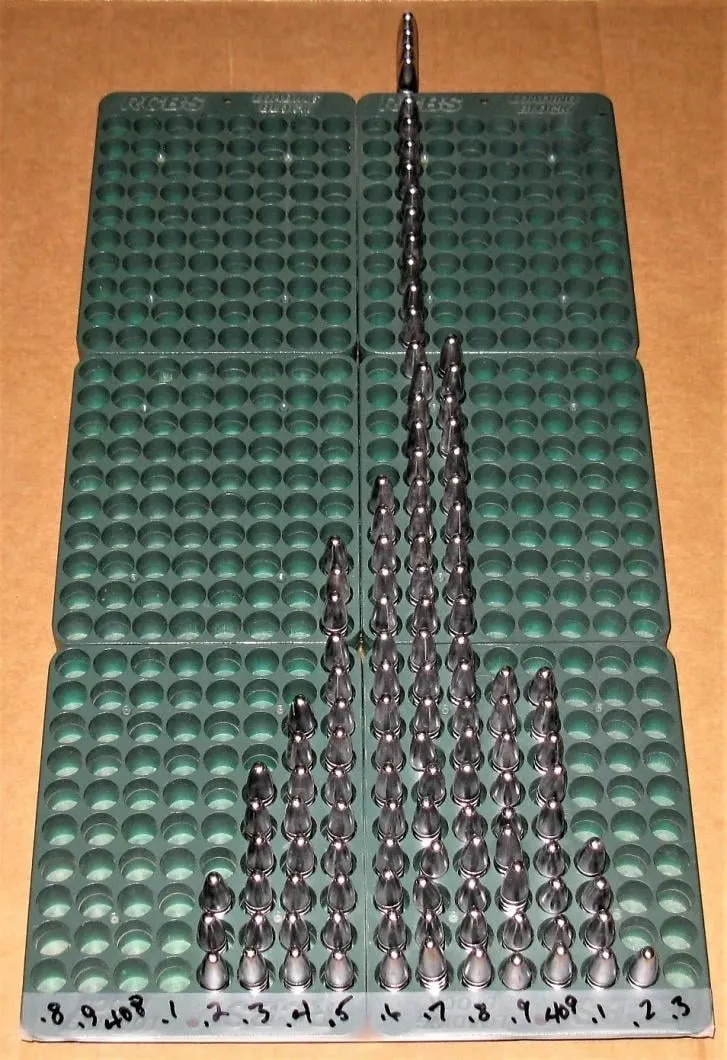
In the opening paragraph I mentioned my typical casting session results in a bullet weight spread of +/- 0.5grs. On bad days it can be worse, on a good day a tad better. The following photo will give you a visual indication of the spread of 122 bullets that were cast with the STM handles after tossing the “cold mould” rejects. The mean (average) weight is 408.7grs. The lightest is 408.2 grs and the heaviest is 409.2grs, resulting in a spread of +/- 0.5grs. By the way, since the sorting board I made was not tall enough, four of the bullets “spilled” over the top of the board. Although the spread was the same as my normal results, you’ll have to take my word for it that using the handles did decrease the standard deviation (SD) of the bullet weights. The overall shape of the weight distribution envelope is taller and narrower since a higher percentage of bullets weigh at or very close to the mean weight. For those of you “into” statistics the SD was 0.209grs, the variance 0.44grs and the mean was 408.69grs. For any statistical experts reading this please cut me some slack since I may be loosely using some statistical terms.
Finally, wondering how well the aluminum STM handles stand up to wear at the pivot joints, I discussed them with Ed Kemmerer, the owner of ST Machining and Desperado Cowboy Bullets. He indicated there have been no issues or complaints. And before I forget one final benefit, for those of you with arthritis in your hands, locking mould handles should be a definite advantage since, once the handles are locked, hand pressure can be reduced while filling the mould and waiting for the sprue to solidify.
2/4/20 – After using the STM aluminum handles for 18 months and casting approximately 2000 bullets, I love the handles. Due to the light weight I experience no hand or wrist fatigue problems. The handles are easy to adjust for different mould thicknesses and, due to the lock nuts, stay firmly adjusted.
Wishing you great shooting,
Wayne