Diminishing Returns of Powder vs. Velocity
The following should be especially interesting to Browning .40-65 BPCR owners. While working on an article on the Buffalo Arms (BACO) JIM410410M1 bullet (408.7gr using 16:1 alloy) in the Browning with Swiss 1.5Fg. I needed some velocity data vs. powder capacity. I thought I’d share the data. The loads were not shot for accuracy, only over a chronograph to determine average velocities for each load. 5 shots were fired with each load with wiping between shots. See the data chart below. BTW, primers were Federal Large Pistol Match GM150M and 0.060” fiber wads were used over the powder.
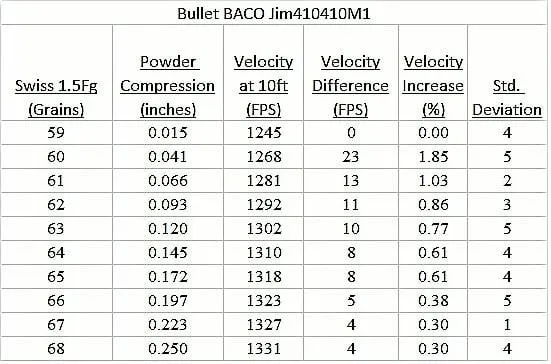
Since the chronograph provided standard deviation data, it was included although it should not be taken as an absolute indication of accuracy due to other factors also affecting accuracy. But with that said, the two lower SD values in the chart do coincide with the best two accuracy loads for my rifle with the bullet.
Another observation: if you do the math you’ll note that the changes in compression is approximately 0.026” per grain, give or take 0.001” or so. This is due to the Browning chamber having a constant diameter 0.5” long neck resulting in each additional grain of powder being compressed the same amount. In chambers such as the Shiloh Sharps .40-65, the neck has a constant taper resulting in more compression required for each additional grain of powder assuming the bullet seating depth does not change.
Wishing you great shooting,
Wayne