De-Clicking Unertl, R.W. Fecker & Lyman Scope Mounts
NRA Black Powder Cartridge Rifle Silhouette (BPCRS) and .22BPCR Association (BPCRA) mandates that external adjustable scope mounts must not have click adjustments. Although there are a few modern manufacturers of new legal scopes with non-click mounts such as Hi-Lux Leatherwood, Montana Vintage Arms and D. Z. Arms to name three, vintage R.W. Fecker, Unertl and Lyman brand vintage scopes and mounts are also used for BPCR competition, especially since they can be found for several hundred dollars less than the modern brands. The problem is most of the vintage scope mount turrets are click adjustable. Unertl and Fecker mounts are very similar, but with some turret design differences. Unertl scope mounts are relatively easy to de-click. Depending on the technique chosen, the process to de-click a “Fecker” ranges from simple to somewhat complicated, but it’s still pretty straight forward once you understand how the turrets are designed. Some Lyman turrets utilize a more complicated design but can be de-clicked.
Unertl Mounts
First, allow me to make the following very clear. I’m no expert on Unertl scopes or mounts. I don’t know if all Unertl turret mount adjustments are similar, but the ones I have seen are easy to de-click. See the photo below of the disassembled ¾” mount. By the way, the spring and plunger pictured to the left of the mount reside in the lower left cavity of the mount. Together they apply the necessary force to hold the scope body firmly against the two adjustable turrets.
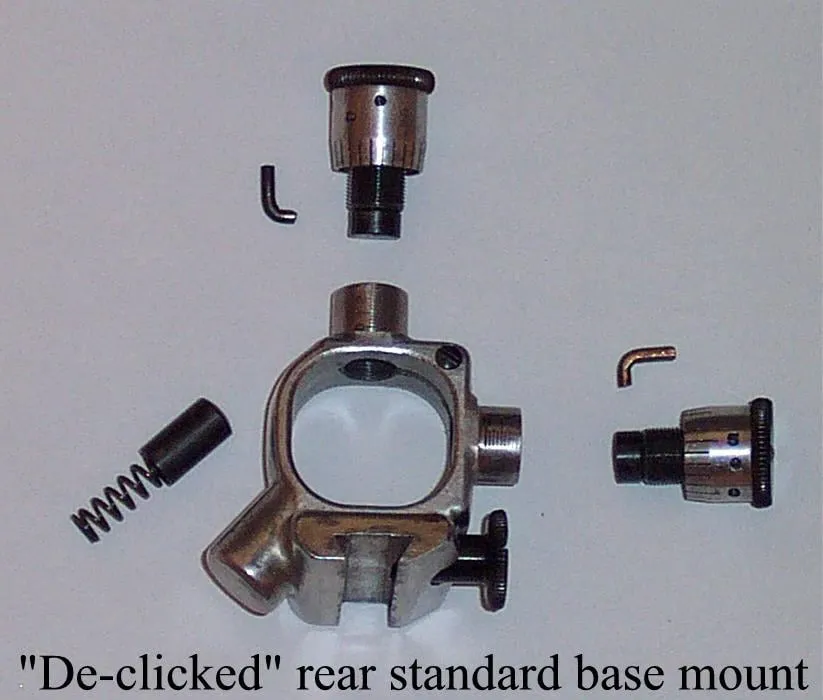
A right-angle pin is installed into a hole in the bottom end of each turret assembly. When functioning as originally designed, as the knob and threaded section of the turret is rotated during adjustments, the pin holds the bottom end from turning while sliding up and down as necessary in a slot in the turret housing. Through the center of the threaded section, the bottom end of the turret assembly is directly connected to a thin round flat disk resting on top of the knob. Since, due to the right-angle pin, the bottom end of the turret assembly cannot rotate, the flat disk cannot rotate. The flat disk has a small detent dimple impressed close to the edge. When the knob is rotated under it the dimple snaps (clicks) over notches formed in the top of the knob. Removing the right-angle pin de-clicks the turret. It’s that simple. Just completely unscrew and remove the turrets. Then grab the right-angle pin with a pair of pliers and pull it out while gently rotating it back and forth. The pin may be very easy or quite tight to remove. If it breaks off and you have no plans for using the click feature, just file off any remaining rough edges. Finally, to control the tension on the now de-clicked mounts, tighten the screw in the upper right-hand corner between the two turrets. Another method that reportedly works to control tension is to clean the turret threads of oil and apply a drop of linseed oil or some rosin. I have not tried either so can’t comment, but it sounds reasonable to me.
Fecker Mounts
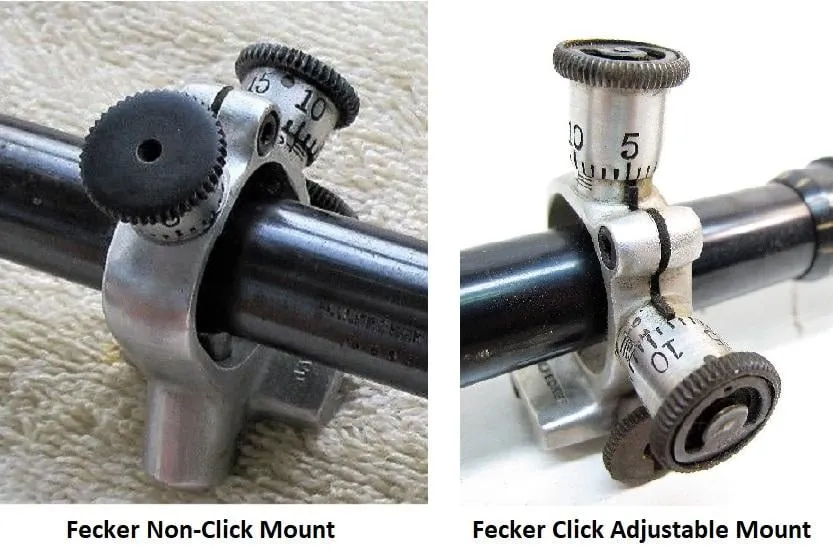
As displayed in the photo above, some R.W. Fecker mounts were produced by the factory without click adjustments, I have one, but the majorities I’ve run across have click adjustable turrets which have a flat U-shape piece of steel I refer to as a click flange. One end of the click flange rides in the turret housing slot. The other end extends up the center of the turret and is locked (peened) to a spring-steel ring in the top of the turret which I call a click ring. The hardened steel click ring has a detent dimple impressed in the center of the thin edge. As the turret is rotated, the click flange keeps the click ring from rotating which forces the detent to “click” over the radial ridges/grooves in the top of the turret as the turret is rotated. Refer to the photo of the disassembled parts further on in this article.
Looking at the mount and turrets, the first thought might be that the turrets should be easy to de-click. Just unscrew each turret and, similar to the Unertl modification, cut off the flange wing that rides in the turret housing slot. But take a closer look and you’ll note that if the flange wing is removed there’s nothing stopping the bottom of the flange, the section that rides on the scope body, from rotating, which would effectively disable turret adjustments.
There are three techniques I’m aware of to de-click Fecker mounts. One is not permanent and, if successful, is easy to convert back to using the click feature. The 2nd and 3rd techniques result in permanently disabling the click feature, the latter being the most complicated of the three.
First Technique
The 1st, hopefully reversible technique, is from Brent Danielson on the BPCR.net forum and is discussed in the following details and photo provided by Brent.
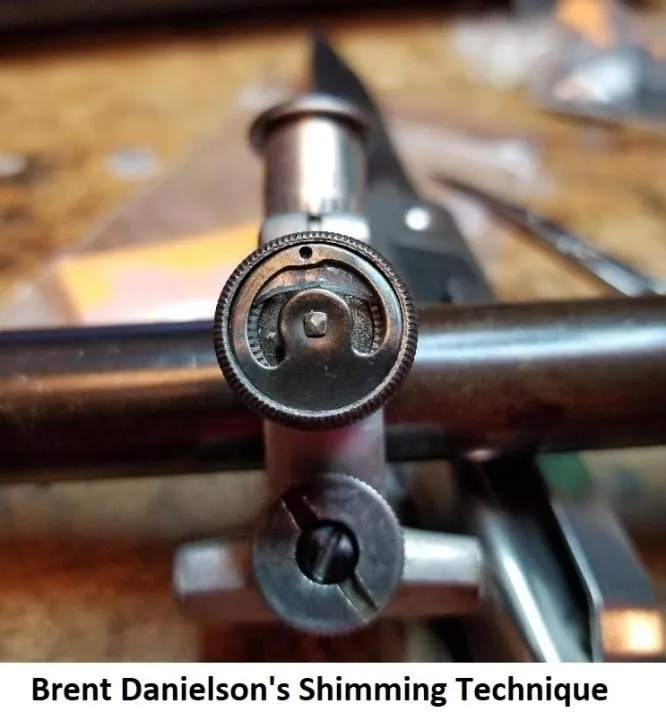
“It involves snipping off a piece of a 0.030” LDPE wad (0.060” is too thick) and then inserting it under the spring clip ring to block the detent in it. The snipping should be shaped much like a fingernail clipping. You will have to experiment for size and shape, but it doesn’t seem super critical. Next use a very small “Eyeglasses screwdriver” or similar (spring steel dissecting probes work really well too). Slide the tip of the tool under the spring steel ring next to the detent and pry it upwards gently while poking the sliver of LDPE under it. A second screwdriver or probe works well for this. Then release the tension on the spring lowering it onto the LDPE which now blocks the detent from engaging the teeth of the cogwheel below it. The detent seems to do a fine job of holding the plastic in place and you can dial to your heart’s content without clicks. So far, it seems to stay in place, though you may want to experiment with shapes and sizes a little if it wants to move on you.”
Wayne’s comment: I tried Brent’s procedure and it worked on one turret but the detent spring broke while attempting to insert the LDPE material under the 2nd turret, hence the “…hopefully reversible technique…” comment above. If successful this is the only reversible method I know of to de-click Fecker turrets. If the detent spring does break refer to the 2nd or 3rd method.
Second Technique
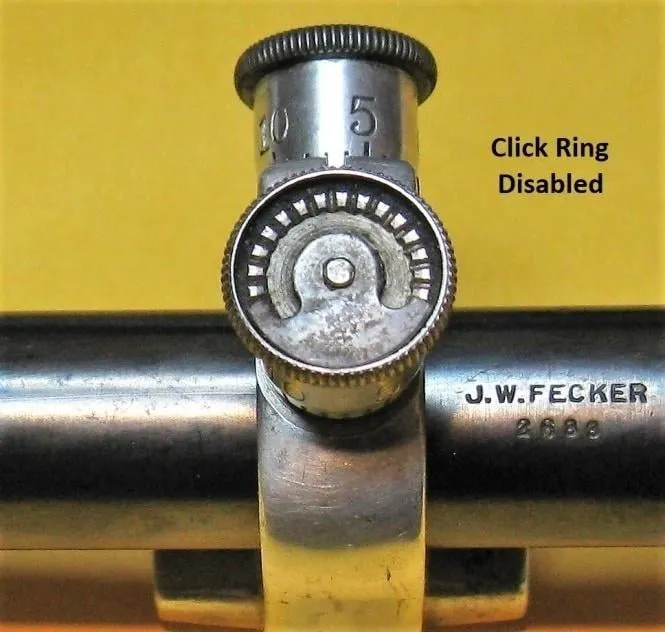
The 2nd and nonreversible but easy method is to wedge a thin flat screwdriver tip under the thin section of the click ring near the detent and lift it up with the help of needle-nose pliers until the thin section breaks off. It’s the easiest nonreversible method but results in an unattractive turret top. Since, during adjustments, the top of the turret continues to rotate under the remaining portions of the click ring, filling/covering the top with epoxy or similar adhesive is not an option. I have not tried it but epoxying or silver soldering an appropriate size washer or cap over the top of the remaining click ring may work.
Third Technique
The 3rd procedure also permanently disables the click feature and results in a nice looking top to the turrets.
To partially disassemble the turret and disable the click feature:
- Remove the turret assembly from the rear mount.
- The click flange must be separated from the click ring. First try wedging a flat screwdriver blade under the center section of the flange and pry it up. It should pop off, but if not use a Dremel or similar tool and a small grinding wheel, grind down the peened center joint sufficiently to remove the flared portion.
- After grinding insert a flat screwdriver blade under the click ring and pop it off the top of the turret. If it won’t easily separate from the click flange grind some more. The ring may break in the process but it’s no longer needed.
- With the two pieces separated, discard the click ring and remove the click flange from the turret.
- Grind off the top end of the section of the click flange that extended up the middle of the turret. Remove enough so that it no longer extends out the top of the turret. About 1/8” should be sufficient.
The following photo displays the parts of the turret after partial disassembly.
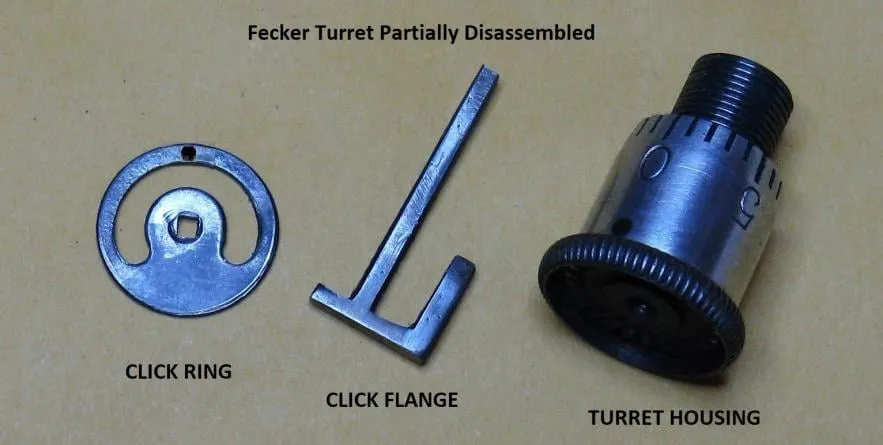
At this point you may think you’re finished, which is usually not the case. Since the click flange is no longer connected to and pulled up and down by the click ring the flange wing must be thinned sufficiently so it easily slides in the turret housing slot when the screw between the turrets is tightened sufficiently to apply correct tension on the turret threads. The additional tension is required since the turret position is no longer being held in place by the now removed click ring. Unless the thickness of the wing is reduced it will likely be “pinched” by the turret housing slot. A couple of techniques that work include clamping the flange in a vice and use a Dremel-type tool or holding the flange with vice grips and gently thin the wing using a bench grinder.
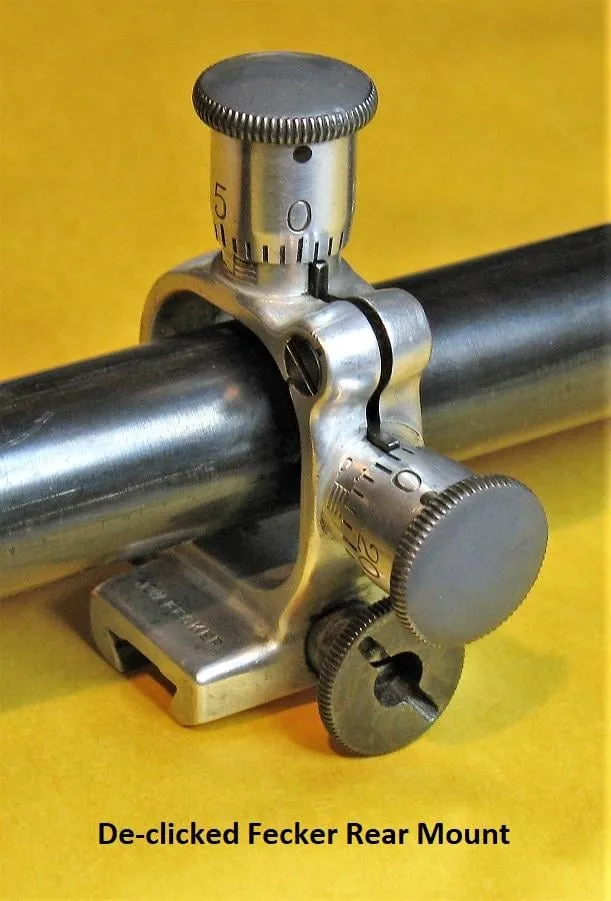
Once all is working properly, although not necessary for functionality, to make the top of the turrets attractive, after cleaning the top with solvent and brush to remove all the remaining oil and crud, cover the center hole with a small piece of tape and fill the top with epoxy to give it a finished look. J-B Weld epoxy works great and results in a very hard nice gray finish as seen in the following photo.
Lyman Mounts
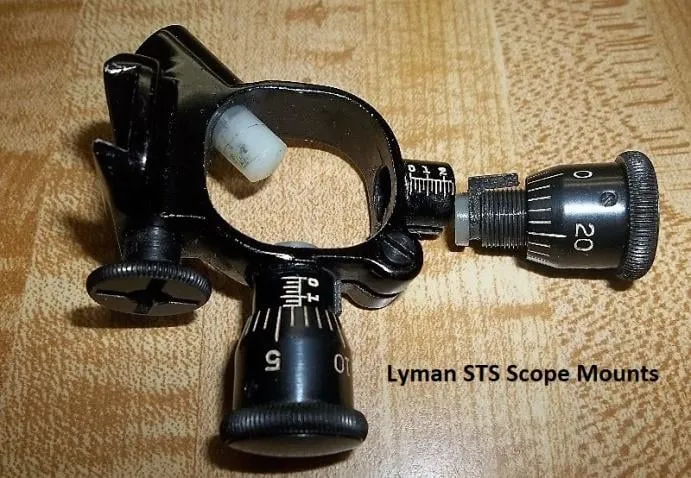
Lyman utilized several turret designs. Some came with the nylon or delrin-type pads contacting the scope tube as in the photo below. Others have metal pads and still others used a flat U-shaped flange like the Fecker’s. The design I’m somewhat familiar with is pictured below and is from a Lyman Super Targetspot (STS) scope. I’ve never had the opportunity to de-click a Lyman turret but have researched the subject and discussed it with others.
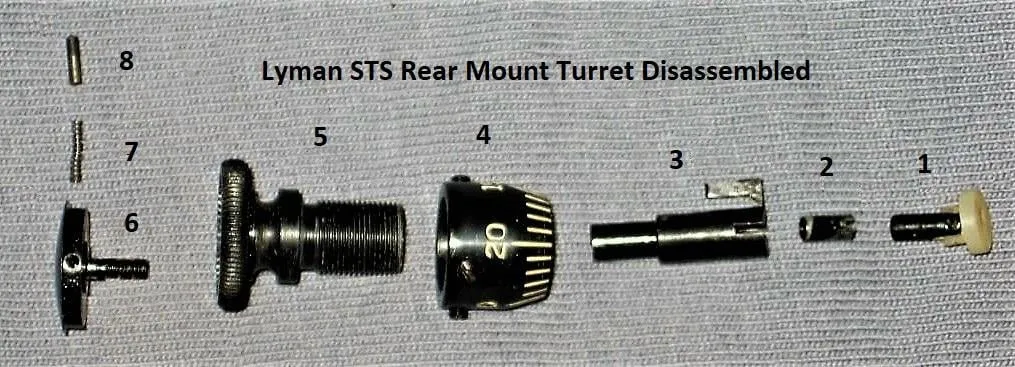
There are two ways to de-click the Lyman turret pictured. The easiest method, without disassembling the turret is to cut or grind off the flange wing from part #3 which will permanently de-click the turret. Removing the flange wing does not disable the turret functions as it would with Fecker mounts. The 2nd method, assuming the turret can be fully disassembled, is to remove the detent spring (part 7) and the detent plunger (part 8). Since the 2nd method does not modify any parts, the click function can be enabled at a later date. The potential problem with the 2nd method is the turret may be very hard to disassemble due to age, corrosion and/or hardened lube.
To start disassembly, slide part 1 out of part 3. The tip of a small screwdriver may be necessary to wedge out part 1. Part 2 has internal threads and screws onto part 6 holding the assembly together. Insert a small screwdriver into the center of part 3 to unscrew part 2. Once part 2 is removed, part 3 should come loose. To separate part 4 from part 5, loosen the 3 setscrews. To separate part 6 from part 5, use a knife blade to gently wedge them apart. The detent plunger and spring can then be removed. It may be necessary to use a dental pick or the tip of a small paper clip to remove the spring. Even after soaking the turret in various “break free” solutions and using localized heating some may be tough to take apart. By the way, after lubrication and reassembly, the three setscrews are used to reset (zero) the turret scales. For an excellent YouTube video detailing the disassembly go to: https://www.youtube.com/watch?v=jxE56dOapA0.
I hope this article has been informative and enables you to modify your vintage scope mounts to meet the NRA BPCRS and .22BPCRA requirements for silhouette competition.
Wishing you great shooting,
Wayne