Considerations & Math for External Adjustable Riflescopes
Contents
- Introduction
- Cost Considerations
- Scope Length & Mount Spacing
- Understanding Minutes-of-Angle (MOA)
- Mount Adjustment Range
- Mount Spacing
- Mounting a Scope for Long Range Creedmoor Matches
- Sliding Versus Rigid Scope Mounting
- Parallax Adjustment
- Hermetically Sealed & Nitrogen Filled
- Scope Magnification (Power), NRA BPCR & 22 BPCRA Scope Limits
Introduction
Having made a significant error in attempting to correct a member offering scope adjustment advice on one of the well-known firearm forums, I realized I needed to reeducate myself on the basic mathematics for installing and adjusting external adjustable scopes. At the very least document the information in one place for easy future access. Don’t let the title of this article scare you if math wasn’t one of your favorite subjects in school. The most complicated math I’ll touch on is a simple algebra equation. In addition, I thought this would be a good time to cover the decision process for those that may be considering an external adjustable scope. But before discussing the physical considerations and mathematics let’s touch on the typical cost of a scope and mounts.
By the way, it’s common for external adjustable scopes to be referred to as Wm Malcolm or Malcolm-style scopes after the well-known 19th century scope designer. I tend to use the terms interchangeably.
Cost Considerations
Prior to Montana Vintage Arms’ relatively recent introduction of their Winchester “B” Series Scope with No.2 mounts for $650 plus shipping, modern new versions of external adjustable high-quality scopes with mounts typically cost around $1,000 to $1,200. Used vintage scopes manufactured in the 1920’s to 1950’s can be found in good condition for around $450 to $600. Another lower cost option is a Leatherwood scope with either J.W. Fecker or Unertl non-click or de-clicked mounts. The mounts that come with the Leatherwood scope are not suitable for BPCR silhouette or long range competition. By the way, non-click mounts are required for NRA BPCR or 22 BPCRA sanctioned silhouette matches.
Mounts are usually provide with the scope or purchased from the same supplier. Although mounts used for hunting and recreational shooting must be of good quality and reliably hold the scope in place, adjustment repeatability is not a major requirement. The mounts are generally adjusted for one distance (typically 100 yards), for zero crosswinds and not moved. Black powder cartridge rifle (BPCR) silhouette competitors must contend with target distances from 200 meters to 500 meters under varying crosswinds and other dynamic conditions and Creedmoor match contenders are attempting to hit targets out to 1000 yards. The rear mount is adjusted many times throughout matches and adjustment resolution and repeatability are of the utmost importance. Therefore, the mounts, especially the rear mount, must be of the highest quality with excellent repeatability. Do not scrimp on the mounts. If purchased separately expect to pay as much for the mounts as for the scope.
Scope Length & Mount Spacing
One of the first likely questions is how long should the scope be? It’s certainly an aesthetic decision to some degree, i.e., what looks good on the rifle, but what a shooter may not realize is the length of the scope determines the spacing of the mounts, directly affecting the maximum adjustment amount and adjustment resolution.
Not only is mount spacing determined to some extent by the length of the scope but is also influenced by other factors. Mounts for the relatively long Malcolm-style scopes are generally spaced much wider than modern-style internal adjustable scopes. The most common accepted spacing for shorter external adjustable scopes is 7.2” center-to-center. Longer scopes require longer spacing for adequate support. As the scope length increases past 23” or so, and depending on the types of mount used, another commonly used spacing is 10.34”. For longer scopes, a spacing of approximately 17” may be necessary. The reason for the very specific spacing dimensions should become clearer during the following discussions.
One practical way of looking at the effect of mount spacing is to consider the scope tube as a lever that pivots on the front mount. As the distance from the rear adjustable mount to the front mount is increased, more adjustment is required by the rear mount to move the front (objective lens) of the scope and the crosshairs the same amount. And this applies to both the vertical (elevation) and horizontal (windage) adjustments. Grab a stick or ruler. Grasp one end with a hand which will be the adjustment point (equivalent to the rear adjustable mount). Now move a finger (the pivot point – equivalent to the front mount) of the other hand along the bottom of the ruler away from the adjustment point while moving the adjustment point up and down the same amount. As the pivot point is moved away from the adjustment point the front end of the ruler moves less and less. Hence the movement of the front (objective) lens of the scope is inversely proportional to the distance between the mounts.
Since the scope crosshairs are always in alignment with the image through the objective lens, it should be obvious from the above example that the total adjustable amount of the image of the crosshairs on the target (target adjustable amount) is also in inverse proportion to the spacing between the mounts. I.e., as the mount spacing is increased the overall target adjustable amount is proportionally reduced. As an example, doubling the mount spacing decreases the total target adjustable amount by a factor of 2 (cuts it in half), but it also increases the adjustable resolution by a factor of 2 (doubles it), tradeoffs that must be considered when determining the length of the scope and mount spacing. Therefore prior to purchasing a scope and mounts, it’s important to consider a couple of key factors.
- Scope length and mount spacing: A longer scope generally requires a wider spacing between front and rear mounts to properly support it which, as noted earlier, reduces the total target adjustable amount. But a shorter scope can run into problems if the shooting range is extensive. For example, attempting to use a 23” or shorter scope for Creedmoor competition out to 1000 yards may not work using short equal-height scope bases (blocks). An example of this situation is discussed further on.
- Bullet impact point change: The total rear mount adjustment range must be sufficient to correct for the amount of bullet drop or impact point change expected over the shortest to longest target range. This is typically measured in MOA (Minutes-Of-Angle) and leads to the following discussion.
Understanding Minutes-of-Angle (MOA)
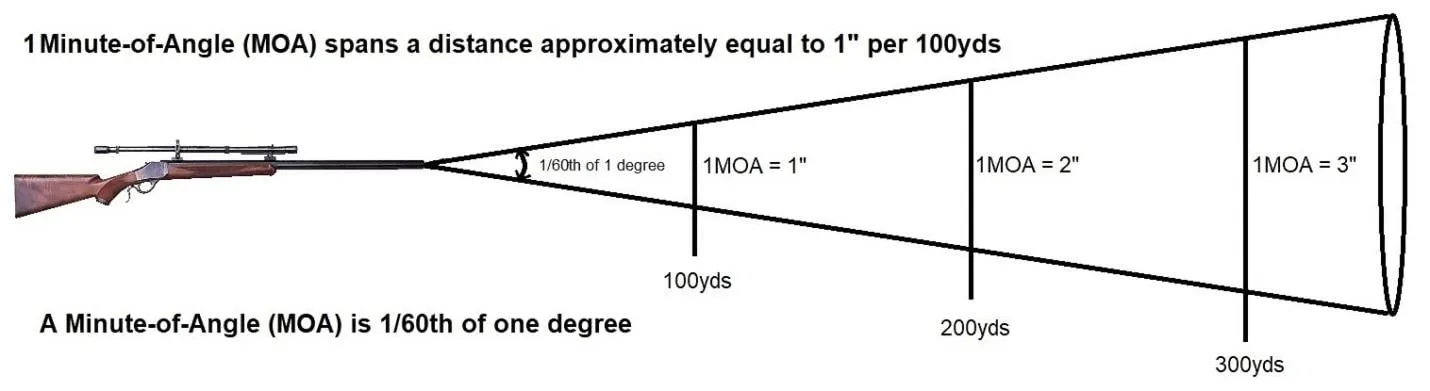
A circle contains 360 angular degrees. Each degree contains 60 angular minutes, also known as minutes-of-angle or MOA. Therefore a MOA is 1/60th of a degree. Although initially it may seem easier for some to think in terms of inches of bullet impact point change, experienced shooters and spotters discuss sight corrections in minutes-of-angle (MOA) to reduce the possibility of ambiguity. Also shooting aids such as spotting boards are laid out in MOAs to indicate the amount of sight adjustment required to correct for off-target hits. A simple trigonometry equation is used to determine that adjusting iron sights or a scope 1 MOA will result in a bullet impact point shift of 1.047” at 100 yards, hence the reason shooters use the rule-of-thumb of 1” at 100yds, 2” at 200yds and 3” at 300yds, etc. Some refer to the approximation as “shooters MOA” vs. “true MOA”. By the way, 1 MOA at 100 meters is 1.145”. Regardless, as depicted in the following illustration, think of MOA as a measurement that gets proportionally larger with distance.
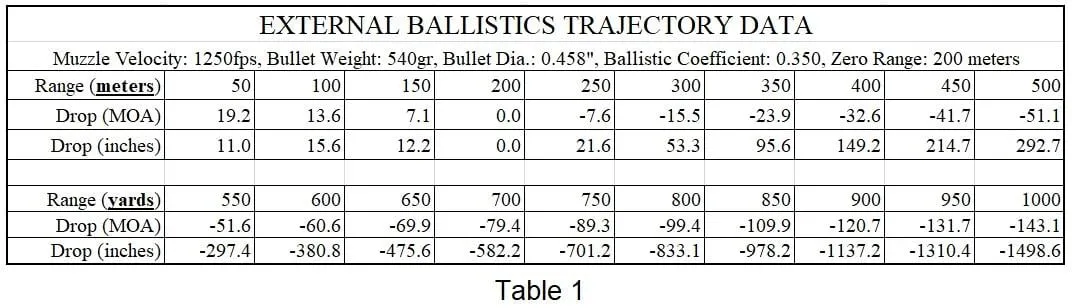
External ballistic calculators report bullet drop over different distances in inches and/or MOA. For an example let’s use a typical BPCR silhouette match situation: a .45 caliber rifle is sighted in to hit dead on at 200 meters with a 540gr bullet being fired at a muzzle velocity of 1250fps. Using a bullet ballistic coefficient (BC) of 0.350, Table 1 lists the results of a ballistic calculator out to 500 meters (for BPCR silhouette) and for longer distances out to 1,000 yards (for Creedmoor matches).
Note that if the 500 meter drop in inches is divided by the drop in MOA the result is 5.73”, 5 times the expected value of 1 MOA (1.145”) at 100 meters. The same applies for 1,000 yards. I.e., if the 1,000yd drop in inches is divided by the drop in MOA the result is 10.47”, 10 times the expected value of 1 MOA (1.047”) at 100 yards.
Mount Adjustment Range
So now, with a basic understanding of MOA, let’s further discuss the BPCR silhouette match example in Table 1 in which the maximum expected bullet drop or impact point change is 51.1 MOA from 200 meters to 500 meters. Therefore if the shooter plans to only use the scope for BPCR silhouette the rear scope mount should be designed with at least 60 MOA of adjustment. Fortunately most scope mounts have an adjustment range of 100 MOA or more to easily handle the above example with front and rear scope blocks of the same height. But if the shooter wanted to use the same setup for BPCR silhouette and for Creedmoor matches the mount options are somewhat limited and additional factors come into play and must be considered. More on this further on. By the way, keep in mind that the adjustment range also depends on the mount spacing as discussed in the earlier stick or ruler analogy.
Mount Spacing

To determine the best mount spacing considering the above factors brings us to some more mathematics, the sight adjustment formula which works for both iron sights and scopes. Rather than bore you or complicate this discussion with how it’s derived, the standard equation is: sight radius (spacing) = rear sight adjustment x distance to target ÷ bullet impact change. But since this article is only about scopes, I’ve replaced the term “sight” in the equation description with “mount” and also converted it to use MOA values. Therefore mount spacing (MS) is equal to the rear mount adjustment (RMA) multiplied by 3600 and divided by the maximum expected bullet impact point change in MOA, or “. MS and RMA values are in inches. 3600 is due to there being 3600” in 100yds, the bases for MOA as defined earlier. And since the formula is based on using MOA it works for any distance.

Using the earlier example, let’s assume the rear mount scale adjustable range is 0.200” and is marked off in increments of 0.001”. Using 60 MOA and 0.200” in the equation results in a mount spacing of 12.0” which will certainly work for a shorter scope but may not be ideal for other reasons discussed later. To determine the minimum bullet impact point adjustment amount, rearrange the equation as “. Using RMA of 0.001” and MS of 12.0”; the equation results in a minimum bullet impact point adjustment of 0.3 MOA. Therefore, each incremental adjustment of the rear mount moves the bullet impact point 0.3 MOA. Now let’s use the same RMA value of 0.001” but shorten the mount spacing to 7.2”, which was mentioned earlier as a standard mount spacing. The result is a minimum bullet impact point adjustment amount of 0.5 MOA, or 1 MOA if the rear mount is adjusted 0.002”. These are much easier values to remember and use and is the main reason for recommending very specific mount spacing’s for different scope lengths.
The previous discussion and calculation assumes the use of a “shooters MOA” (1.0” per 100yds) in the sight equation). If the “true MOA” value of 1.047” is used the mount spacing is 6.88”. I mentioned earlier that other commonly used mount spacing’s are 10.34” and 17”. These are recommended by Montana Vintage Arms for their longer scopes and are roughly based on using the “true MOA” of 1.047”. Using the sight equation the more accurate values are 10.32” for a rear sight adjustment of 0.003”/true MOA and 17.2” for a sight adjustment of 0.005”/true MOA.
The above examples discuss setting up the scope and mounts to handle the elevation adjustments necessary over the expected target ranges. Windage adjustment is generally not a major consideration when mounting a scope, assuming the scope body is properly aligned with the rifle barrel. But the same equation applies. Adjusting the rear mount 0.002” left or right with a mount spacing of 7.2” would move the bullet impact point exactly 1 MOA in either direction.
Mounting a Scope for Long Range Creedmoor Matches
Montana Vintage Arms’ website mentions that their long range Creedmoor Mount is not recommended for a 23” scope on a 30” or longer barrel; further stating that at the adjustment top-of-travel the scope will be pointed at the barrel, thus obstructing the view. So if you’re planning on using an externally adjustable scope out to Creedmoor ranges (800yds to 1,000yds), be aware of potential problems when attempting to use a short scope. The following example will highlight the problem.

Let’s consider an example of a shooter that has a short scope with a mount spacing of 7.2” on a .45-70 rifle. He’s been using it for BPCR silhouette matches in which the shortest distance is 200 meters. He’d like to use the same rifle and scope setup for Creedmoor competition out to 1,000yds with the same loads in the earlier example in Table 1. If the rifle is sighted to hit dead on at 200 meters, the ballistic calculator indicates an additional bullet drop of 143.1 MOA at 1,000 yards. Using the scope adjustment equation rearranged as “ with a mount spacing (MS) of 7.2”, the rear mount would have to be adjusted up an additional 0.29”. Knowing from the earlier example that 0.002” of rear sight adjustment is equal to 1 MOA, another way to verify the necessary sight adjustment is to multiply 143.1 MOA by 0.002” per MOA which is approximately 0.29”. Assuming the rear mount has sufficient adjustment range, many do not, a short scope around 23” or shorter will not work in this situation with the relatively short front and rear scope blocks typically used. The combination of the short scope length and the tilt angle (to the barrel) necessary for 1,000yds shooting would result in the scope image being blurred by the muzzle end of the barrel.
To confirm the problem I used a J.W. Fecker 20.5” long scope with 7.2” mount spacing on a Browning BPC rifle with a 30” barrel using standard front and rear scope blocks of the same height. The front sight had been removed. The rear scope mount was adjusted to hit dead on at 200 meters. After removing the rear block screws, shims were inserted under the block. The 1st detectable blurring of the image was with shims totaling 0.21”. With shims totaling 0.29” significant blurring was evident and would be worse with a longer barrel. Therefore higher than normal scope blocks would be necessary to further separate the scope from the barrel. Another solution is to use a longer scope in order to position the front objective lens close to the muzzle. With either of the noted solutions, if the shooter wished to use the same setup for both BPCR silhouette and Creedmoor distances, a rear mount with extended adjustment range or switching out different height rear scope blocks would be necessary.
Sliding Versus Rigid Scope Mounting
Vintage and modern copies of externally adjustable vintage scopes are generally designed to slide in the mounts to reduce the effects of recoil on the optics, internal components and mounts. After each shot the scope is manually or automatically returned to “battery” (the firing position).
For hunting situations the preferred setup is a rigid or fixed mounted scope with a long eye relief. With the adrenalin rush and the excitement of the hunt, there’s a good chance the hunter will forget or not have time to slide the scope back to battery if a quick follow up shot is necessary. If a sliding scope setup is used for hunting, one option is to install a coil spring assembly around the scope body to automatically return the scope to battery after each shot. The coil spring assembly is a common feature found on vintage externally adjustable scopes but is not allowed in NRA BPCR or 22 BPCRA sanctioned silhouette matches.
A hundred rounds or more can be fired in matches and the competitor likely fires many more in preparation. Although some have successfully used rigidly mounted scopes for competition, most prefer a sliding mounting system utilizing a Pope-style rib (see note below) or similar setup, especially for rifles chambered for cartridges such as .45-90 or larger. But even with a smaller chambering why subject the scope to the full recoil when one with a Pope-style rib or other attachments are available to allow the scope to slide? With each shot the scope slides forward out of “battery”, thus reducing the stress on the scope and mounts during long strings of shooting. Since a return coil-spring assembly is not an option due to being too large in diameter per sanctioned match rules, the shooter must remember to manually return the scope to battery after each shot.
Note - A Pope-style rib is a raised rib typically located on the front, top or bottom, portion of the scope. It extends a few inches along the scope and allows the scope to slide in the mounts due to recoil, but ensures the scope does not rotate in the mounts by the use of a slot in the front mount designed to accommodate the rib.
Parallax Adjustment
Parallax adjustment (see definitions below) is another feature to consider. Some high-quality scope suppliers offer it, others may not. Those that do not provide parallax adjustment suggest that parallax is not a factor due to the construction and relatively low power (generally 8-power or less) of the scopes. Their justification is that parallax error is minimal with the small diameter and long focal length lenses used in external adjustable scopes and the resulting small exit pupil diameters (see definitions below). Some competitors are convinced that parallax adjustment offers an advantage and the setting is changed for each target distance. But most BPCR silhouette shooters with parallax adjustable scopes set the parallax for one target distance (e.g., turkey silhouettes at 385 meters) and don’t change it during silhouette matches, further justifying the decision by a scope supplier not to offer parallax adjustment. If the scope is being used for silhouette and Creedmoor competition, adjustable parallax should be considered a requirement.
Notes:
Parallax: The displacement or difference in the apparent position of an object viewed along two different lines of sight. Without parallax adjustment or if the parallax is not adjusted properly, depending on the distance the scope is focused, the crosshairs will move slightly in relationship to the target in the sight image when the user moves his/her head.
Exit pupil diameter: The diameter of the image projected on the eye pupil. It can be roughly calculated by dividing the diameter of the objective lens by the power of the scope. The pupil diameter size of a human eye is typically 5 to 9mm for young individuals, and decreases slowly with age.
Hermetically Sealed & Nitrogen Filled
Due to wide temperature variations and the possibility of wet weather, a hunting scope should be hermetically sealed and nitrogen-filled if possible. Depending on the design and other features offered such as parallax adjustment, waterproofing an externally adjustable scope can increase the cost of construction and is generally not required for most competitive conditions. Leatherwood is the only brand of externally adjustable scopes I’m aware of that are sealed and filled with nitrogen, and parallax adjustment is not available.
Scope Magnification (Power), NRA BPCR & 22 BPCRA Scope Limits
This article would not be complete without a discussion on scope magnification and the additional specifications imposed by the NRA and 22 Black Powder Cartridge Rifle Association (22 BPCRA) for “sanctioned” matches. But first let me say that I’m strictly a big bore BPCR and 22 BPCRA silhouette shooter. As of this writing I’ve launched well over 8,000 big bore and many more .22LR bullets down range. Having never shot in BP Target Rifle or Creedmoor matches I can’t speak for the scope power requirements of either sport but after discussing it with several shooters the requirements are the same.
The typical scopes used in big bore BPCR or 22 BPCRA silhouette have 5X (5 power) to 10X (10 power) magnification. I have used 6X, 8X and 10X scopes and my preference is 10X when shooting at the big bore turkey (385 meters) and ram (500 meter) silhouettes. But 10X is a little strong for off-hand shooting at the 200 meter chicken silhouettes for which 5X or 6X would be a better choice. By strong I’m referring to the movement of the crosshairs on the target which is magnified by the scope power. Therefore 8X is a good compromise.
As noted below, neither the NRA nor the 22 BPCRA specifies the scope power or length but the current NRA rules include the following stipulations:
- Maximum rifle weight with scope is 15 pounds.
- No length or power limitation. Scope tube body to be ¾” or less in diameter and any ocular or objective lenses, adjusting or assembly rings to be less than 1” in diameter.
- No internal adjustments for windage or elevation.
- Mounts are to be of a traditional style of the period, and contain the windage and elevation adjustments for the scope in either, or both, the front or rear mounts. No click adjustments in the mount. Either dove tail mounting or scope block mounting is allowed.
The current NRA Rifle Silhouette Rules handbook further states that, original scope mounts of either the Cataract or Malcolm style or variations thereof, or replicas or derivatives of either style, are allowed provided the replica or derivative conforms to the criteria of rule 4) above.
The same rules apply for 22 BPCRA competition with the exception that the ocular or objective lens diameter must be 1” or less measured from the inside of the lens opening. And the outside diameters of the adjusting or assembly rings are not included in the measurements.
For much more information on currently available scopes and additional details, see my article titled, Searching for a Cost Effective BPCR Scope Solution for Silhouette Competition. Hopefully the above discussion has provided some insight into the features and selection criteria when considering or purchasing an external adjustable riflescope.
Wishing you great shooting.
Wayne