Comparison of Remington, Winchester & Starline .45-70 Brass
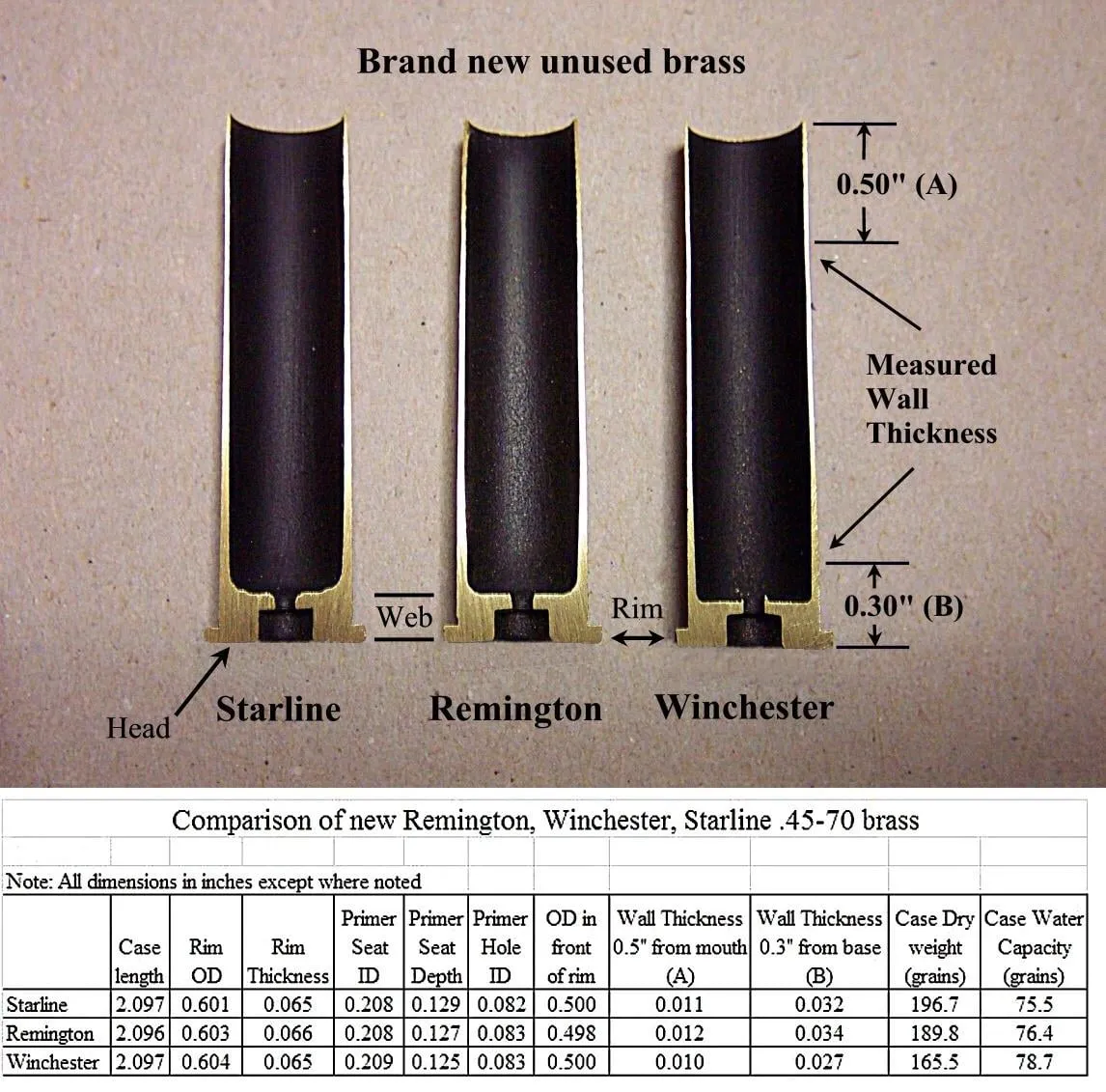
While attending an annual NRA Meeting & Trade Show, I dropped by the Starline booth and picked up a couple of samples of Starline .45-70 brass. Starline has a reputation of making high-quality brass which I found is cheaper than either Remington or Winchester, at least from the sources I buy from. Since I also have some new Remington and Winchester cases on hand I decided to section a couple of new cases of each brand and make some measurements.
Starline is very nice looking brass. The primer flash holes are uniform with no rough edges inside which are evident in Remington and especially Winchester. Since, to date, I’ve predominantly use Remington, deburring the flash holes is a normal step in my new brass preparations, which may not be necessary for Starline. Measuring the primer pockets depth, the Starline averaged 0.129”, Remington 0.127” and Winchester 0.125”. BTW, Remington rim thickness averaged 0.066”; Starline averaged 0.065” as did the Winchester. The next step was to check out the neck wall thicknesses. I used 0.5” as the neck length measurement limitation since I never seat bullets any deeper.
Using a tube micrometer around the perimeter of the neck area, the Starline average thickness varied from 0.010” to 0.0105”, for an overall variation of 0.0005”, which is about half the variation I have found in Remington or Winchester brass. Measuring from the lip to 0.5” down into the case, the Starline and Winchester wall thickness do not vary or taper. Remington walls tapered from the case lip to the rim. At 0.5” into the case the wall is approximately 0.002” thicker than at the lip.
One can debate that tapered case neck walls are a positive or negative depending on the dimensions of the rifle chamber. The Browning .40-65 BPCR chamber length from breechblock face to transition step averages 2.125” and it has a well defined (constant diameter) 0.5” long neck. Therefore, striving for uniform bullet neck tension, case necks should have no taper, so I outside-neck-turn Remington cases to remove the taper. When fire-formed the necks will conform to the chamber dimensions, resulting in a constant inside diameter (no taper) and uniform neck tension. Knowing what I know now, if I were purchasing new brass for my Browning .40-65, I’d start with Starline .40-65 brass and stretch it 0.025” using Tim Smith-Lyon’s .40 cal. case stretcher (sold by Tim or Buffalo Arms). Another option is to use Starline .45-70, then reform and trim it to .40-65 in order to match the Browning chamber length. Since the Starline neck does not taper, neck-turning is not necessary nor recommended.
The chamber in the Browning .45-70 BPCR from breechblock to transition step averages 2.118” and has a constant taper from rim to the transition step. Therefore, an ideal case should have a tapered wall that matches the chamber taper, resulting in fire-formed cases with a constant neck inside diameter (no taper) and uniform neck tension. Hence, Remington brass, stretched 0.015” to 0.020” with Tim’s .45 cal. stretcher would be the ideal choice.
Based on the photo and dimensions below you can see why it’s well known that Winchester carries more capacity. Note the Winchester thinner wall thickness and the relatively sharp inside corner radius from the web to the walls, which is also the reason Remington has more capacity than Starline although the Remington walls are slightly thicker. By the way, the web is defined as the thick portion of the case that surrounds the primer pocket and flash hole. The head is the end of the cartridge case in which the primer is inserted and the surface upon which the headstamp identification is imprinted.
As noted earlier, I always deburr the primer holes in my Remington brass to ensure even distribution of the primer flame. Based on what I found when sectioning the cases, I definitely recommend deburring Winchester cases. I checked several Winchester new cases and the burrs in all were significantly worse than Remington. Notice the ridge sticking up in the primer hole in the Winchester case. It extended 3/4 of the way around the perimeter of the hole. Due to the uniform smooth edge of the primer hole, Starline may not need deburring at all.
Wishing you great shooting,
Wayne