Case Stretching & Separating in Black Powder Cartridge Rifles
The photo below is an example of a split Winchester .40-65 case next to an unfired case of the same original length. Adjusting for the gap in the photo, the case was still stretched another ¼” when the neck section was pulled into the throat and part of the bore. Clearly visible is the chamber to throat transition step, the approximately .100” of freebore, the leade and rifling impressions. The shooter had two cases separate from the same lot of reloads. Both separated at the same location. By the way, the case had been reformed from original Winchester .45-70 and trimmed to a length of 2.1”, about .025” less than the chamber length, so the length was not a factor in the separation.
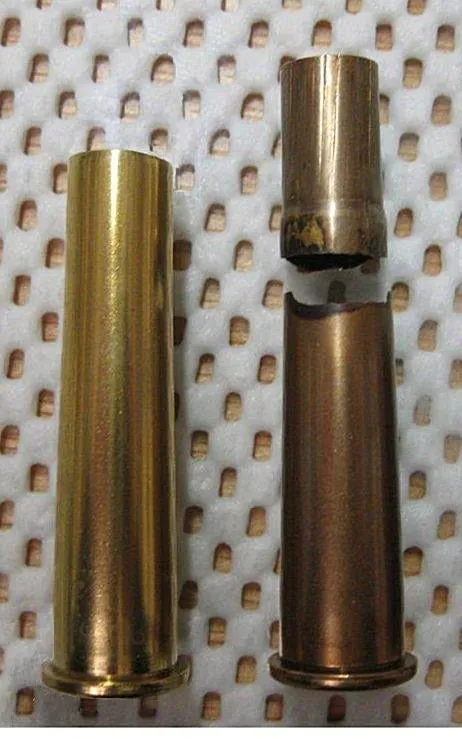
The shooter indicated he hastily cleaned the chamber & bore prior to the shots and may have not cleaned all the moisture out. Plus, he was using a blow tube without the “O” ring seal that it was designed for. But he contributes most of the reason for the separation to using a case with excessive neck tension due to lip peening when the cases were cleaned with stainless steel pins. See to my article titled, Case Cleaning - Ultrasonic Vs Tumbler with Ceramic Media, Tumbler with Stainless Steel Pins. He said “I normally do not use neck tension as I slip fit my bullets (custom made for my bores) into fire-formed cases. The cases that separated were fire-formed, but because of the SS media the neck or should I say the mouth was extremely tight to the point I had to use my press to seat the bullets also shaving some lead at the mouth of the cases. I should have stopped at that point & tried to evaluate what was going on but it had been some time since I loaded for the .40-65 so I brushed it off.”
I’m betting it was a combination of excessive chamber moisture and excessive neck tension that led to the separations. The shooter plans on using ceramic media to clean cases and a much better fitting blow tube from now on, and no doubt will be paying much closer attention to his reloading process. It has also been suggested that a contributing factor may have been work hardening of the case from many firings, therefore the case necks may need annealing. For more details on annealing, see my article titled, Annealing BPCR Case Necks.
There are several factors that determine if a cartridge case will stretch and/or completely separate when fired in a BPCR. But before jumping into a discussion on case stretching, a few terms need to be defined. One is headspace, defined by the Sporting Arms and Ammunition Manufacturers Institute (SAAMI) as “The distance from the face of the closed breech of a firearm to the surface in the chamber on which the cartridge case rests”. I prefer the definition found in Speer’s reloading manual, “The distance from the surface of the barrel or chamber that positions the cartridge and prevents its further forward movement into the chamber, to the face of the bolt or breechblock”. Therefore, in full agreement with both definitions, the headspace of a rimmed cartridge rifle is measured from the face of the bolt or breechblock to the bottom of the “rim seat” which stops the cartridge from moving forward.
Another term is head clearance which SAAMI describes as, “The distance between the head of a fully seated cartridge or shell and the face of the breech bolt when the action is in the closed position…”. Although distinctly different as defined above, headspace and head clearance are commonly confused with each other. Firearm manufactures try to keep the head clearance as small as possible, but some clearance is needed to allow for variances is case rim thickness.
Depending on how a cartridge is loaded, there are many variables that affect how it reacts under firing conditions. Generally, when a rimmed cartridge is fired the firing pin strikes the fully seated primer and shoves the cartridge forward until the rim makes firm contact with the rim seat. When the primer ignites, the force from the primer alone is more than sufficient to drive it back out of the pocket until it contacts the breechblock. As the powder ignites and pressure builds up, the case will expand and should “lock” against the chamber walls assuming the chamber is not wet with water or lubricant, resulting in permanent primer setback unless the case stretches back and reseats the primer flush with the rear of the case head. If case stretch is negligible, then the amount of primer “setback” will be equal to the head clearance. If the case does stretch back and flush seats the primer than the amount of case stretching is also equal to the head clearance. If you’re wondering if cases are stretching enough to reseat the primer, run the following test. Fire an unloaded case with only a primer. If the primer is backing slightly out of the case but is flush after firing normal full power loads, then it’s an indication that the cases are stretching slightly or possibly sliding back. If they are stretching, they may return to the original length, or even shorten some after firing, especially if they were full-length resized.
There are several factors that contribute to case stretching, some much more than others. Two important ones are chamber pressure and case shape, but there are others including but not limited to: head clearance amount, case length versus chamber length, over powder wad-to-case-wall friction, bullet-to-case-neck friction resulting from neck tension, dirty or rough inside case walls, powder column friction, bullet crimping and necks that are too soft due to excessive annealing. In addition, anything that prevents the case from sufficiently expanding and gripping the chamber wall can result in case stretching. Some examples are: brass tensile strength, hard brass or brass that is work hardening due to multiple firings and resizing, chamber wall lubrication (see note below), and even breech seating (see note below).
Notes:
-
If the chamber wall is over lubricated from oils or with excess moisture from an improperly designed blow tube, cases can stretch both backward and forward; more on this later. Wiping the bore between shots and not using a “drying mop” or other techniques to remove moisture from the chamber can result in separated cases. I wipe between shots and, to save time, have modified the wiping rod to include a slot for the drying patch to fully enter and dry the chamber as the wiping patch is pushed out of the bore. The drying patch is replaced between relays.
-
Breech seating is a loading technique whereby the bullet is separately loaded into the chamber/throat followed by loading a case full of powder. Since the bullet is not in the case neck, when fired there may not be sufficient back pressure to expand the case to tightly grip the chamber wall, resulting in the powder column and wad friction trying to stretch the case forward.
I’ll start with case stretching in BPCR rifles chambered for “bottleneck” ammo - ammo in which the cartridge case has a well-defined shoulder. BPCR bottleneck cartridges typically use “rimmed cases” which headspace on the front of the rim. When fired, high pressures will try to force the case body to stretch in two directions: backward until the rim contacts the breechblock and forward until the shoulder contacts and fully forms into the chamber shoulder. Depending on how well the case dimensions match the chamber dimensions, the front portion of the case can be stretched forward by the pressure from the forward moving unburned powder column hitting the shoulder, which is the main reason BPCR bottleneck cases tend to stretch more than BPCR straight wall cases. Some stretching can also take place in the neck due to “bullet pull” or friction between the case, wad and/or bullet caused by neck tension.
Bottleneck cases can separate in the neck region but it’s more likely that the case will separate in front of the thick web forward of the rim, commonly referred to as case head separation, after being fired and full-length resized several times. Since the case stretches some when fired, full-length resizing is generally used to “set back” the shoulder to the correct length resulting in the overall case length being slightly long, and trimming is required. The stretching and resizing process forces material from the case walls to migrate forward. Eventually the wall in front of the web is too thin and separates as the head (rim and web) is driven back by chamber pressure.
So what about case stretching in straight wall ammo? Case head separation can occur but it’s less likely than in bottleneck cases. Cartridges with straight-wall rimmed cases also headspace on the front of the case rim. With no shoulder there’s less forward pressure on the case walls and less stretching forces on the case, again assuming the chamber wall is not excessively lubricated and the inside walls of the case was clean prior to loading. Properly cleaned BPCR straight wall cases may stretch slightly but generally it won’t be much unless the cases are relatively long, bringing other factors mentioned earlier into play. For example, assuming similar loading techniques, a .45-110 or .45-120 case is more likely to stretch than is a .45-70 or .40-65 case. The stretching forces on the case will increase due to the added friction between the longer case and longer powder column, especially if the powder is tightly compressed.
Shorter cases can normally be full-length resized, reloaded and fired many times before trimming is required. But too much moisture or lubricant on the chamber wall can cause a problem. It’s somewhat rare but as displayed in the photo above, if the chamber wall is highly lubricated or has excess moisture, straight wall cases have been known to completely separate with little or no prior visual warnings. Dirty or rough inside case walls can exacerbate the problem and LDPE (poly) wads are known to expand in diameter under pressure and grip the neck wall much tighter than paper or vegetable fiber wads.
Consider the following situation. The inside of the case is corroded or has not been properly cleaned of powder fouling. A tight-fitting poly wad was used to separate the powder from the bullet. Once the wad was inserted a compression die was used to highly compress the powder. The cartridge case has a cannelure and the bullet is crimped in place. The rifle chamber wall has been cleaned and oiled and the shooter forgot to remove most of the lube with a dry patch; or excess moisture has accumulated due to the aggressive use of a poorly fitting blow tube or the chamber was not dried after wiping. As the cartridge fires and chamber pressure increases, the forward portion of the yet to be ignited irregular-shaped hard black powder granules are forced against and tightly grip the dirty case wall. Due to increased compression the already tight poly wad tries to expand further and tightly grips the dirty case wall. The bullet fully expands before it starts to move forward, forcing the case neck into full contact with the chamber and increasing neck tension. The bullet crimp adds to the friction inside the case neck and mouth. Under these conditions it should not come as a surprise that the case stretches or the case neck separates at the cannelure and is pulled into the bore by the bullet.
Cases with cannelures are more prone to separating due to the slight thinning of the case wall when the cannelure was formed, but cannelures are not required for case separation. Although the above is likely a worse-case scenario, separation can result if only some of the noted conditions are present and the case may have to be fired several times before it separates.
With straight wall cases, because no shoulder exists to serve as a stop, if the case separates the front portion can be driven forward with the bullet or pulled forward into the bore by the wad and/or bullet as displayed in the photo above. I’ve heard of situations where the front section of the case completely exited the bore along with the bullet. It’s a common practice to purchase or make blow tubes for BPC rifles that use a cartridge case at the end of the tube. When doing so ensure the case closely fits the rifle chamber to minimize excess moisture accumulating in the chamber. More on this and how to construct a blow tube is discussed in my article titled Making a Blow Tube for BPCR Shooting. Although I’ve never experienced a completely separated straight wall cartridge case, I have had a couple show signs of thinning in the middle. At the time I was using a blow tube with a full length resized case.
Since stretching is generally insignificant in properly cleaned and loaded straight wall cases of the most popular cartridges, neck-only case resizing does not provide quite the same level of benefits that it does for bottleneck cases. The main reason the technique is used with straight wall cases is to obtain the correct case-to-bullet neck tension while ensuring the brass uniformly matches the chamber dimensions as close as possible for maximum bullet alignment. Neck-only sizing also minimizes resizing stresses on the rest of the brass, therefore reducing work hardening of the brass and extending the case life. For additional information on resizing go to the article titled, To Resize or Not to Resize.
Wishing you great shooting,
Wayne