Bullet Casting Lesson Relearned
Anyone with even a minimal knowledge of bullet casting is likely aware that both antimony and tin are commonly mixed with lead to form casting alloys. Although the addition of tin does increase the alloy hardness, its main function is to improve the “castability” (sometimes referred to as fluidity, flowability, or pourability) of the molten metal. Concentration of 1% to 2% tin improves the alloy flow characteristics and allows it to fill all corners and grooves of the mould. Tin is expensive, so “smokeless” bullet caster generally use no more than necessary and utilize antimony, a more efficient hardening additive.
Some concentrations of antimony, such as found in wheel weights for example, may work OK with the addition of tin for casting black powder cartridge rifle (BPCR) bullets. But adding significant amounts of antimony has a negative effect on bullet obturation (bumping up in diameter when fired), which is necessary to seal the bore, minimizing gas blow-by and lead vaporization. Therefore, if somewhat harder bullets are required, BPCR shooters generally increase the concentration of tin. Common BPCR bullet alloys are: 30:1 (30 parts lead to one part tin), 25:1, 20:1 and 16:1.
For several years I’ve been casting bullets with very aerodynamic nose designs commonly referred to as “money bullets”, a term coined by the late Dan Theodore, a well-known and respected BPCR bullet designer. I.e., shooting a money bullet will increase your chances of winning or getting you “in the money” so to speak. Buffalo Arms Co. (BACO) supplies many moulds for bullets of different calibers and weights based on Dan’s money-bullet designs. Although BACO designs their mould dimensions based on using 20:1 alloy, due to the relatively long streamline nose profile I prefer 16:1 alloy to ensure the nose does not experience setback (nose expanding and shortening) along the axis of the bullet when fired.
Nose setback will decrease the ballistic coefficient of the bullet and can affect accuracy when shooting in less-than-ideal conditions at longer distances. When using the BACO single-cavity .40 caliber money-bullet moulds, I’d determined 16:1 alloy casting temperature should be approximately 760 to 765 degrees to fully fill out the mould. Being naturally an inquisitive person, I decided to try a money-bullet load that had proven to be very accurate but change the bullet alloy from 16:1 to 20:1 alloy. If the accuracy fell off it could be a sign of nose setback.
Using 20:1 alloy and a casting temperature of 765 degrees resulted in several of the bases not fully filling out, all at the same location on the perimeter of the base. A few also displayed a wrinkle or two in the nose section, which is not a significant problem. See the following photo.
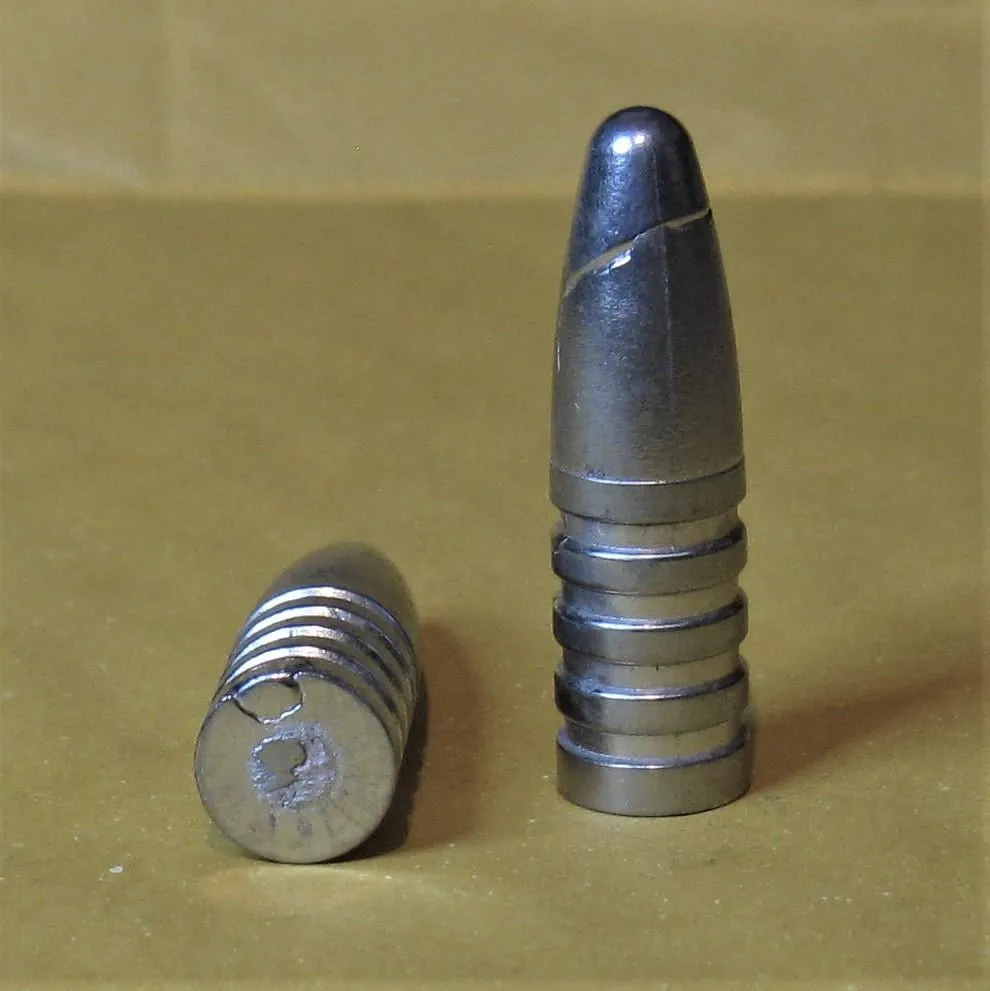
It’s well-know that a slightly damage or deformed nose will have minimal or no effect on accuracy, not so for base deformities which are a major concern. Even small voids or imperfections around the perimeter of the base will affect accuracy, allowing hot gases to blow by, further cutting the edge of the bullet base (gas cutting) and vaporizing lead onto the bore, resulting in decreased accuracy. Using wads of the correct diameter between the powder and bullet can mitigate the effects of the damage as long as the bullet is in the bore, but base imperfections can affect in-flight stability. Therefore, it’s best to discard bullets with imperfect bases. Thinking the problem was my ladle-to-mould pouring technique, several ways to mate the ladle to the mould was tried along with varying the pouring rate. Eventually a sufficient number of good bullets were cast but many were discarded during the session. At this point I was scratching my head and hoping the problem would go away when using a different mould, but alas that did not happen.
Changing to another single-cavity BACO money-bullet mould with 20:1 alloy heated to the same 765 degree did not eliminate the voids. In fact, they were even worse. Getting quite frustrated I took a break and grabbed a “cold one” while staring at the pot and thinking about the problem. Then “the light came on”. When casting with various bullet alloys and different moulds it’s a common technique to increase the alloy temperature until there are no voids in the bullet base and/or wrinkles in the nose. And as the percentage of tin is decreased the alloy temperature must be raised accordingly. As noted earlier, adding tin increases the alloy flow characteristics. Therefore, decreasing the tin content from 16:1 to 20:1 has the opposite effect, requiring additional heat to compensate. Being a little dense and having been casting for years using 16:1 alloy, I forgot the above fundamentals. After slowly increasing the temperature, which is easy with the digital temperature-controlled RCBS Easy Melt pot, the bases filled out nicely and the nose wrinkles disappeared at 783 degrees. Lesson relearned.
During a later casting session, I ran into a similar problem after casting a hundred bullets or so. I eventually found that cleaning out the inside of the ladle spout with a tapered flat tip screwdriver or similar tool eliminated the edge voids. I believe that crud building up in the spout results in turbulence in the lead flowing into the mould, creating edge voids.
Wishing you great shooting,
Wayne