Browning & Winchester “Modern” 1885 Low Wall Rifle History (And Options for 22 BPCRA)
I authored and published a book titled, Browning Model 1885 Black Powder Cartridge Rifle which included some information on the later Winchester BPCR versions. Therefore many incorrectly assume that I’m an expert on all versions of the modern Miroku-manufactured Browning and Winchester 1885 rifles, including the High Wall and Low Wall models. The latest (3rd Edition) of the book is still being sold and I’m very active in big bore BPCR and 22 BPCRA silhouette competitions. Hence I continue to get questions about the rifles, some which I’ve had to plead ignorance, especially concerning the Low Wall models. Since the Low Wall versions are not mentioned in my book, I had not research the rifle’s history.
So as not to continue showing my lack of knowledge and disappoint those with questions, I felt compelled to “dig into” the history of the modern Low Wall versions. By modern I’m referring to rifles designed by Browning but manufactured by the Japanese company Miroku for sale by Browning and Winchester, see the note below. I stress the word “modern” here since the original Winchester 1885 Low Wall was introduced in May 1886 and discontinued in March 1919. If you are interested in a detailed history of the original Winchester Single-Shot rifles there are two excellent books authored by John Campbell titled The Winchester Single Shot and the Winchester Single-Shot Volume II.
Note: In August 2006 US Repeating Arms, a division of the Olin Corporation, announced a long-term licensing agreement with Browning for the manufacture and distribution of Winchester-brand rifles and shotguns. The company had been plagued by slumping sales for several years and, prior to the licensing agreement, had announced the closing of their 140 year old firearm factory based in New Haven, CT. In 2007 US Repeating Arms changed their name to Winchester Repeating Arms. Winchester and Browning are now located in the same facility in Morgan, UT.
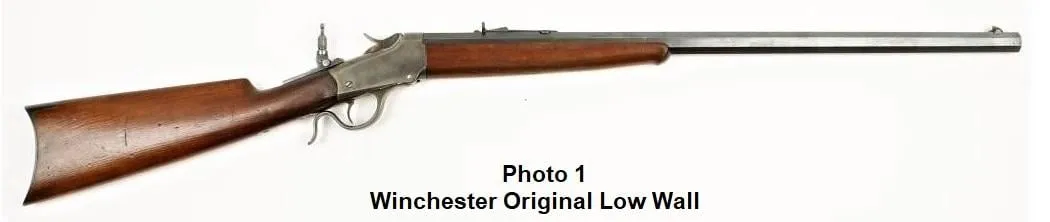
Although the receiver and profile of the modern Browning and Winchester rifles appears to be very close to the original 19th and early 20th century Winchester’s, Photo 1 is an example, the internal action components are not the same. Browning describes the modern action design used in both the 1885 High Wall and Low Wall rifles as an “improved” version of the action used in their prior Model 78 (B-78) High Wall single-shot rifles. The redesigned incorporated a couple of effective safety features and a limited-range trigger-pull adjustment that complicated the action with additional parts. I’m betting that the legal department influenced the design in order to minimize the possibility of product liability issues. Another change is a forearm hanger mounted directly to the front of the receiver for the purpose of “free-floating” the barrel from the forearm.
Uncovering specific details about the modern Browning and Winchester versions was a lot harder than I expected. Neither Browning nor Winchester maintains a detailed timeline of rifle models on their websites and do not make a policy of releasing the quantities manufactured with the possible exception of limited runs or limited editions. And searching the Internet for information was a frustrating effort. Fortunately I had archived files from an old Shooters.com black powder forum which surprisingly included a thread on when the modern Winchester’s Low Wall .22LR was first available. I also had a few Winchester catalogs from the same dates.
By the way, since many shooters prefer to use tang-mounted iron sights, the following details mention if/when versions of the rifle with an extended tang, drilled and tapped for a tang sight, were available.
The Modern Browning Low Wall
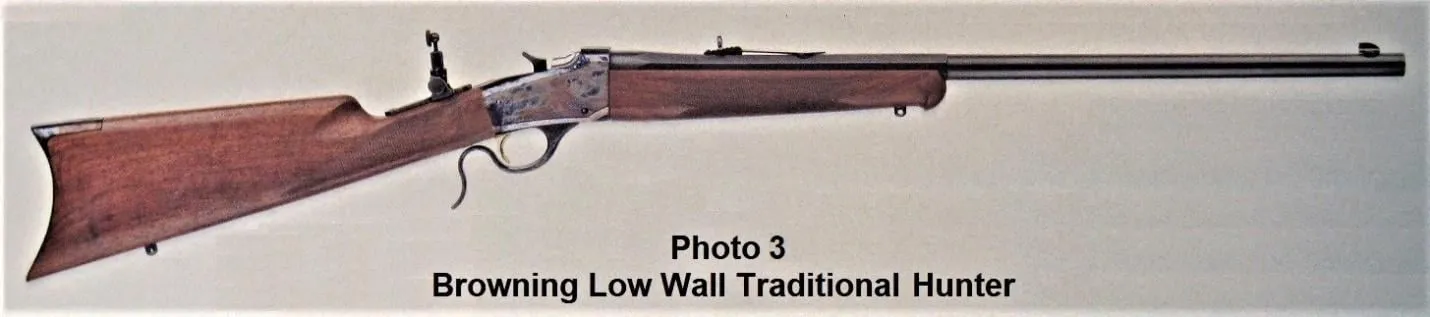
Referred to as the Model 1885 Low Wall, Browning introduced the modern version in 1995, but it was only offered in four rifle chamberings: 22 Hornet, 223 Rem., 243 Win. and 260 Rem. For lack of a better name I’m referring to this model as the “standard” Low Wall as displayed in Photo 2. The Traditional Hunter model (Photo 3) was added to the line in 1998 with a case-colored receiver, 1/2 octagon 1/2 round 24” barrel, extended tang and a Lyman tang sight. It was listed as available in three popular handgun chamberings: .357Mag, .44Mag and .45Long Colt. Although not listed in any of the catalogs, very small quantities were also manufactured in .30-30 Win. and .38-55 Win. chamberings. Though both the standard 1885 Low Wall and the Traditional Hunter model were listed in Browning’s 2001 – 2002 combined two-year catalog, the rifles were discontinued in 2001 along with the full line of 1885 High Wall rifles. Browning never offered a Low Wall .22 rimfire version. Also note that Browning’s catalogs never listed the manufacturing suggested retail prices (MSRP).

The Modern Winchester Low Wall
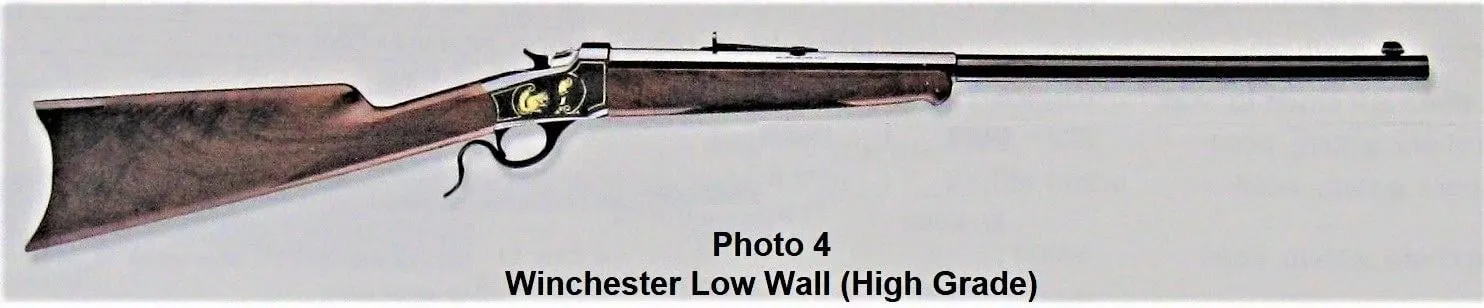
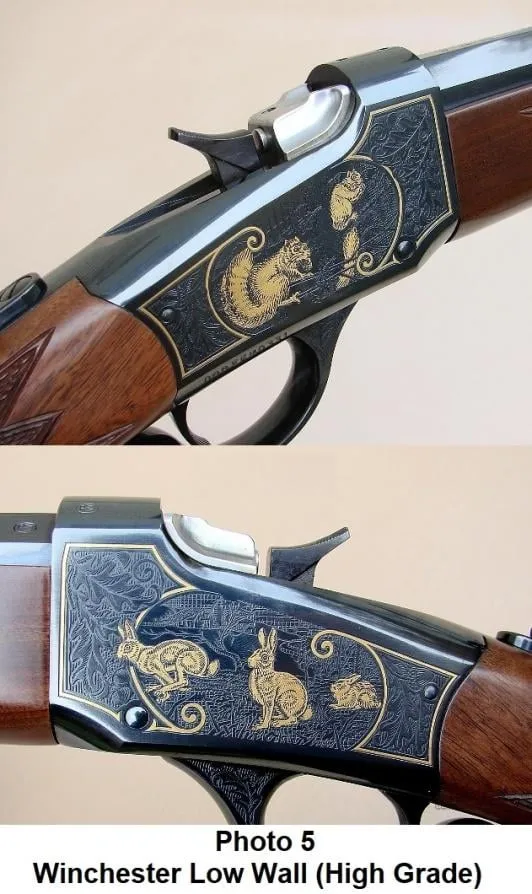
Although first listed in Winchester’s 2000 catalog, in late 1999 and in 2000 Miroku manufactured a limited run of 1885 Low Walls for Winchester. 2,400 Grade 1 and 1,100 High Grade rifles were manufactured in .22LR. The Grade 1 was very similar to the Browning Low Wall Traditional Hunter pictured in Photo 3 but with a blued receiver and no gold plated trigger. Some Grade 1 and High Grade rifles were manufactured in 1999 with serial numbers xxxxNNSAR. NN is the 1999 date code and SAR indicates a prototype. The rest of the rifles have serial numbers that deviate from Browning and Winchester’s serial number standard. The serial numbers are 0000EFxxxx for the Grade 1 and 000EFHxxxx for the High Grade rifles. The High Grade version is pictured in Photos 4 and 5. Both grades featured a 1/2 octagon 1/2 round 24” barrel and an extended tang which was drilled and tapped to accept a tang sight (available separately). The MSRP was $775 and $1,234 in the 2000 catalog, $828 and $1,180 in the 2001 catalog. The 2001 catalog noted that, “Very small numbers of this limited run remain”. Due to the price the High Grade version may not have been as popular as Winchester had anticipated, hence one possible reason for the slight price reduction in 2001. The rifles were not listed in the 2002 catalog.
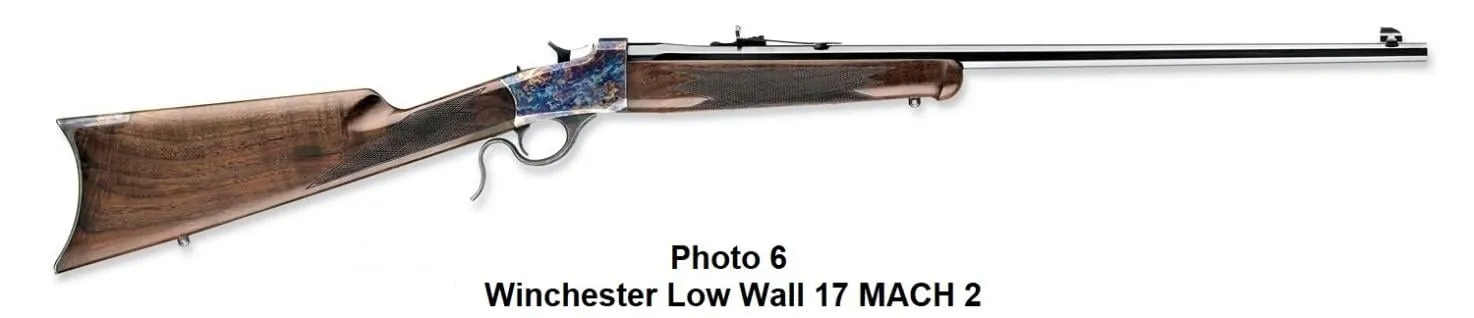
In 2003 Winchester once again reintroduced the 1885 Low Wall but only in .17HMR (.17 Hornady Magnum Rimfire). The catalog photo looks identical to Photo 6 below but lacks the top of the case deflector sticking up behind the hammer. See the details discussed below concerning the 2005 catalog listing. So it may have only had an extractor? The MSRP was $936. The MSRP and listing in the 2004 catalog were the same as in the 2003, but with one exception. The photo is identical to Photo 6. The top of the rotate-able ejector stop is clearly sticking up but there’s no mention of the feature and how it works. The rifles did not have an extended tang.
It should be noted that, while the original Winchester Low Walls featured a spring loaded ejector, many of the modern Browning and Winchester Low Walls only have an extractor. An extractor pushes the spent case back out of the chamber sufficiently for manual removal vs. an ejector that’s spring loaded and forcibly “ejects” the case. A modern rifle with a case deflector has an ejector.
The rifle displayed in Photo 6 was listed as a new (referring to the chambering) historical firearm in the 2005 catalog and again in the 2006 catalog. The new chambering was .17 MACH 2 (aka .17HM2 or .17 Hornady Mach 2). It featured a selectable ejector stop or case deflector enabling either ejecting and holding the spent case (catch position) for manual removal or ejecting the case to the left or right of the shooter. The feature was discussed in the catalog. If you look closely, the top of the mechanism can be seen sticking up behind the hammer. The rifle did not have an extended tang. The MSRP was $1,014. The Low Walls were not listed again until 2013.
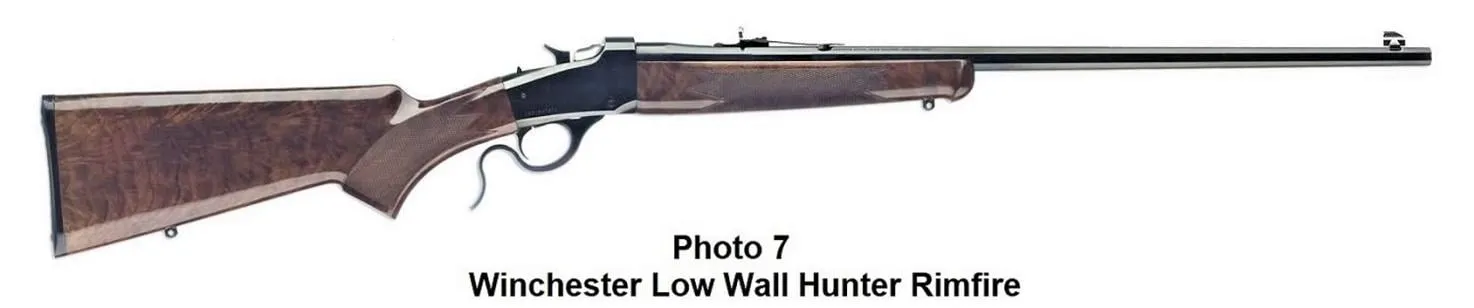
In the 2013 catalog the 1885 Low Wall was displayed and listed as a historical limited production model which may not be in the production line every year. Other than noting it was available in rimfire and centerfire chamberings, no other details were provided. The 2014 and 2015 catalogs display and list the Low Wall as being available in .22LR, .22WMR (.22 Winchester Magnum Rimfire), .17HMR and .17WSM (.17 Winchester Super Magnum). But it was designated as the Model 1885 Rimfire in 2014 and as the Hunter Rimfire (Photo 7) in 2015, the first time the Hunter name is used. As in the 2013 catalog, the 2016 catalog displays and lists the 1885 Low Wall as a limited production rifle in rimfire and centerfire chambering with no additional details. The 2017 thru the current 2020 catalogs display and once again lists the rifle as the Hunter Rimfire in .22LR, .22WMR, .17HMR and .17WSM, but all the listed chamberings were or are not available every year. The current rifles have an ejector with a case deflector. From 2014 to 2020 the MSRP has remained at $1,469.99.
Although not discussed or listed in any of the catalogs, Winchester’s website indicates the Low Wall was also available in the following chamberings: 22 Hornet, 222 Rem, 223 Rem, 22-250 Rem, 243 Win, 6.5x55 Swedish and 204 Ruger. The MSRP was $1,399.99. I did find Internet sales listings for the rifles in all the calibers. Most likely they were limited runs made exclusively for and distributed by the well-known distributor Davidson’s. See more details on Davidson’s below.
Options for 22 BPCRA
During the last few years’ interest in 22 BPCRA competitions has grown immensely resulting in an increased interest in the Browning and Winchester 1885 Low Wall rifles chambered in .22LR. By the way, 22 BPCRA is somewhat of a misnomer since modern .22LR ammo with smokeless powder is used, not black powder. The term comes from a non-profit corporation titled 22 Black Powder Cartridge Rifle Association which was established to govern the sport. 22 BPCRA regulations define the types of firearms used and the rules governing silhouette competition are very similar to big bore BPCR competition, hence the justification for the 22 BPCRA title.
So what’s the bottom line for the shooter looking for a Browning or Winchester Low Wall chambered in .22LR? As noted earlier, Browning never offered a .22 rimfire version, so that option is out, leaving only an original or a modern Winchester. If you only plan to use a vintage-style external-adjustable scope than any .22LR version of the original or modern Winchester works once the barrel is drilled and tapped appropriately. But if a tang-mounted sight is desired than the shooter is limited to locating an original Winchester or one of the Grade 1 or High Grade modern rifles listed in Winchester’s 2000 and 2001 catalogs with an extended tang. If you’re not in a rush, there is a possibility that Winchester may offer a Traditional Hunter in .22LR in the future, which will have an extended tang. If a set trigger is preferred, the only option is an original Winchester since none of the modern Miroku manufactured rifles feature a set trigger. There are a couple of relatively simple modifications that can be made to the rifle to reduce the trigger pull but unfortunately no one makes an after-market set trigger for the modern Low Walls.
Concerning availability, besides other distributors, current Winchester Low Walls may be available through Davidson’s, a well-known wholesale firearms distributor. The company has a long-term relationship with Browning and Winchester. Many versions have been exclusively distributed by Davidson’s as Limited Editions or Limited Series rifles. Their current inventory can be accessed by going to their Gallery of Guns website: https://www.galleryofguns.com/.
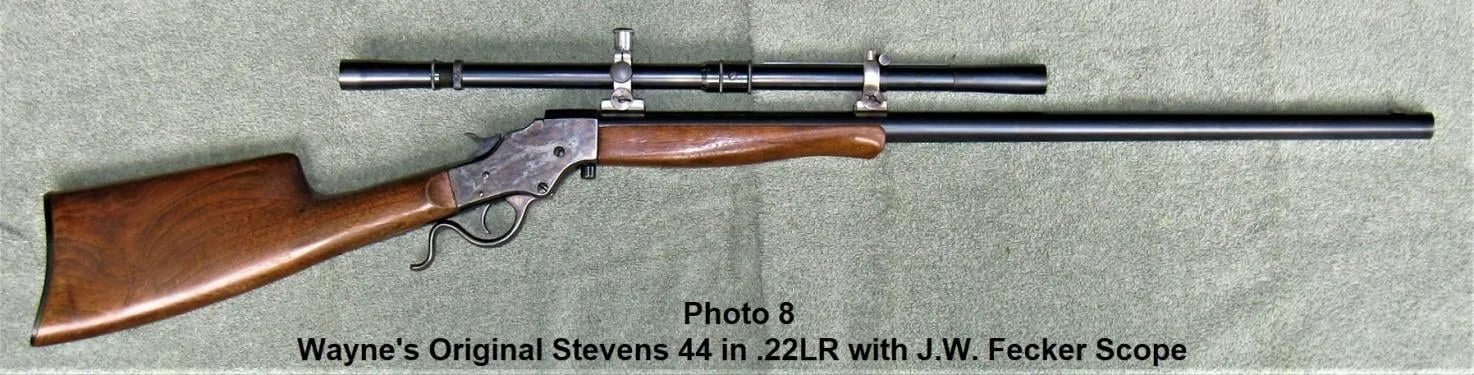
Prior to closing I thought I’d offer some general comments about 22 BPCRA competition and other rifle options. Shooters competing in sanctioned matches must use a rifle that meets the rules established by the 22 BPCRA. Although it’s allowed and some shooters get excellent results utilizing a .22LR barrel insert in a vintage-style centerfire big-bore caliber rifle, the majority use a vintage or vintage-style modern single-shot rifle chambered for .22LR. The rifle must be capable of reliably hitting a ram silhouette (10.7” high x 12.9” wide) at 200 meters, and even harder, a turkey silhouette (7.7” high x 7.5” wide) at 150 meters. In addition to the original, some modern Winchester 1885 Low Walls as noted and vintage Stevens models (Photo 8) fit into this category as do modern reproductions of Stevens and Low Wall rifles displayed below.
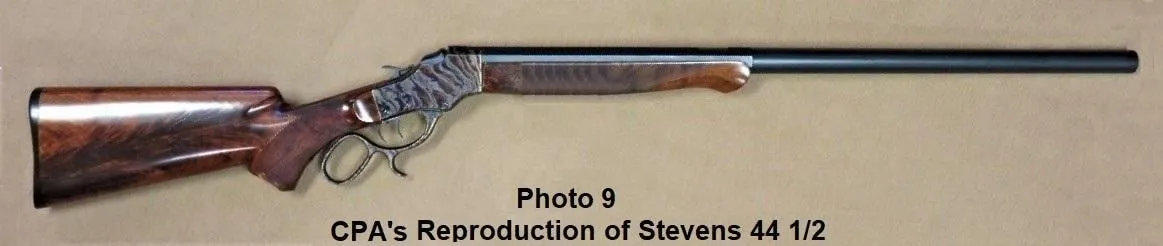
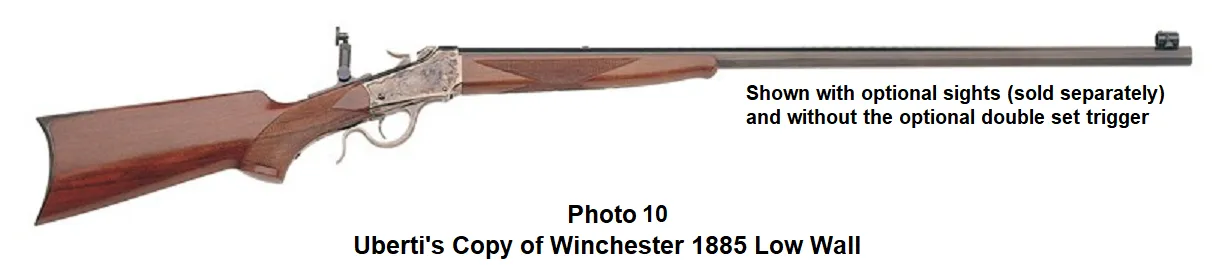
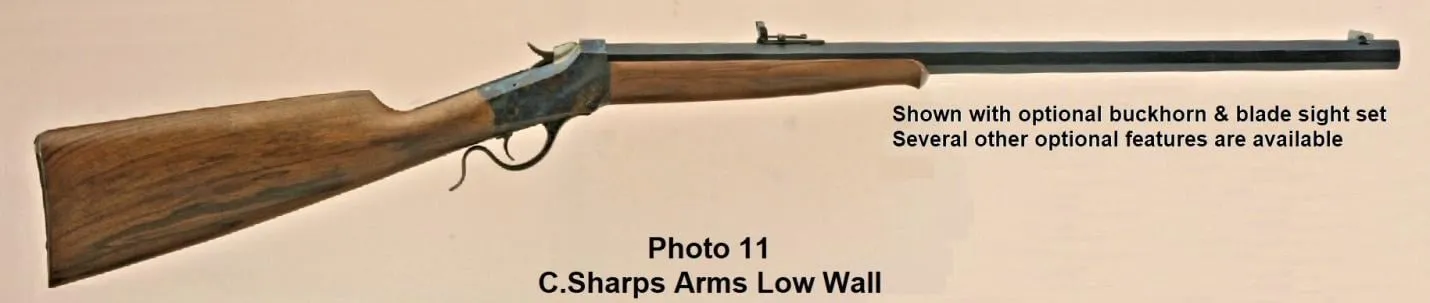
Three examples of current production rifles that meet 22 BPCRA rules include very high-quality version of the Stevens 44 1/2 rifle (Photo 9) by CPA Rifles (https://www.cparifles.com/), Uberti’s copy of the Winchester Low Wall (Photo 10) made by the Italian firm exclusively for Taylors & Co. Firearms (https://www.taylorsfirearms.com/) a USA-based firearm distributor and C.Sharps Arms’ (https://csharpsarms.com/) Winchester Low Wall copy (Photo 11). The CPA 44 1/2 rifle only comes with a double set trigger and an extended tang. Taylors’ Uberti Low Walls feature an extended tang and are available with or without double set triggers. C.Sharps Arms’ Low Wall has an extended tang with several optional upgrades available including a pistol grip, set trigger and other features.
Wishing you great shooting,
Wayne