BPCR Primer Wads Testing Results
In a previous article titled, Large Pistol Primers and Primer Wads in BPCRs, I define and discuss the use and possible benefits of over-primer wads (OPWs) and under-powder wads (UPWs). I’ve been using UPWs punched out of 0.004” copier paper, but have never run tests to determine if they are effective or if a different thickness is a better solution.
3/13/15 - To test UPWs, loads with different thicknesses of UPWs were loaded and tested at a local range limited to 200 yards. With the exception of the different thickness wads and resulting change in powder compression, all loads were identical. The following details and target photos pretty much tells the story. The conditions were not ideal but not too bad. A gusting 10 to 15 mph cross wind was the main obstacle. It was not compensated for between shots, therefore contributing to the horizontal shot spread.
By the way, AV is for Average Velocity, ES is for Extreme Spread and SD is for Standard Deviation.
Not listed on each target are the following:
-
Rifle: Browning .40-65 BPCR
-
Bullet: From Buffalo Arms mould # 409400M4
-0.409” diameter 400 gr “Money Bullet using 16:1 alloy
-
Finger seated in the case with nose 0.005” off the lead when loaded
-
Lube: White Lightning (pan lubed)
-
Primer: Remington 2-1/2 Large Pistol
-
Over-powder wad: Walter’s 0.060”
The rifle was cleaned and allowed to cool down between strings. There were no signs of leading throughout the tests. One “fouling” shot was fired prior to starting each string and all shots were fired over bench mounted cross sticks. A blow tube was used to keep the fouling soft between shots.
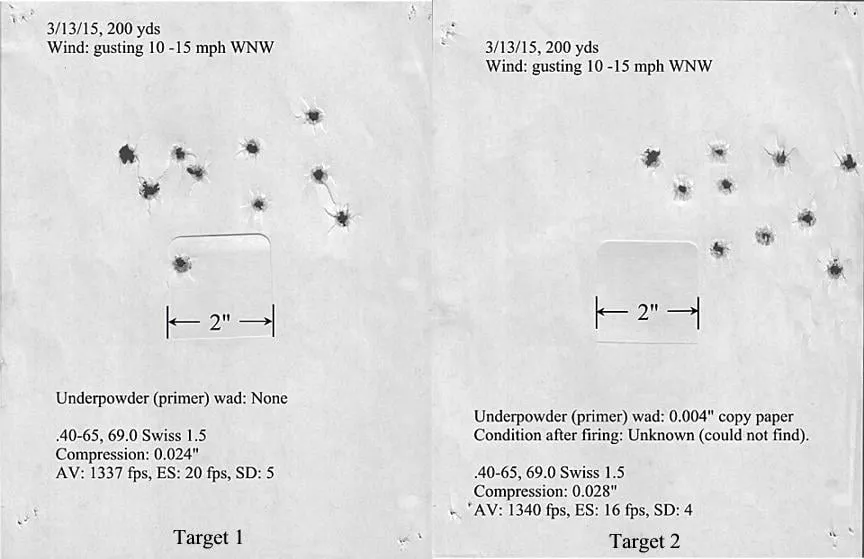
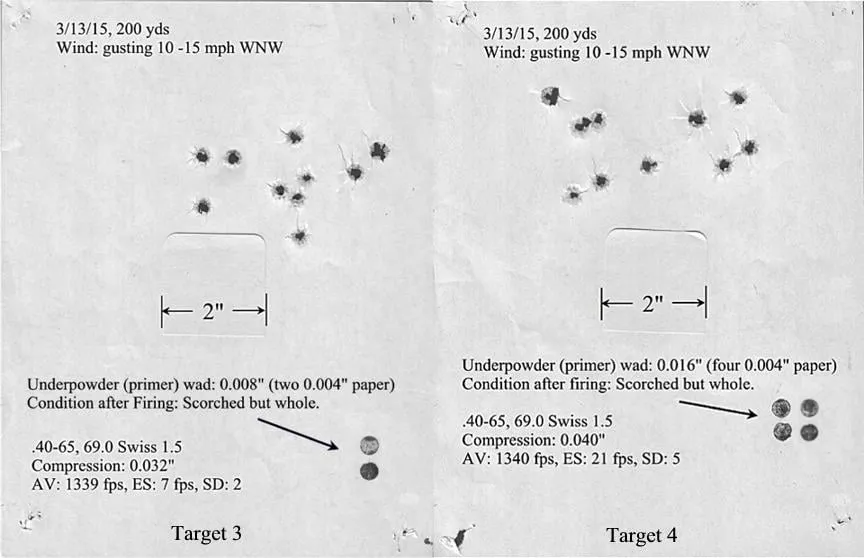
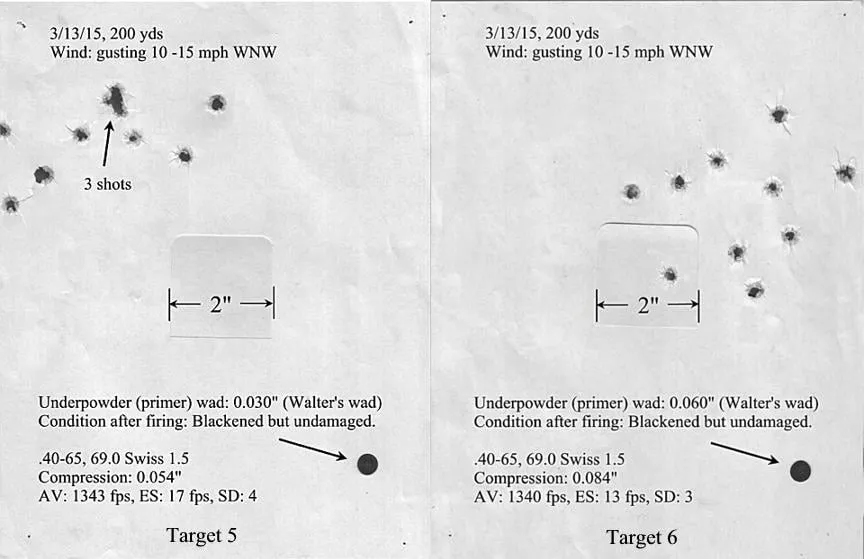
The big surprise was the condition of the wads. It had been suggested by several shooters that primers, even pistol primers, create sufficient energy to punch through even thick wads. That may be the case if the wad is sandwiched between the primer and the flash hole, effectively ensuring the wad cannot move. Although the 0.004” wads punched out of copier paper were not found, scorched but fully intact examples of the material used for the thicker wads remained in the bore or in the case. Two layers were used for 0.008” (Target 3) and 4 layers for 0.016” (Target 4). Several of the paper layers from the 0.008” and 0.016” wads were found inside the fired case and inside the bore just forward of the chamber. These were blackened some and scorched around the edges but definitely whole with no holes in the centers. The 0.030” (Target 5) and 0.060” (Target 6) thick Walther wads were blackened with a small shallow dimple in the center but otherwise in perfect condition. None of the Walter wads made it to the bore. All were in the rear half of the fired case.
Note, OPWs punched out by the primer insertion process would’ve definitely had a hole blown through the center or obviously the cartridge would not fire. But that’s not the method I’ve been using. Test results using OPWs may be different.
I’m assuming even the slightly compressed powder column sufficiently reinforces the wad, preventing the primer gases from punching through. Based on the condition of the wads the primer explosion forced the wad and powder column forward, allowing the primer gases to vent around the edge of the wad and ignite the powder.
As noted earlier, the reason hot primers are no longer considered ideal for black powder is the belief that the primer explosion drives the powder column and bullet forward prior to powder ignition. Based on this test, apparently even mild primers create sufficient power to further compress or move the powder and possibly the bullet forward. Seating the bullet hard into the lands may mitigate this to some extent but not if the primer is only compressing the powder. Additional experiments as documented below were run to test this condition.
From my point of view the above testing was inconclusive. The different powder compressions may have affected the results as much or more than the various wad thicknesses. Based on the Target 3 load results, using a 0.008” UPW seems to be the winner so far with my loads
More tests were run on 3/23/15. One with identical loads using the 0.008” wad to see if the Target3 loads above with very low ES and SD can be duplicated; another with 0.008” UPWs compared to a load with no UPWs but with the same powder compression; another with very thin UPWs cut from coffee filter paper; several with different thickness of UPWs with heavy powder compression and the bullet hard into the lead when chambered. The heavy powder compression and hard seated bullet tests are to determine if the condition will reduce or eliminate the powder column moving forward. If it does, the result should be pierced wads. I also plan to compare 0.004” and 0.008” OPWs cutout with and seated by the primer. The results of the testing are documented below.
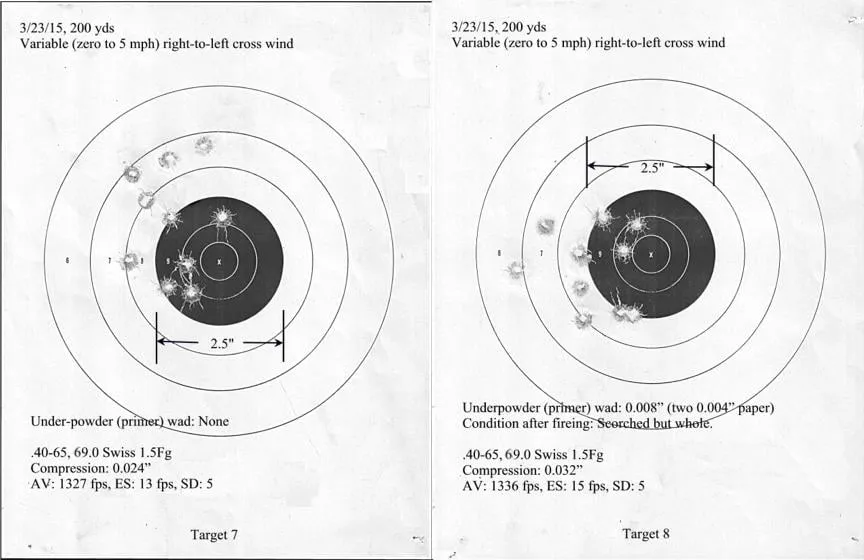
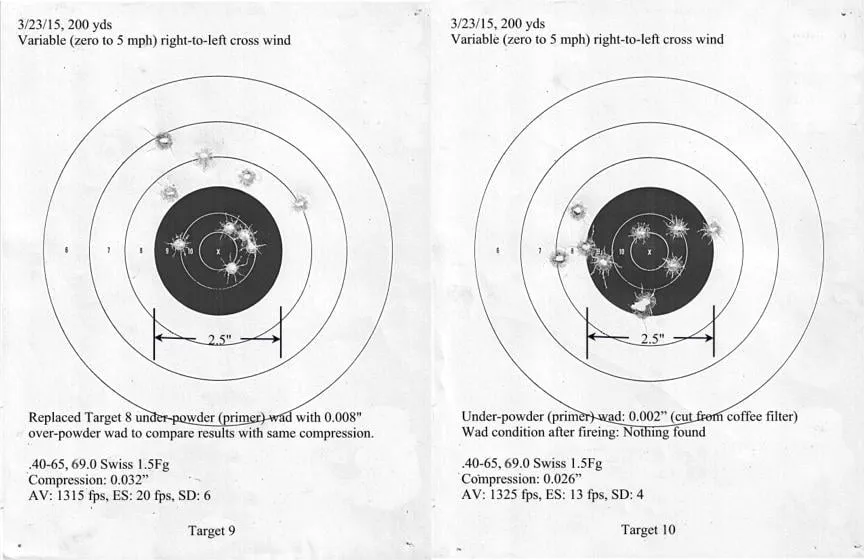
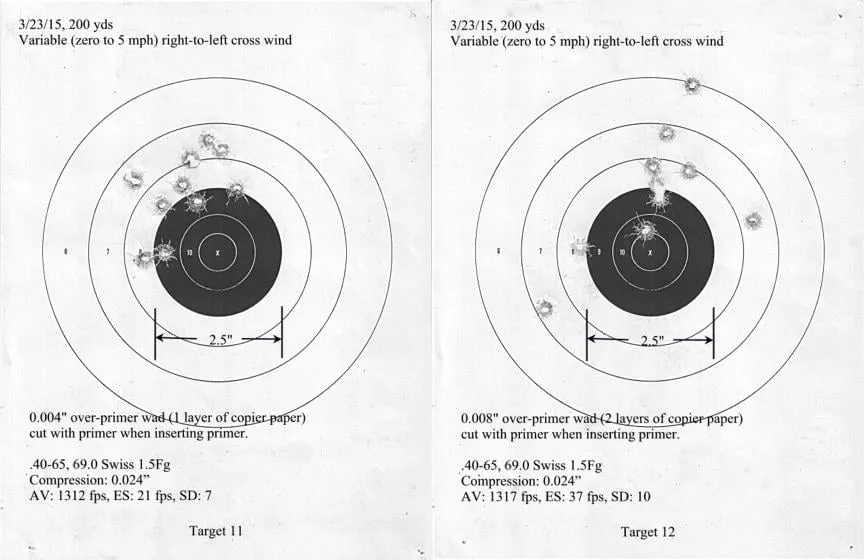
3/23/15 – Additional range experimenting to further test primer wads. Conditions were better than the previous tests with a variable (zero to 5 mph) right-to-left cross wind. With the exceptions noted on each target, the rifle, bullet, lube, primer, over-powder wad and shooting setup was the same as above in the earlier tests. The most obvious difference from the earlier targets are the reduced horizontal shot patterns due to the milder cross winds. Comparing targets 1 & 7 and 3 & 8, you will note the velocities were slightly lower for the same identical loads. Other than the positioning of the chronograph, I can think of no other reasons for the slight difference.
Target 7 is the result of not using a primer wad and can be considered statistically identical to the earlier Target 1 load test with no primer wad.
Target 8 was an attempt to determine if the earlier Target 3 low ES and SD could be duplicated. Based on the results the data was not duplicated.
The powder compression used with Target 9 loads was identical to Target 8 loads. The intent was to get some idea if the earlier Target 3 low ES result was due to using a UPW or due to the slight increase in compression. Since the earlier results could not be duplicated the intent of this test was not realized. But note the interesting drop in velocity without a UPW although it may not be significant since target 7 loads (no primer wads) resulted in a higher average velocity.
Target 10 loads used a very thin UPW cut from 0.002” coffee filter paper, which was suggested by an experience shooter, indicating it would leave no ash or residue and result in reduced ES and vertical spread. Base on the outcome I’m inclined to agree, but more testing would be required to confirm the results.
OPWs of the thickness noted were used for Target 11 & 12 loads. The wads were cut by and seated by the primer when seating the primer. The results speak for themselves, indicating to me that no primer wads or UPWs are a better alternative than OPWs. Some have suggested that the main benefit of a primer wad is to keep powder granules from entering the primer hole and possibly causing erratic ignition. I doubt that based on the results indicated by Targets 11 & 12.
Finally, in an attempt to determine what was required to force the primer to pierce UPWs, powder compression was significantly increased and the cartridge overall length extended to force the bullet hard into the leade when chambered. Remember, the UPWs are seated flat over the flash hole prior to loading and compressing the powder. The same powder amount was used as with all the other loads but an additional 0.240” (4 ea. 0.060” Walter wads) were added to the top of the powder column when compressing the powder. After powder compression, another 0.060” Walter wad was added prior to thumb seating the bullet to ensure the 1st driving band was in hard contact with the leade when chambered. Two rounds were loaded for each UPW thickness. When chambering, a cartridge seating tool was used to fully chamber each cartridge, forcing the bullet into the leade. The cartridges were not fired at a target but over a chronograph to check the average velocity as follows:
0.004” (1 layer of copier paper): 1311 fps
0.008” (2 layers of copier paper): 1315 fps
0.016” (4 layers of copier paper): 1316 fps
0.030 Walter wad: 1315 fps
0.060 Walter wad: 1310 fps
I was again surprised by the results. As were the results in the earlier testing, none of the wads I found were pierced. As tested before, the UPWs ranged in thickness from 0.004” to 0.060”. None of the 0.004” wads were found but I did find a few small burnt pieces of the 0.008” wads just in front of the chamber. All the 0.016”, 0.030, and 0.060” wads were scorched but whole and remained in the case. As noted in the earlier tests, no doubt the compressed powder column is reinforcing the wad, preventing the primer gases from punching through.
Another interesting result: in general, UPWs with light powder compression resulted in slightly higher velocities than either OPWs or UPWs with heavy compression. Keep in mind, the same powder charge was used for all the tests. Possibly, when diverted around the edge of the UPW, the primer flash is doing a better job of igniting the lightly compressed powder.
That’s it for primer wad testing. No more for me; I’m finished - maybe. One of the benefits realized was a good bit of “trigger time”, which is always good. Although the accuracy improvement may be slight, based on the limited testing, from now on I plan on using UPWs punched out of coffee filter paper rather than OPWs or no primer wads. It’s my best guess that the 0.002” coffee filter UPW is spreading (defusing) the primer flame some prior to being destroyed by the primer and powder burn, resulting is a more consistent and possibly more efficient powder burn. Or maybe it’s simply due to keeping powder out of the primer.
Wishing you great shooting,
Wayne