BPCR Lube-Groove Cartridge Components
This is the 2nd article in a 4-part series on loading and testing BPCR ammunition. The 1st article was published in the May 2021 edition of The Single Shot Exchange Magazine and titled*, New Case Preparations for BPCR Competition*. In it I defined the steps I take to ensure new brass is properly prepared for a specific rifle. This article is a follow-up and, with the exception of the brass case, overviews the components used to load cartridges with lube-groove bullets also known as “grease-groove” bullets or commonly referred to as “greasers”.
Bullet profile
Once the cases are ready the next step is to select a bullet that dimensionally fits the throat and bore. Two types of bullet profiles are commonly used. One has a nose diameter close to or slightly larger than the groove diameter. For lack of a better descriptor, I’ll refer to these as standard profile bullets. The other is a nose-riding bullet with a nose diameter slightly less than the bore diameter. The nose-riding bullet can be seated further out of the case since the nose will slide into (rides in) the bore. One benefit of a nose-riding bullet is the nose self-aligns in the bore. The other is it allows for additional powder capacity in the case. All the bullets displayed in Figure 1 are nose-riding designs. The nose diameter of a nose-riding bullet should be about 0.001”, but no more than a couple of thousands smaller than the bore diameter to allow for some fouling from previous shots. Nose-riding bullets are by far the most popular design used by current-day BPCR competition shooters. There are several excellent suppliers of casting moulds. Following are some examples of popular .40 caliber nose-ridding bullets I’ve used in a .40-65 rifle.
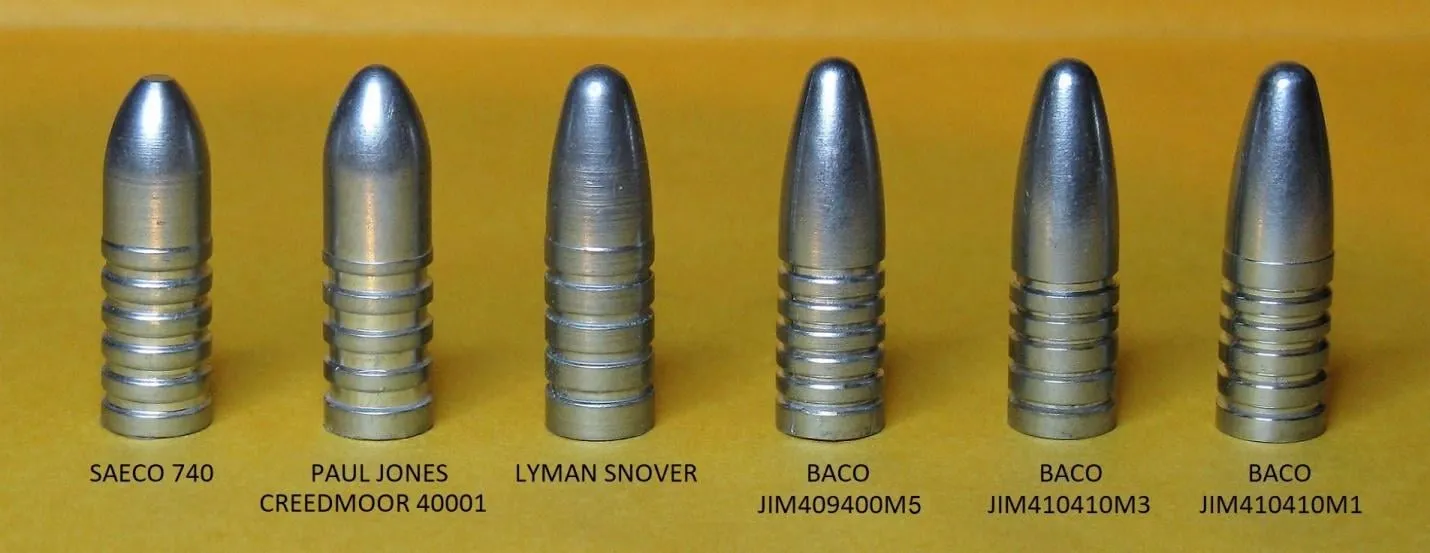
Figure 1
Commercial bullet suppliers
For BPCR shooters not prepared to cast their own bullets there are a few commercial suppliers of cast or swaged bullets using 20:1 alloy and black powder lube. Four companies that come to mind are Buffalo Arms, Chey-Cast Bullets, Montana Precision Swaging and The Bull Shop.
Bullet alloy
The common alloys of lead and tin are 30:1, 25:1, 20:1 and 16:1. 20:1 (20 parts lead and 1 part tin) is the most common these days but many shooters are using 16:1 or even harder alloys to ensure the streamline (higher ballistic coefficient or BC) nose design bullets will not experience nose setback (nose expanding and shortening). Very popular are the “money bullets” which are based on the designs of the late Dan Theodore. The BACO bullets displayed in Figure 1 are “money bullet” designs. Contrast those to the SAECO and Paul Jones Creedmoor bullets with blunter, lower BC noses. Since most of the bullets I shoot are “money bullets” designs, I’ve standardized on 16:1 alloy. Shooters can mix their own alloy from pure lead and tin or purchase already mixed alloy from a few suppliers.
Bullet length/weight
Bullets should be of acceptable length for the bore twist rate of your rifle. Bullet designers make trade offs for weight, nose profile and bullet length among other features. The common twist rate for .40 caliber rifles is 1:16, and 1:18 for .45 caliber rifles. Therefore, most bullets are designed for these twist rates. But some are using twist rates as fast as 1:14 for .40 caliber and 1:16 for .45 caliber. Bullet weight is less critical for paper target shooters but silhouette shooters need as much weight as feasible to reliably knock over the heavy silhouettes, especially the ram silhouettes. It’s my belief that 400grs is the minimum requirement, but there are .38 caliber shooters that will no doubt disagree. So, there’s some tendency to use bullets that are too long for the twist rate in smaller caliber rifles such as in .40 or .38 calibers. A bullet that is too long for a twist rate will result in poor accuracy due to instability, especially at longer distances as the velocity decreases.
Lube grooves & lube capacity
When designing lube-groove bullets the number of grooves, the width, the depth and the locations are considerations. I will not attempt to discuss all the possible variations or make a recommendation concerning lube grooves other than to comment on the lube capacity. More lube is generally better if the shooter will be using a blow tube to keep the bore fouling soft between shots. Shooters that wipe between shots can use bullets with less lube carrying capacity. But shooting conditions also determines to some extent the amount of lube capacity required. For example, very hot conditions generally require more lube, especially when blow tubing.
Bullet lube
When researching BPCR bullet lubes several brands of commercially available lubes will be mentioned such as SPG, DGL, White Lightning and NASA. And there are hundreds if not thousands of homemade recipes. Many articles and a book or two can be found covering the numerous ingredients and mix ratios used to make BPCR lubes. The two most popular commercial brands are SPG and DGL. SPG was developed by Steve Garbe in 1983 and is arguably the most popular of all the BPCR lubes. SPG, LLC offers two versions, the original (Classic) version and the Tropic version for shooting in high temperatures. NASA lube is made and sold by The Bull Shop. White Lightning was a popular lube at one time. Due to the unfortunate passing of Dan Theodore, the manufacturer and supplier, the secret recipe was lost. I have a large amount of White Lightning and will continue to use it until I run out, at which time I’ll likely switch to either DGL or SPG.
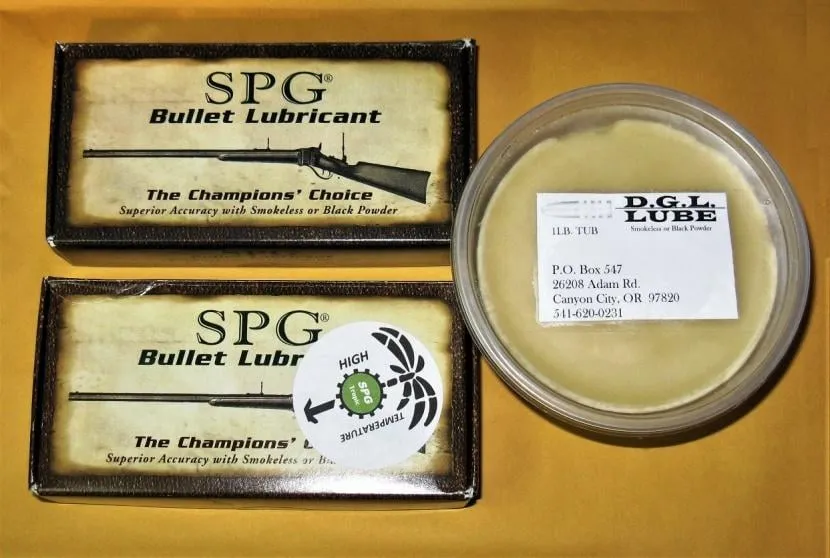
Figure 2
Over-powder wads
Wads are used to separate the powder from the base of the bullet. The wad protects the bullet base from damage and helps to seal the hot gases from blowing by and etching the side of the bullet, resulting in bore leading. Wads can be made from a wide variety of materials, but typically are cut from various types of card stock, vegetable fiber gasket material, HDPE (high-density polyethylene) or LDPE (low-density polyethylene). HDPE or LDPE are commonly referred to as poly wads. LDPE is the more common of the two. The two most common commercial wad thicknesses are 0.030” and 0.060”. Some shooters, me included, place a thin paper wad between the thicker wad and the bullet to ensure the thicker wad does not stick to the bullet base resulting in instability. The thin wads are punched out of newspaper or printer paper.
Wads can be cut from many materials using a hammer driven punch or a reloading press punch. Buffalo Arms Co. sells both. By far the most popular commercial supplier of ready-to-load wads is John Walters (Walters Wads). John sells vegetable fiber and LDPE (poly) wads for various calibers and either 0.030” or 0.060” thickness. Walters wads are also available from Buffalo Arms Co. Sagebrush and Sage’s Outdoors are other suppliers of vegetable fiber wads as is Circle Fly Wads. Flintlocks Inc. sold fiber wads at one time and may still do.
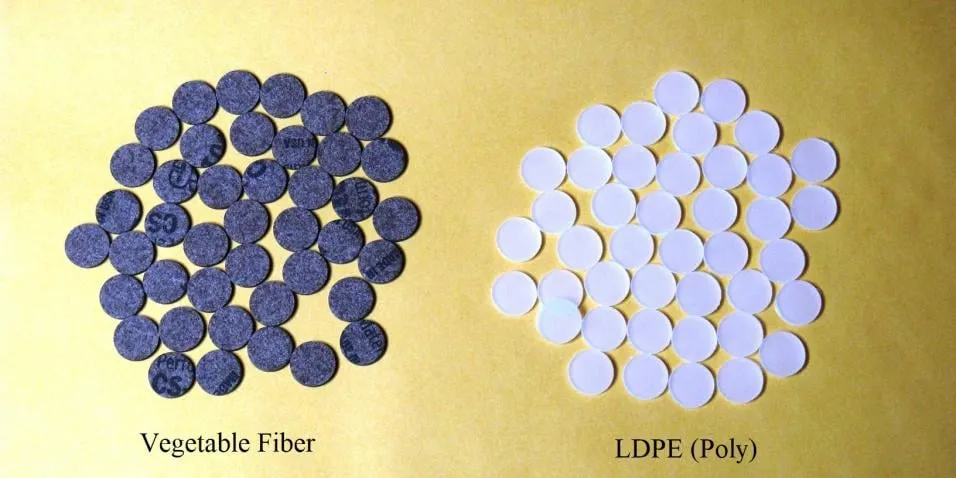
Figure 3
If you plan to make your own wads, I highly recommend a Fred Cornell style wad cutter punch. It’s a very good and easy to use wad cutting die that installs in a loading press. However, it does leave one edge of the wad slightly rounded and the other edge sharp. Although not critical, I recommend orientating the sharp edge against the powder in order to get the most effective seal.
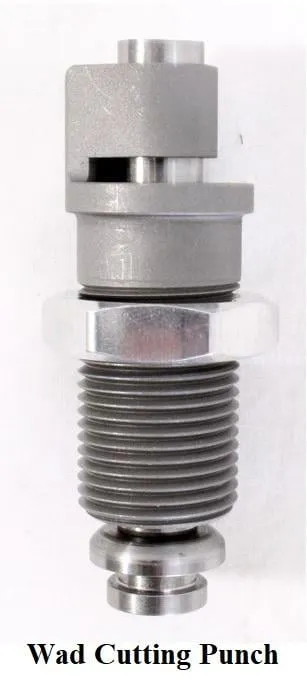
Figure 4
Black powder
At one time Goex powder (made in the USA) was the most widely used brand. Over the last couple of decades Swiss powder (made in Switzerland) has displaced Goex as the preferred brand. The Goex plant shut down in 2021 but was restarted in 2022 under new ownership. Although not as popular as Swiss or Goex, Olde Eynsford (made by Goex) is used by some. Graf Black Powder is a private label version of Goex sold by Graf & Sons, a well-known distributor and retailer of reloading supplies. Schuetzen brand (made in Germany) may be used by a few but mostly by muzzle loaders and reenactment shooters. And there are a small number of shooters using black powder substitutes such as Pyrodex, Blackhorn 209 and Triple Se7en. Elephant & KIK black powder is no longer available. Elephant was made in Brazil by the Pernambuco powder factory. KIK was made in Slovenia by the KIK-Kamnik powder company.
By the way, all the black powder suppliers have switched from metal cans to containers made of antistatic plastic. Although antistatic plastic can be made in several colors, clear, red, etc., the black powder containers are typically black and contain small amounts of carbon to make the plastic slightly conductive to electricity (antistatic). So, pouring BP out of the plastic containers cannot build up a static charge.
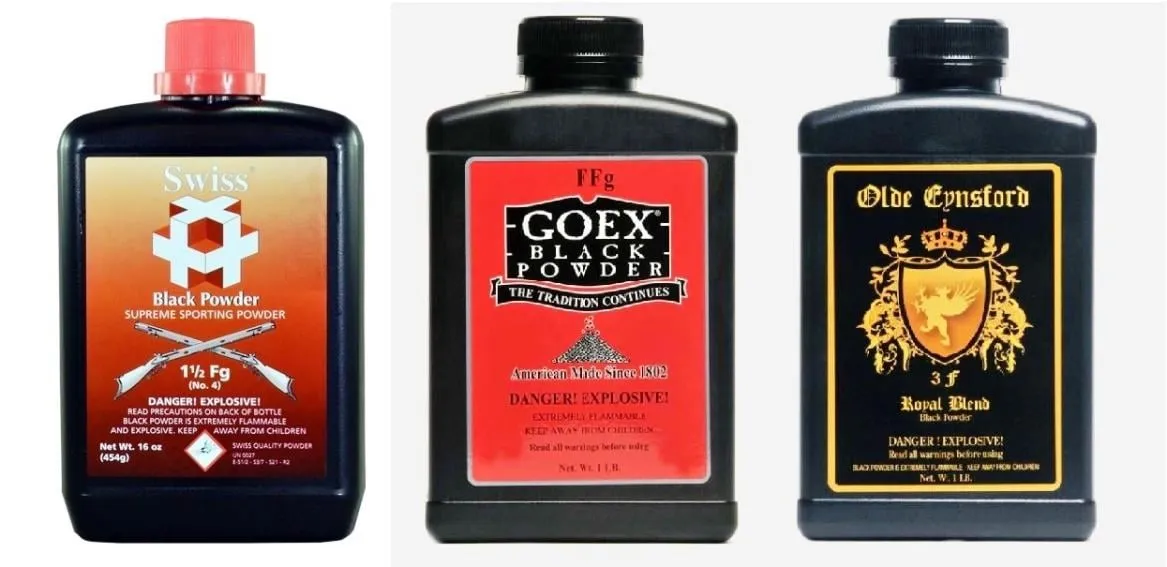
Figure 5
Primers
Going back a couple of decades or more, the general consensus was that a “strong” primer was required to reliably fire the black powder. Hence, it was standard practice to use magnum rifle primers in BPCRs and the Federal GM215M Gold Medal Match Large Magnum rifle primer was very popular. The power (brisance) it produced was more than the other large rifle primers at the time. More recently, due to experimenting by some well-known competitively successful shooters, it was found that lowering the power of the primer can directly contributed to a significant reduction in the standard deviation (SD) of the velocity spread. In many cases (no pun intended) the SDs dropped from double digits to low single digit values. I’m not aware of conclusive evidence as to why a weaker primer reduces SD. It’s been debated that a stronger primer can push the powder column and bullet forward prior to full powder ignition, resulting in shot-to-shot inconsistencies.
I favor Federal Match GM150M large pistol primers due to their lower power (brisance) and low standard deviation but Federal 150LP, CCI 300LP, Winchester Large Pistol (WLP) and Remington 2-1/2 LP primers are also good for black powder. The CCI BR2 Bench Rest Large Rifle primers are popular with some shooters. These produce the lowest power and standard deviation of the many brands of large rifle primers.
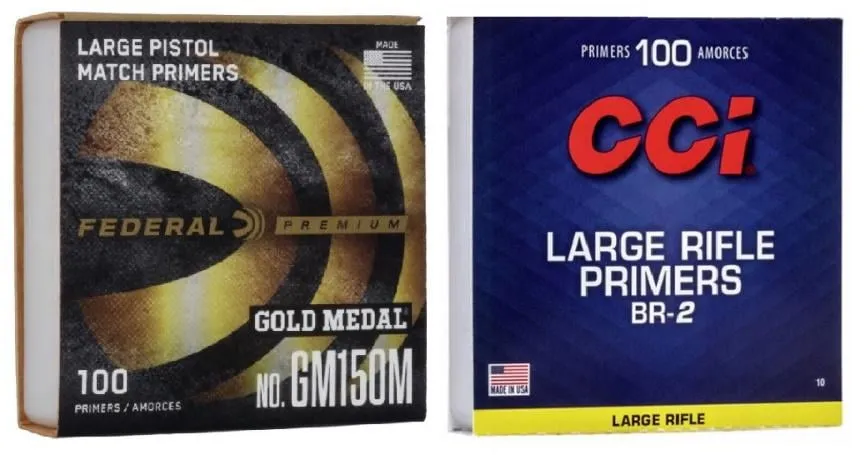
Figure 6
Primer wads
Some use thin paper wads inserted under the powder to cover the flash hole. Using hand-held or reloading press punches, the wads are cut from various materials: newspaper, printer paper, ash less paper, coffee filters, etc. The wad is dropped into the bottom of the case after priming and prior to adding powder. The intent is twofold, further reduce the brisance of the primer and prevent powder from entering the primer and interfering with the consistency of the burn.
Another technique uses the primer to cut out the wad as displayed in Figure 7. The paper is slipped between the primer and the primer pocket as the case is being primed. I currently use an older version of the Lee Precision hand priming tool. The tool and the shell holder have been modified to accept a long slip of paper. Using a Dremel Rotary Tool with a diamond wheel, a slot was cut in the shell holder and the priming tool. The paper is slipped under the case rim prior to inserting the primer and then advanced before priming the next case, and so on. Although Figure 7 shows the primer wads being cut from yellow printer paper, I use strips cut from coffee filters.
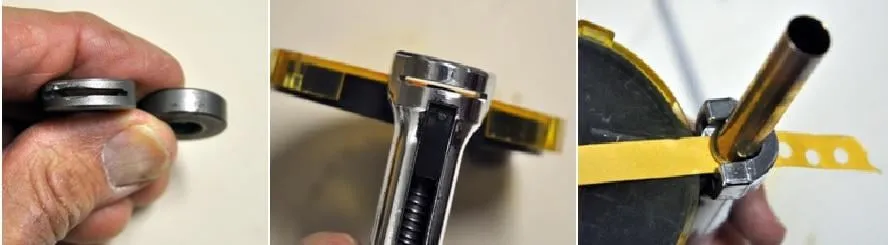
Figure 7
Wishing you great shooting,
Wayne