BPCR Accuracy vs. Cast Bullet Weight Dispersion
In a previous article titled, Weight Variations in BPCR Cast Bullets published in the October 2020 Edition of the Single Shot Exchange Magazine I discussed my casting method, techniques and equipment used to minimize weight dispersion. I mentioned not having any idea what variation in weight is necessary to significantly affect BPCR accuracy but that I had started an experiment to find out. The details of the experiment and the results are the subject of this article.
After casting a batch of bullets for black powder cartridge rifle (BPCR) silhouette matches, I’ve always checked and discarded any with imperfections and sorted them by weight into 0.1gr groups using a sorting rack constructed of modified bullet trays glued together. The intent of sorting is to minimize possible accuracy affects due to variations in bullet weights. The total weight spread also provided a good indicating of my casting process. Although the typical variance from the average weight has been relatively small, varying +/- 0.5gr on a good day up to +/- 1.0gr on a bad day of casting, I’ve always wondered if weighing and sorting was really beneficial, but continued the practice. Due to others reporting good results without weighing, I finally decided to run an experiment to determine how much of a change in weight is necessary to noticeably affect accuracy.
Some top shooters have suggested that +/- 0.5grs is the goal for match grade ammo and others are satisfied with weight variances of up to +/- 2grs. Now let’s think about this a bit. A +/- 0.5gr variance in a .45 caliber 540gr bullet results in a spread of less than a 0.2%, not 2% or even 1%, but 0.2%. And +/- 2grs is less than 0.4%. Is it really necessary to attain that level of casting precision for match grade accuracy? Having no idea I intended to find out via the following experiment.
The only realistic way that I know of to change a bullets weight a specific amount is to remove material. Therefore this experiment will be somewhat one sided meaning the accuracy testing will only consists of bullets lighter than the reference load. After additional thoughts I settled on tests utilizing 15 bullets with a weight spread of up to 9.5 grains (4.5grs to be removed in increments of 0.5gr and 5grs to be removed in increments of 1.0gr). By the way, the material must be removed from the center or uniformly from around the perimeter so as to minimize the effect on the spin stability of the bullet.
The Plan
- Cast a batch of sixty bullets with Paul Jones’ .45 caliber #45001 Creedmoor mould. The bullet was chosen due to the nose design and the excellent accuracy I’ve attained with it in the Browning .45-70 BPCR at 200yds, the limit at my local range. In good shooting conditions, a good load it will average 1MOA or better at 200yds. Also the large nose and rounded tip profile made it easier to modify.
- In increments of 0.5grs and 1.0grs, reduce the weight of the bullets.
- Use a lathe and three techniques to reduce the weights: drill out the base, drill out the nose and turn down one driving band.
- Lube them with White Lightning lube and load all identically with a Swiss 1.5Fg powder charge of 65.5gr weighed to within 0.1gr and with the same cartridge overall length (COAL) such that the 1st driving band is in contact with the leade.
- Using four targets, shoot the reference batch and each test batch in a Browning .45-70 BPCR during the same conditions at 200yds and identify the bullet hole locations in the order shot and by bullet weight.
The Details
- Sixty bullets were cast with 17:1 alloy and sorted by weight using a laboratory precision scale (Figure 1) rather than the standard RCBS loading scale normally used. A typical bell-shaped distribution curve resulted with a mean weight of 535.4grs and a variance of -0.5grs to +0.3grs
Note – during sorting the weights were rounded up or down to the closest 0.1gr. Therefore the weight of the one on the scale was rounded up to 535.4grs.
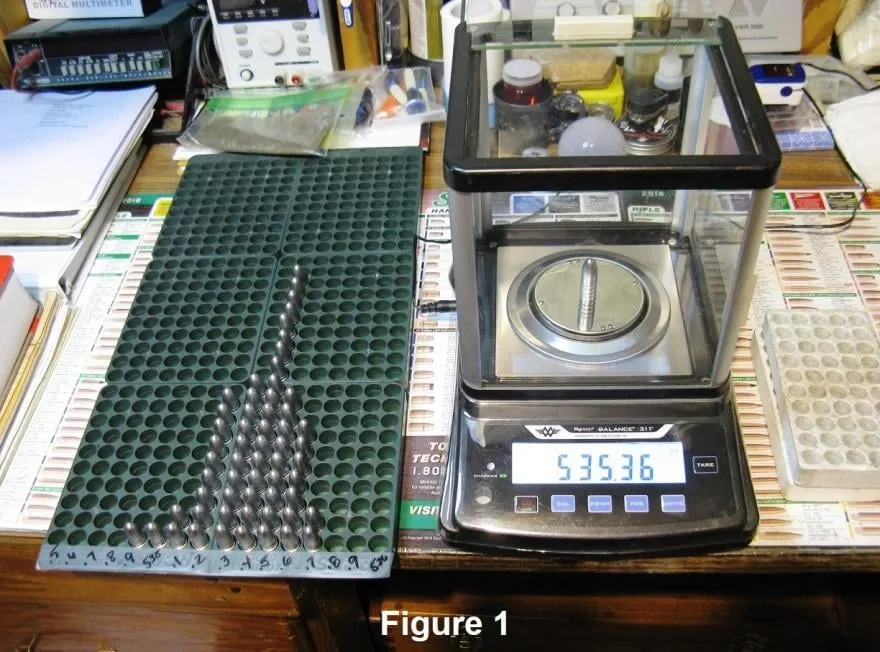
- Five bullets were selected from the highest and lowest weights from this session and five from a previous session to use as fouling shots to condition the bore prior to shooting each test batch.
- Ten bullets of the same weight were selected to load and shoot as a reference. Note – all the reference bullets were selected from the center of the distribution curve and all weighed 535.4gr.
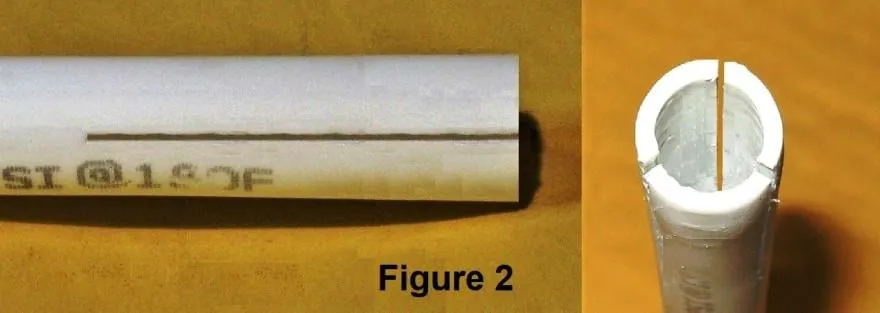
- A 2ft. length of ½” PVC PEX tubing was purchased from Home Depot to modify one end into a split-finger collet that would not damage the bullets in a lathe. The inside diameter (ID) was 0.020” larger than the bullet diameter, which was perfect for the task at hand. Using a slitting saw in a Dremel tool, one end was split lengthwise into three 2” long equal width sections to match the 3 jaws of the lathe chuck (Figure 2). The saw removed sufficient material to allow the collet ID to be reduced to less than the bullet diameter when squeezed by the chuck jaws. When the lathe jaws were opened the fingers easily released the bullet for removal. The tube was not shortened. It therefore extended out the left side of the spindle bore, providing a convenient length to grasp it by hand while inserting and removing bullets from the split end.
Note – for machinist reading this, I considered using a 5C collet in a collet chuck but 5C collets can deform soft material. Besides being gentler when holding the bullet, I thought the long PVC tube and collet would make the process a little easier since trial-and-error was required to either drill or turn the bullets to the exact weights, requiring removing, weighing and reinserting each bullet several times. In any case it worked great.
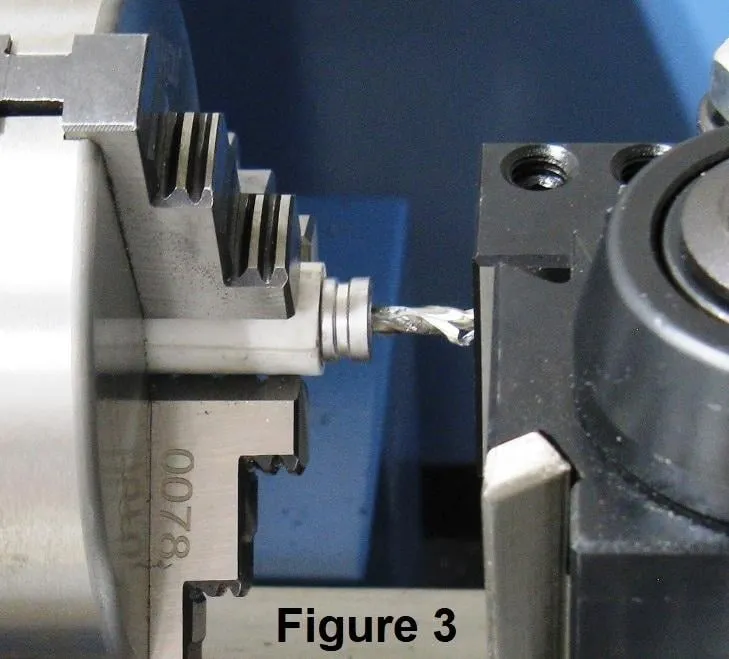
- A hole was drilled in the center of the base of fifteen bullets (Figure 3). Based on the reference bullets weight, ten were reduced from 535.4grs to 530.9grs in 0.5gr increments. Five were reduced from 530.9grs to 525.9grs in 1.0gr increments. All were identified by marking the nose with a felt tip marker.
Note – since an arbor was not available at the time to mount a chuck in the lathe tail stock the drill bit was mounted in a boring bar tool-post holder and aligned with the center of the bullet.
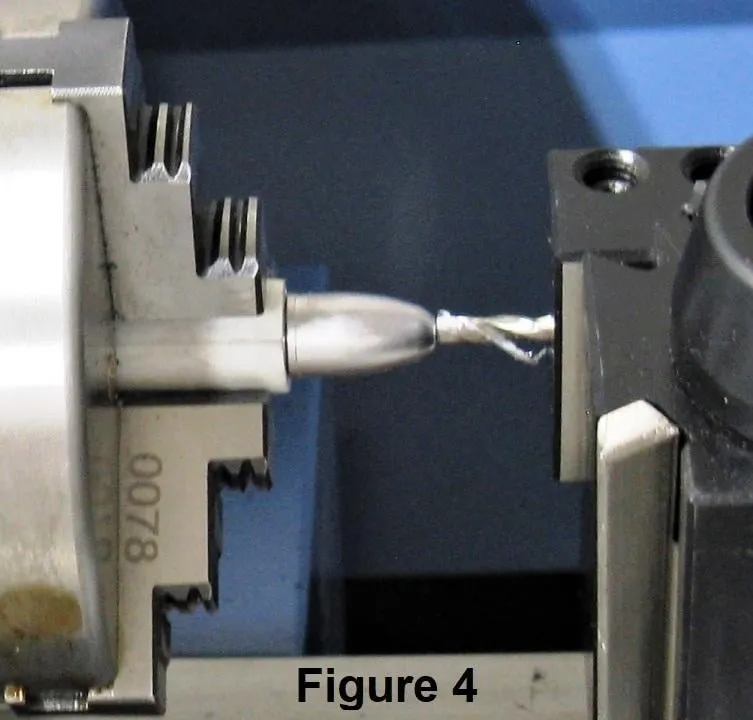
- A hole was drilled in the center of the nose of fifteen bullets (Figure 4). The resulting weights are the same as in the base-drilling process.
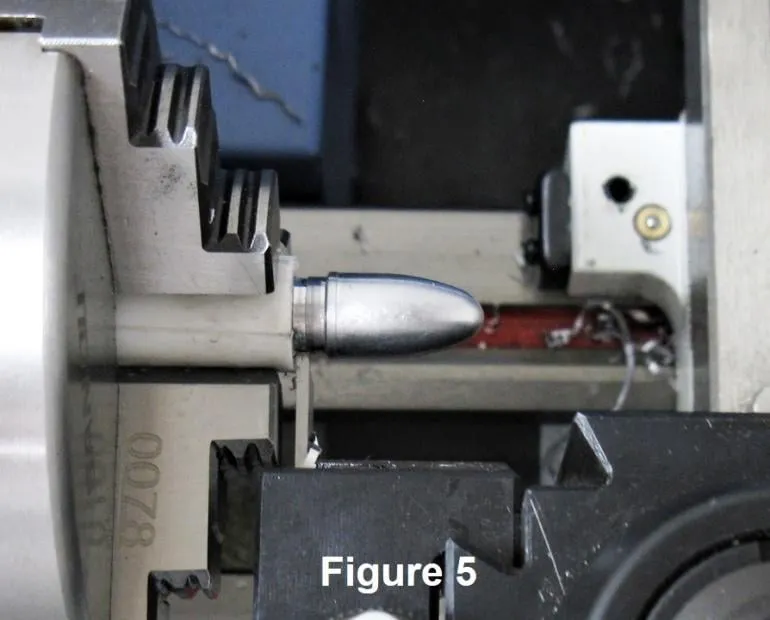
- Using a cutoff blade the centrally located driving band was turned down on fifteen bullets (Figure 5). The resulting weights are the same as in the base and nose-drilling process.
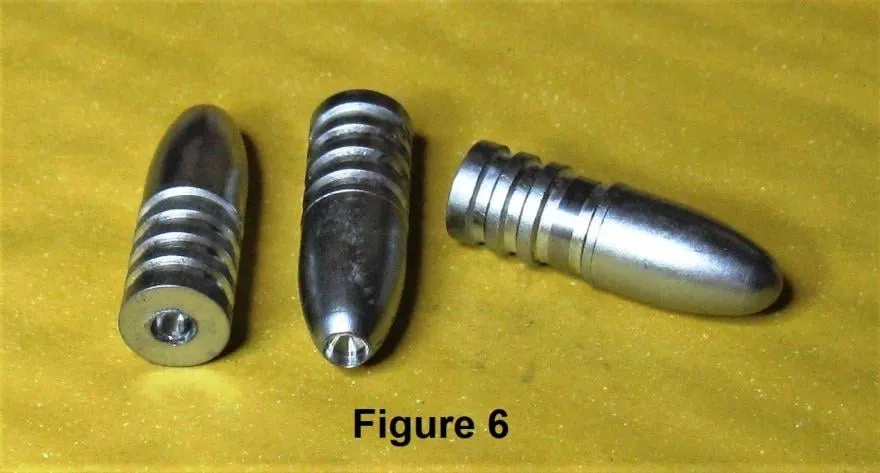
A sample bullet from the results of each technique is displayed in Figure 6. I can tell you that removing 0.5grs at a time is very little material. Drilling out the nose or base may have been possible on a drill press but the lathe was required to turn down the driving band. If you’re wondering why I choose the three techniques, I thought it would be interesting to see the results of reducing the weight at three locations rather than only one. Although external ballistics is not the subject of this article, shifting the center-of-gravity and the center-of-pressure by drilling out the base or nose will likely have some effect. And reducing the diameter or completely removing the centrally located driving band may affect the ballistic coefficient (BC) to some extent. By the way, the problem I ran into after removing most of the driving band is lube retention in the much wider gap.
The Results
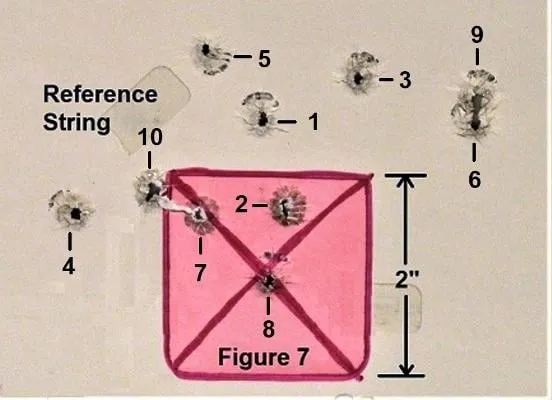
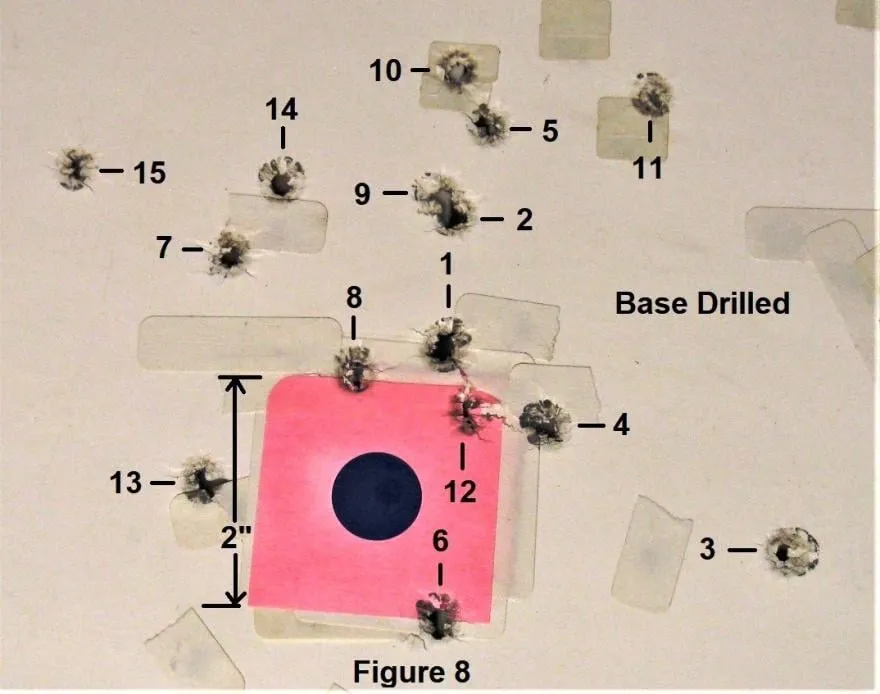
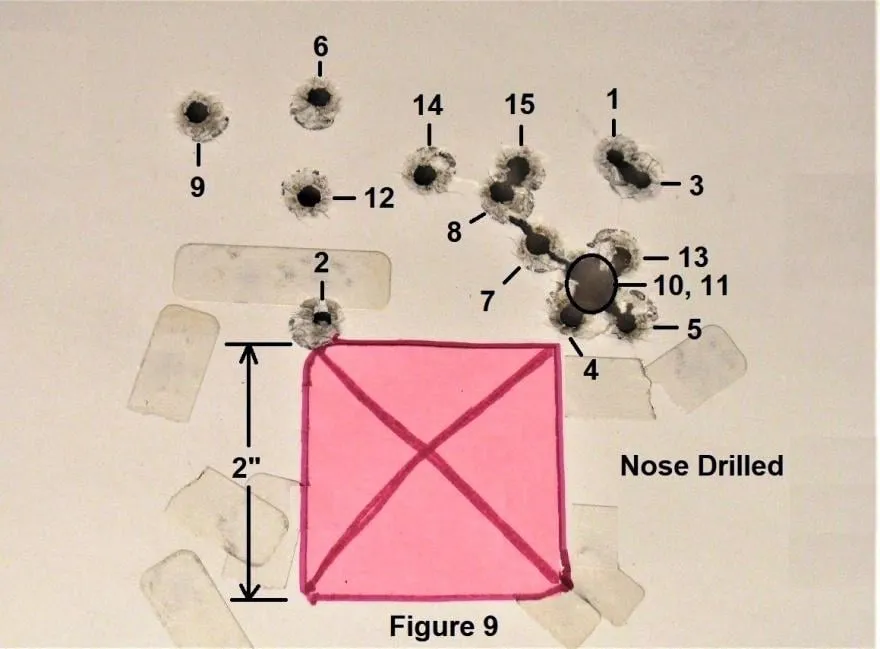
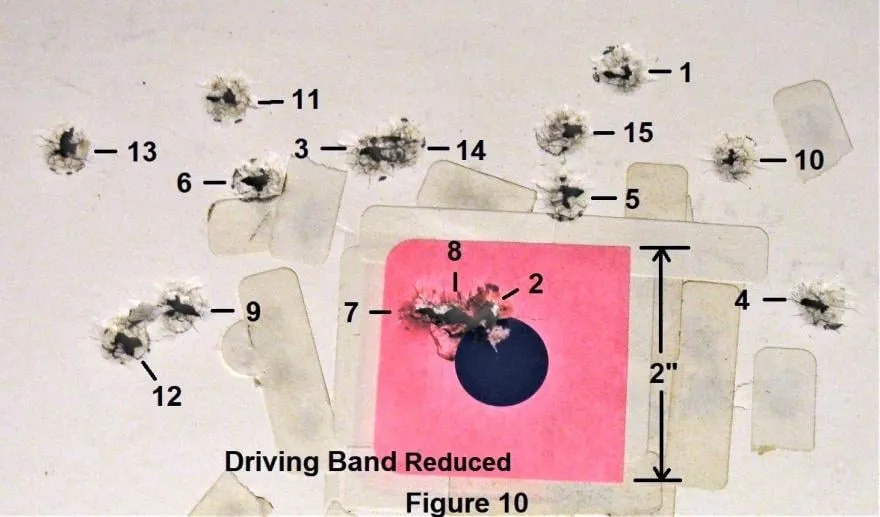
The day was warm (78°) with a variable sometime quartering cross wind from zero to 5mph. As indicated by the wider horizontal spread, the cross wind did increase some while shooting the driving-band reduced string (Figure 10). The Browning .45-70 BPCR with a 10X Fecker scope was shot off a bench using bench cross sticks with the barrel resting on the null point. The bore was wiped between shots. The shots were spaced out so that the bore stayed warm to the touch, definitely not hot. All loads were identical except for the bullet weights. The scope sight setting was not changed between strings.
Prior to each string the bore was cleaned and three fouling shots were fired, each followed by wiping. The target center square is 2” on a side subtending 1MOA at 200yds. You’ll note some light outlines of tape in the photos that was used to cover old bullet holes. The modified bullets were shot in weight order with #1 being the heaviest and #15 the lightest. Except for the reference string in which all bullet weights were identical (535.4gr), there was a 9.5gr weight spread between bullet #1 and #15 of each string. Unfortunately, due to forgetting to compensate for bullet drop, the chronograph screens were hit and damaged, effectively eliminating any possibility of documenting velocities.
Comments/Conclusion
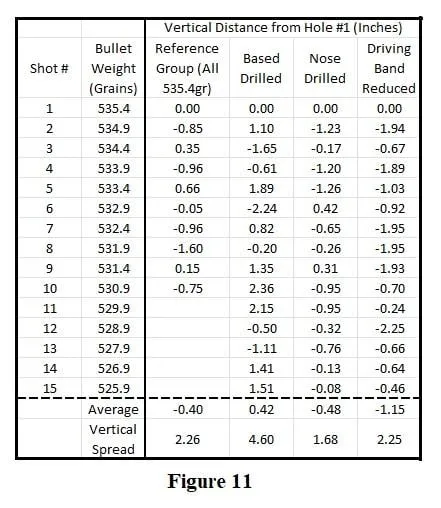
If it’s not clear in the Figure 11 spreadsheet, positive numbers (distances) are hits above hole #1 & negative numbers indicate hits below hole # 1. Based on the target hit locations & spreadsheet analysis (Figure 11) there is very little or no overall vertical correlation associate with the reduction in bullet weights. It would be logical to expect the velocity to increase with a reduction in weight, resulting in higher vertical hits. In that case the majority of hits should be above hole #1 which was made by the heaviest bullet. But based on the average vertical distance from hole #1 such was not indicated by the groups. In fact, just the opposite. Most of the hits were below hole #1 as indicated by the negative averages. What’s missing is velocity data due to the damaged chronograph noted earlier. So, I’m unable to draw concrete conclusions from the data other than it’s clear that bullet weight variations of up to 9.5grs had little or no effect on the accuracy.
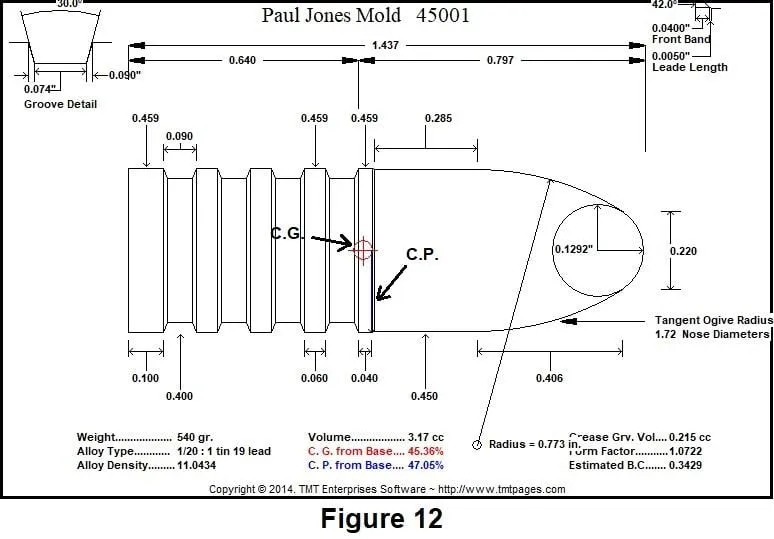
I noted earlier that external ballistics is not the subject of this article, but let’s discuss it a bit. Figure 12 is the bullet specification which includes the location of the center-of-gravity (C.G.) and the center-of-pressure (C.P.). It’s a well-known fact that the center-of-gravity lags behind the center-of-pressure in most if not all “pointed” bullet designs. Also, external ballistics suggests that stability should improve as the C.G. is moved closer to the C.P. Therefore, it was a real surprise to see the significantly larger group size due to drilling out the base since it should have moved the C.G. forward and closer to the C.P. It may be that the hole, although perfectly centered & uniform, results in turbulence which affected accuracy. For the same reason I was surprised by the reduced spread of the nose drilled bullets. Since I’m no expert on external ballistics my understanding may be incorrect.
Also, due to the fact that C.G. lags behind C.P., a perfectly stabilized bullet should hit the paper in a nose up configuration resulting in the imprint of the rim of the bullet base slightly offset below the hole cut by the nose, which wasn’t the case for many of the bullet holes. To use laymen terms, some of the holes suggest the bullets were either tipping (yawing) or wobbling (experiencing precession) in flight, but based on the reference group size it was not a significant issue at 200yds. And I’ve shot the same bullet and identical load in a recent silhouette match out to 500 meters with good success. I’m only guessing but suspect precession was the cause of the bullet-hole irregularities and is generally known to diminish over longer distances. Those of you with a better “handle” on external ballistics and analyzing bullet holes can debate the results if you’re so inclined.
So, getting back to the subject of this article, what can be concluded from the results? As noted earlier, I rarely exceed a weight spread of +/- 1gr when casting. Therefore, except for peace-of-mind, the results suggest there’s no justification to continue weighing and sorting bullets other than occasionally weighing a sample size to confirm my casting technique has not degraded. The results should also be comforting to those that experience larger weight spreads when casting.
Finally, some readers will likely suggest that running the experiment at 500 meters would be a better test and may uncover a clear weight related correlation. I certainly would not disagree but a shooting range longer than 200yds is a two hour drive from my home. And if a difference of 9.5grs does not significantly affect the group size at 200yds, I’m certainly not going to be concerned about the effects of a variance of +/- 1gr or a bit more on group size at 500 meters or longer. By the way, although I have no intentions to redo the experiment, if I did the reference group would be expanded to 15 shots, I’d use a 25X scope and all shots would definitely be over a chronograph.
Wishing you great shooting,
Wayne