.40 Caliber BPCR Accuracy - Twist Rate vs. Bullet Length vs. Velocity
First, some background information. To date I’ve put over 7,000 rounds through my Browning .40-65 Win. BPCR. The bore twist rate is 16:1 (16-twist bore), i.e. for those of you not familiar with twist rate, the lands and grooves in the bore forces the bullet to make one full turn for each 16” of length it travels down the bore. Having started out with GOEX powder I eventually switched to Swiss 1.5Fg in various loads too numerous to mention. Swiss 1.5Fg powder loads have ranged from 55 to 72grs, powder compression from 0.010” to 0.330” and velocities from 1100 to 1345fps. I started out blow tubing and eventually switched to wiping between shots. I also finger seat bullets with no crimping.
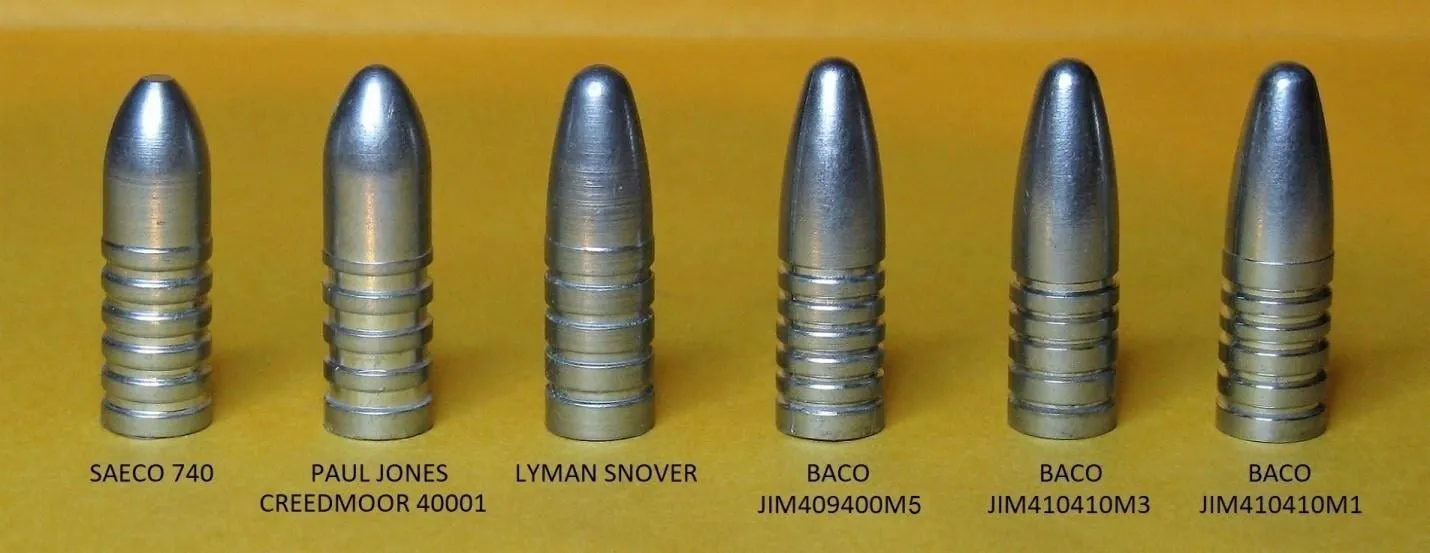
The photo displays the bullets I’ve experimented with in the Browning. The Buffalo Arms’ (BACO) JIM410410M3 and JIM410410M1 moulds/bullets are my designs and were discussed in detail in the article titled Money Bullets” for the Browning .40-65 BPCR. All the bullets in the photo feature “nose-riding” designs meaning the nose slides into (rides in the bore) and is aligned with the bore assuming the nose diameter is slightly smaller but very close to the bore diameter. Approximately 0.001” smaller is about right and allows some room for fouling.
Note – Since Paul Jones has retired his moulds are no longer available, but other suppliers offer Creedmoor moulds including several weight versions from BACO.
Getting back to the subject of this article, I’ve determined that many loads start to become unstable at 450 to 500 meters with relatively slow muzzle velocities in .40 caliber 16-twist bores due to the bullet length and nose profile. Trade-offs are necessary for weight, nose profile and bullet length among other features when designing bullets for a specific application and twist rate. Some .38 caliber BPCR shooters may disagree but I firmly believe that at least 400grs is generally required to reliably knock over those heavy ram silhouettes at 500 meters. But even good hits with 400gr or heavier bullets will not guarantee 100% success.
So far with thousands of rounds of 410gr bullets down range I’ve “rung” three rams, two with center hits and one with a high hit. By rung I mean the 500-meter ram silhouette did not fall over although the noise (ringing) from the hit can be heard and the impact spot easily seen through the spotting scope. A .40 caliber 400gr to 410gr bullet with a high ballistic coefficient (BC) nose design to minimize velocity loses such as a “money bullet” or elliptical profile will be around 1.4” long. Regardless of what the Greenhill Formula and modifications thereof suggest, I’ve come to the conclusion that a 16-twist bore is too slow of a twist rate for a 1.4” or longer bullet at distances approaching 500 meters when the muzzle velocities are less than 1250fps.
To stabilize a cylindrical object in flight generally requires spinning it around its longitude axis. As the length is increased a faster spin rate (rotations/time) is required. Bullets are no exception and various mathematical formulas such as the Greenhill Formula have been developed to determine the necessary spin rate. A bullets spin rate is determined by the speed it travels through the bore and the twist rate of the bore. Therefore, increasing the velocity or using a “faster” twist-rate bore will increase the spin rate.
Since most of us do not have the luxury of switching out barrels with faster twist rates to handle longer bullets, one possible solution is to increase the velocities assuming the case has sufficient capacity to handle the necessary powder charge. In my earlier article on “money bullet” designs, 59grs of Swiss 1.5Fg was listed as an accurate load, resulting in a muzzle velocity of approximately 1240fps. Since then, after evaluating hits on paper, I’ve experienced some stability problems with the load and have determined accuracy starts to degrade at around 450 to 500 meters when muzzle velocities drop below 1250fps, which requires at least 60grs of Swiss 1.5Fg with a 410gr 1.4” long “money bullet” in my rifle.
As commented earlier, to stabilize longer bullets generally requires faster twist rates; therefore, you may be thinking, why not just use shorter bullets which would seem to be a logical solution. The SAECO 470, Paul Jones Creedmoor or Lyman Snover moulds are shorter than 1.4” and all three meet or exceed my 400gr minimum requirement. The SAECO is 1.320” long. The PJ Creedmoor and Lyman Snover have identical lengths of 1.378”. The problem with the SAECO and Creedmoor bullet is due to their less streamline lower BC nose profile, which rapidly sheds velocity resulting in similar stability issues at around 500 meters. The Lyman Snover would therefore seem to be a good compromise at 1.378” long with a higher BC nose.
Others have reported excellent accuracy results with the Lyman Snover in 16-twist bores. Some time ago I ran extensive tests with it using a range of 55grs to 61grs of Swiss 1.5Fg with up to 0.170” of powder compression to a velocity of 1257fps with unacceptable 500-meter accuracy in the 16-twist Browning bore. The limited lube capacity of the bullet may have been part of the problem since I was using a blow tube at the time. I plan to wipe between shots and/or push the bullet faster to see if accuracy improves but due to case capacity limitation my self-imposed limit of 0.1” of powder compression with Swiss 1.5Fg will have to be exceeded or use a finer grain faster burning powder.
“Speaking” of self-imposed limit, I’ve found accuracy generally improves when:
- Nose-riding bullets as described earlier are used for bore alignment.
- The bullet diameter (driving bands) is slightly larger than the groove diameter.
- The bullet is in firm contact with the leade when fully chambered.
- Case overall lengths are no more than 0.010” shorter than the chamber length.
- The case mouth lip is flared as much as possible to help align the rear of the bullet in the chamber.
- Swiss powder compression is 0.1” or less.
My current Browning load utilizes the BACO JIM410410M1 410gr bullet cast with 16:1 alloy. With 61grs of Swiss 1.5Fg, 0.060” fiber wad and 0.067” of compression the muzzle velocity averages 1281fps. Since the Browning has a relatively long freebore the bullet is seated out to firmly contact the leade with a cartridge overall length (COAL) of 3.060”. By the way, my fire-formed cases (reformed from Remington .45-70) are trimmed to 2.120” (0.005” less than the chamber length). I’ve made casts of many Browning .40-65 chambers. The chamber lengths average 2.125” as it does in my rifle.
Adding to my earlier comment about needing at least a velocity of 1250fps for 500-meter accuracy, no doubt some shooters will disagree, but in my opinion a .40-65 Win. chambered rifle with a 16-twist bore will be hard pressed to attain acceptable accuracy past 600 meters with a 400gr or heavier bullet unless it’s pushed quite hard with a heavy load utilizing a lot of powder compression or a finer grain powder such as Swiss 2Fg, or 3Fg which may be a better solution. Therefore, I recommend the longer Ron Long .40-65, .40-72 or .40-82 Win. chamberings for added velocity or better yet specify a 14 to 14.5-twist bore.
Several years ago, a very well-known BPCR shooter and experimenter Dan Theodore ran extensive tests and bullet stability measurements on .38, .40 and .45 caliber bullets. Besides being a very experienced BPCR shooter, he also had an engineering and analytical background and figured out the ideal .40 caliber bore twist rate should be 14.3:1 for 1.4” to 1.45” long bullets. I had several conversations with him on the subject prior to his tragic death in 2015. BTW, many of the moulds offered by BACO were designed by Dan.
Since I prefer the reduced recoil of the .40-65 Win. over longer or larger caliber cartridges, I ordered and received a Shiloh Sharps 1874 Sporter #1 .40-65 Win. in late 2017 after winning a $2,000 certificate in the 2017 Texas State Silhouette match. Having initially asked for a 16-twist bore I quickly reconsidered and ordered a 14.5 twist bore based on the recommendation from Arnie Seitz (aka “beltfed”), a well-known experienced BPCR shooter, and after reviewing my earlier notes from discussions with Dan Theodore. Having fired a little over 600 rounds through it so far, I’m still getting used to the Sharps loading and firing characteristics. It does seem to easily handle 400gr and heavier 1.4” long bullets out to the rams without stability issues. Now I need to figure out how to shoot better with it, which is not meant to imply that I’m a better shooter with the Browning. BTW, since I’m generally known as the “Browning Guy”, please keep the Sharps comments to yourself.
Wishing you great shooting,
Wayne